
Constitutional Court Reviews Challenge to Presidential Education Requirements in Election Law
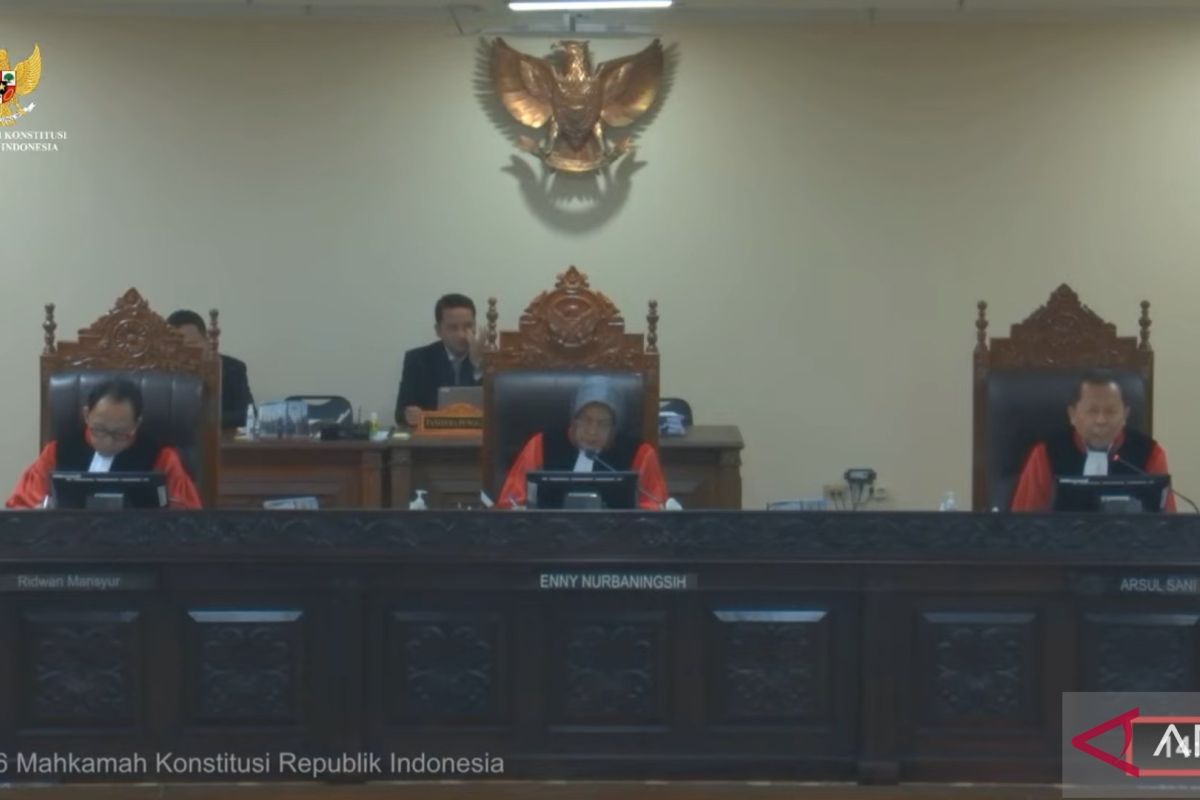
Jakarta (ANTARA) – The Constitutional Court (MK) held a preliminary hearing on a judicial review of Law No. 7 of 2017 on General Elections, which challenges the education requirements for presidential and vice-presidential candidates.
Case No. 370/PUU-XXIV/2026 was heard by a panel of judges led by Constitutional Court Justice Enny Nurbaningsih, with Ridwan Mansyur and Asrul Sani as members, at the Court’s Building I in Jakarta on Thursday.
The petition was filed by five applicants: Alfian Maulani, Syamsul Jahidin, Ria Merryanti, Dimas Yoga Pratama and Kharisma Jomenta Surbakti. They are challenging Article 169(r) of the Election Law and its explanatory note.
“The applicants’ petition currently challenges the principal provision, specifically the phrase ‘or another equivalent school’ in Article 169(r),” Syamsul Jahidin said.
The applicants are also challenging the explanatory note to Article 169(r), which states that “equivalence of education to senior secondary school is determined by the central government and/or regional governments in accordance with statutory provisions”.
In outlining their petition, the applicants said one of them had suffered concrete, specific and actual constitutional harm as a direct result of the provision containing the phrase “or another equivalent school”.
“Applicant I is an ordinary citizen who must have at least a bachelor’s degree to be able to work, in stark contrast to Vice-President Gibran Rakabuming Raka, whose educational background is still being debated publicly,” he said.
The applicants argue that Article 169(r) has caused legal confusion and public controversy. They say the phrase “or another equivalent school” gives presidential and vice-presidential candidates special treatment by allowing them to register with only a certificate of equivalency, thereby infringing the applicants’ constitutional rights.
“Article 169(r) of the Election Law has caused legal confusion and public controversy,” Syamsul said.
On the basis of their arguments, the applicants asked the Court to accept and grant their petition and to provide a constitutional interpretation of the provision stating that equivalence to senior secondary education must be determined by the central government and/or regional governments.
“[We ask the Court to] declare that the wording on education equivalence to senior secondary school being determined by the central government and/or regional governments under statutory provisions in Article 169(r) of the Election Law contravenes the 1945 Constitution and is conditionally unconstitutional, and has no binding legal force unless the explanatory note to the article is interpreted accordingly,” said Dimas Yoga Pratama, the fifth applicant, reading out the petition’s requests.
Constitutional Court Justice Asrul Sani advised the applicants to show how the provision had caused them constitutional harm.
“You all have senior secondary school diplomas. You need to consider where your constitutional interest lies in relation to that provision,” Asrul said.
“Is what you call commotion and difficulty explaining things because of your work as lecturers a constitutional harm? Or are you prevented from standing as a presidential candidate? Think it through first,” he added.
Asrul said constitutional harm, although not every aspect of it can be made concrete, must be logically established.
“If someone is disturbed by, for example, commotion on social media, is that constitutional harm? If that is considered harm, it is obvious: just stay off social media. Then you would not know whether there is commotion or not,” he said.
He stressed that the applicants needed to formulate their alleged constitutional harm logically.
Justice Enny Nurbaningsih likewise asked the applicants to explain the constitutional harm they had suffered. Justice Ridwan Mansyur, meanwhile, asked them to clarify their legal standing.
Source: jawawa.id (https://jawawa.id/newsitem/constitutional-court-reviews-challenge-to-presidential-education-requirements-in-election-law-1791478392)
Originally published by Antara (Indonesian) (https://www.antaranews.com/berita/5777806/mk-uji-materiil-uu-pemilu-menyoal-syarat-pendidikan-capres-cawapres), translated from Indonesian