
Constitutional Court Reveals Reasons for Not Removing Free Nutritious Meals from 2026 State Budget Education Funds
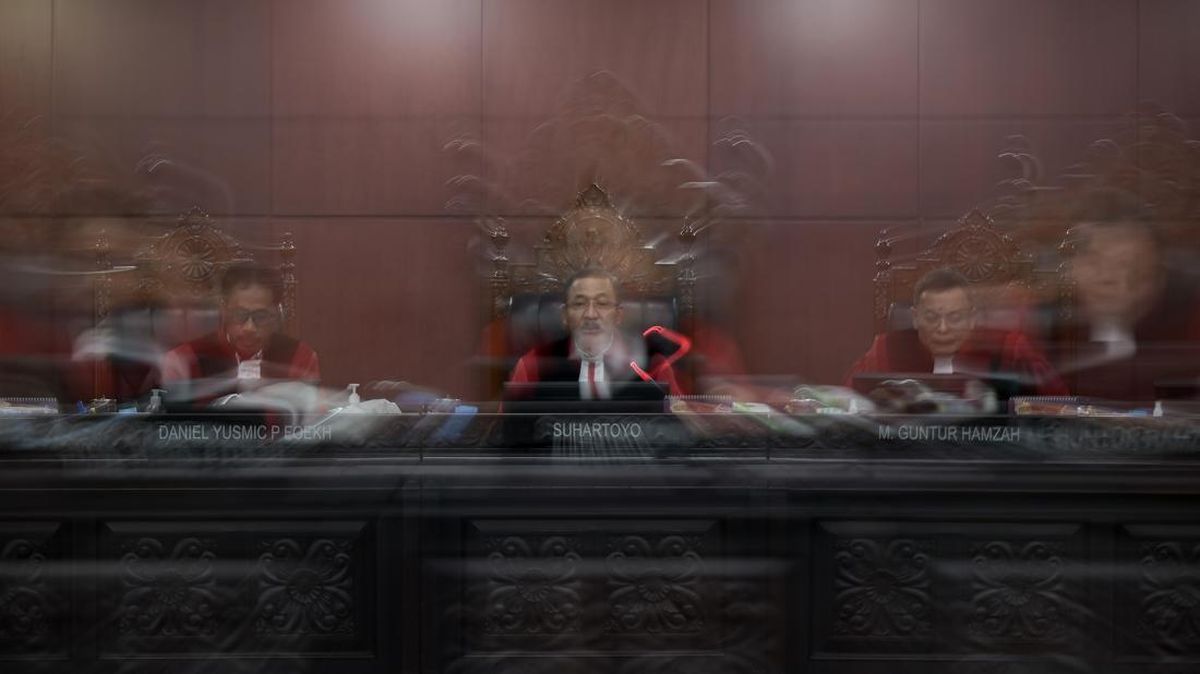
The Constitutional Court has revealed the reason the Free Nutritious Meals (MBG) programme was not immediately separated from the education budget in the 2026 state budget (APBN).
Constitutional Justice Enny Nurbaningsih said removing the MBG budget from the education allocation in the current fiscal year could actually render the 2026 APBN unconstitutional, even though funding the programme through the education budget is acknowledged to conflict with the spirit of the constitution.
Enny said that, substantively, MBG is a constitutional programme because it is one of the government’s priority programmes resulting from the 2024 general election.
However, the Court stressed that the programme’s budget must henceforth be drawn up as a separate budget line, detached from the education budget.
“The Court affirms that the nutritious meal distribution programme in the form of the MBG programme is, in substance, constitutional as a manifestation of the government’s priority programme resulting from the 2024 General Election,” she said while reading out the Court’s ruling on Thursday (30 July).
Enny explained that the Court considered the impact if the MBG budget were immediately removed from the education budget already set in the 2026 APBN.
According to her, such a move would cause the education budget allocation to fall short of the minimum 20 per cent of the APBN required by Article 31 paragraph 4 of the 1945 Constitution.
“The implication is that the education budget threshold of at least 20 per cent of the 2026 APBN would not be met. This would in fact cause the 2026 APBN to contravene Article 31 paragraph 4 of the 1945 Constitution of the Republic of Indonesia,” she explained.
On the other hand, Enny said that if the MBG budget were separated from the education budget in the current fiscal year, the government would also have to make major adjustments to the structure of the APBN.
The government would not only be obliged to replenish the education budget to meet the 20 per cent mandatory spending requirement of the APBN, but would also have to find new funding sources outside the education budget to finance MBG operations.
Therefore, the Court considered that the interests of the state and legal certainty must be maintained. The 2026 APBN remains constitutional, even though the explanation of Article 22 paragraph (3) of the 2026 APBN Law was declared conditionally unconstitutional, provided it is no longer used for subsequent years’ budgets.
Despite granting an exception for the 2026 APBN, the Court stressed that the MBG programme must not continue to be included as part of education operational activities.
Enny said the Court declared that the minimum 20 per cent education budget of the APBN and regional budgets (APBD) should be prioritised for financing the core components of education.
These components include students, teachers and education personnel, facilities and infrastructure, curricula, and educational evaluation and development. Meanwhile, MBG programme financing is not included among the core components of education.
“The MBG programme, or other namings of the nutritious food distribution programme within the education budget, must be removed or separated from the definition of education operational activities so that it no longer draws on the education budget allocation in the APBN,” said Enny.
According to the Court, separating the budget would also provide a stronger legal foundation while guaranteeing legal certainty for the implementation of MBG as a government priority programme.
Government response
In response to the Court’s ruling, the government stated it would abide by the decision that was read out.
“The government will certainly comply with the Constitutional Court’s ruling concerning the MBG budget, which must be separated from the 20 per cent education budget as stipulated in Article 31 of the 1945 Constitution,” said Coordinating Minister for Legal Affairs, Human Rights, Immigration and Corrections, Yusril Ihza Mahendra, to reporters on Thursday (30 July).
Yusril said the implementation of the Court’s ruling would take effect in 2028, because deliberations on the 2027 APBN are already under way.
“In accordance with the dictum of the Constitutional Court’s ruling, its enforcement will be carried out in 2028, given that deliberations on the 2027 APBN have been under way since early 2026,” said Yusril.
Source: jawawa.id (https://jawawa.id/newsitem/constitutional-court-reveals-reasons-for-not-removing-free-nutritious-meals-from-2026-state-budget-education-1785416060)
Originally published by CNN Indonesia (https://www.cnnindonesia.com/nasional/20260730182346-12-1386777/mk-beber-pertimbangan-mbg-tak-dicabut-dari-dana-pendidikan-apbn-2026), translated from Indonesian