
Constitutional Court Rejects Student Challenge to Election Law
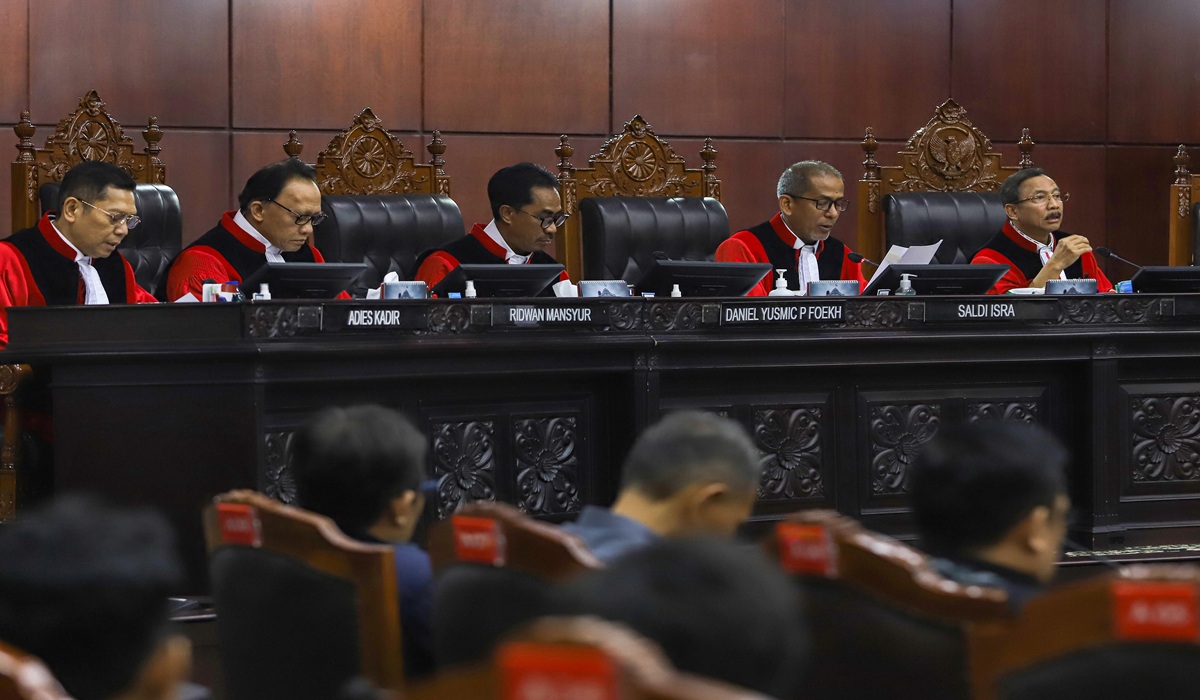
The Constitutional Court (MK) has rejected a petition for judicial review of Article 475 paragraph (2) of Law Number 7 of 2017 on General Elections, ruling that the petitioner lacks legal standing. The petitioner was Muhammad Reihan Alfariziq, a student of the Faculty of Law at the University of Muhammadiyah Yogyakarta.
“The petitioner in Case Number 219/PUU-XXIV/2026 does not have the legal standing to file the petition,” said Deputy Chief Justice Saldi Isra when reading out the legal considerations of the ruling at the Constitutional Court building in Jakarta on Thursday (23/7).
In its considerations, Saldi explained that the constitutional harm alleged by the petitioner did not meet the requirements. According to the Court, the petitioner could not demonstrate any constitutional harm that was specific, actual, or at the very least potential, arising from the enforcement of the article concerning vote count results.
“The petitioner’s perceived loss of constitutional rights as a student and voter has no causal relationship with the enforcement of the statutory norm being challenged,” said Saldi Isra.
The Court also affirmed that, in disputes over election results, it examines not only the final vote count but also problems at the stages of election administration relating to the constitutionality of processes that could affect the outcome of the election.
In the petition, the petitioner challenged the phrase “only on the results of vote counting” in Article 475 paragraph (2) of the Election Law. They argued that the phrase creates legal uncertainty because, textually, it limits the Court’s authority to disputes over vote count results, whereas in practice the Court also examines procedural violations that affect election outcomes.
The petitioner asked the Court to declare the phrase contrary to the 1945 Constitution and to interpret it as covering both the results of vote counting and the conduct of the electoral process that influences the determination of elected or re-elected candidate pairs in the Presidential and Vice-Presidential Election. However, as the petitioner was found to lack legal standing, the Court did not proceed to examine the merits of the petition.