
Constitutional Court Rejects PBB Muktamar VI Lawsuit on Party Leadership
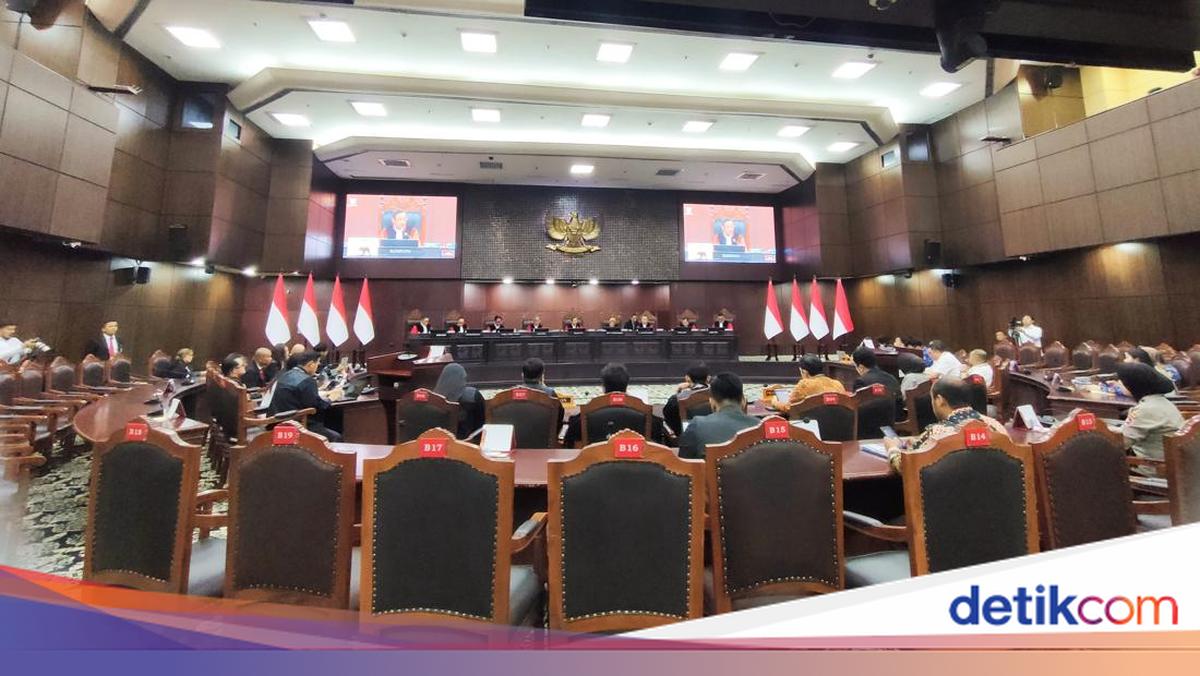
The Constitutional Court (MK) has refused to accept a petition from the Central Board of the Crescent Star Party (PBB) concerning the results of its sixth Muktamar in Bali. The court stated that the government cannot determine a party’s leadership if certain conditions have not been fulfilled.
“Adjudicating: declares the petition for review of the phrase ‘registered with the department’ in the norm of Article 23 paragraph 2 of Law Number 2 of 2008 on Political Parties (State Gazette of the Republic of Indonesia of 2008 Number 2, Supplement to the State Gazette of the Republic of Indonesia Number 4801) cannot be accepted. Rejects the petitioners’ application for the rest and the remainder,” said Chief Justice Suhartoyo during a hearing in Central Jakarta on Wednesday (17/6/2026).
The petition was filed by Gugum Ridho Putra and Dega Kautsar Pradana under case registration number 146/PUU-XXIV/2026. Gugum is the Chairman of PBB elected at the Muktamar VI in Bali.
The text of Article 23 paragraph 2 of Law 2/2008, as challenged by the PBB Central Board, reads: “The composition of the leadership resulting from a change in the central-level leadership of a Political Party shall be registered with the Department no later than 30 days from the occurrence of the leadership change.”
The court stated that Article 23 of the Political Party Law guarantees parties the freedom to organise and replace their leadership in accordance with their constitution and bylaws (AD/ART). This provision simultaneously limits the scope for government intervention, as the determination of leadership can only occur after the party’s internal mechanisms have been followed and the requirements stipulated by law have been met.
“Therefore, the government cannot determine the leadership if the requirements have not been fulfilled or if there is still an unresolved dispute. Conversely, if these conditions have been met, the government is obliged to grant ratification as a form of administrative legal recognition,” said Constitutional Justice Arsul Sani.
The court stated that the determination of a political party’s leadership by the Minister of Law, based on the fulfilment of the requirements of Article 23 and the absence of a dispute as referred to in Article 24 of the Political Party Law, provides legal certainty. According to the court, if ratification is merely understood as registration while an internal dispute is still ongoing, this could potentially create legal uncertainty for the political party itself.
“Thus, ratification by the Minister of Law through the issuance of a Ministerial Decree is a form of administrative recognition granted when the legal requirements have been met and there is no internal dispute, thereby ensuring legal certainty while limiting government intervention. Because if only registration is carried out without ratification, it could actually cause uncertainty regarding the legitimate leadership,” the justice stated.
The court assessed that the Political Party Law, in principle, positions the Party Tribunal or equivalent body as the primary mechanism for resolving leadership disputes. This is intended so that the state does not wish internal party political disputes to be brought directly to the general courts, as parties have organisational autonomy and the right to manage their own internal affairs.
“The petitioners’ concerns regarding the ineffective resolution of leadership dualism because the Party Tribunal is formed from within the party itself, therefore to understand the phrase ‘political party dispute’ in the norm of Article 32 paragraph 1 of Law 2/2011, it must be linked to the norm of Article 33 of the Political Party Law as a path for resolving internal disputes when resolution through the Party Tribunal or equivalent body has not been achieved,” the justice said.
The court emphasised that the Constitutional Court’s authority has been limitatively determined in Article 24C paragraphs 1 and 2 of the 1945 Constitution of the Republic of Indonesia. The court stated that disputes over political party leadership do not fall within the Constitutional Court’s jurisdiction.
“Therefore, it is inappropriate to petition the Court to add, expand, or create new authority for the Constitutional Court beyond what has been determined in the 1945 Constitution by adding the authority to resolve political party leadership disputes. Moreover, the Political Party Law has already regulated the court authorised to handle such matters,” the justice concluded.