
Constitutional Court Rejects Judicial Review on Expired Internet Data Quota
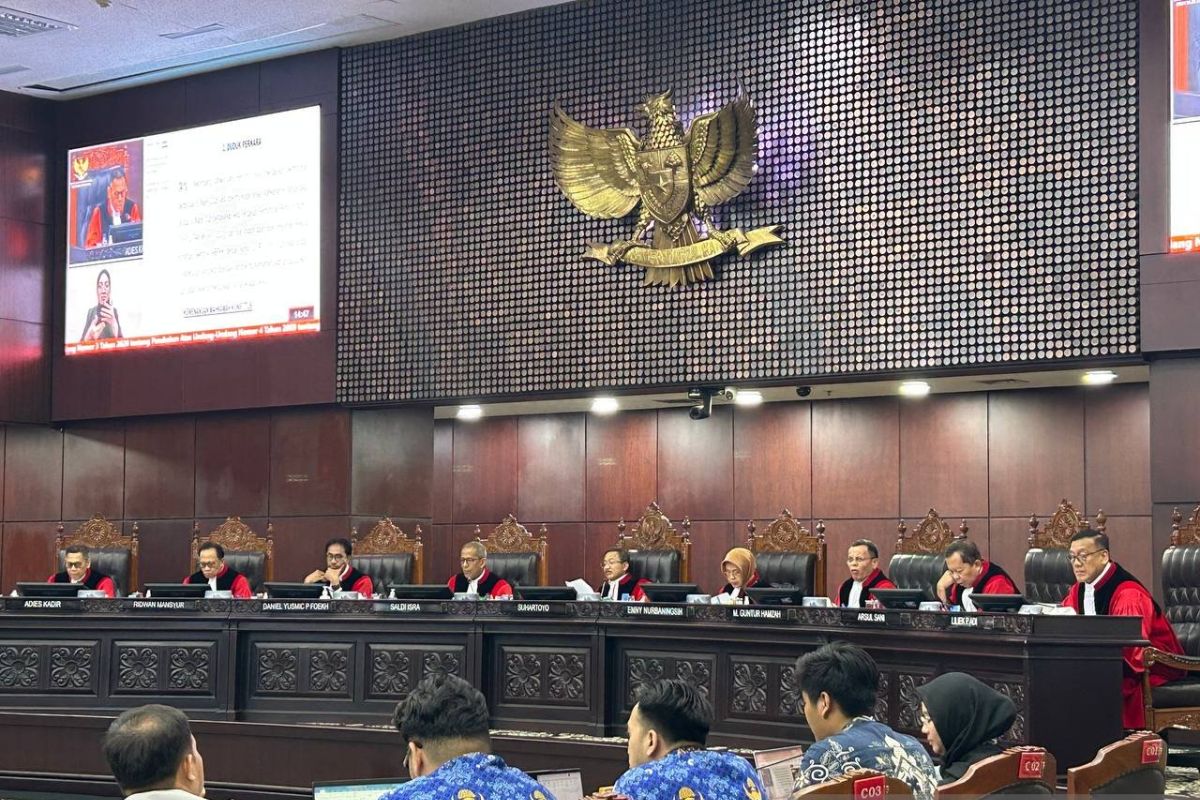
Jakarta (ANTARA) - The Constitutional Court (MK) has declared that the judicial review petition concerning the Job Creation Law (Law Number 6 of 2023) in conjunction with the Telecommunications Law (Law Number 36 of 1999), which questioned the expiration of internet data quotas, is inadmissible.
“In adjudicating, we declare petition number 165/PUU-XXIV/2026 inadmissible,” stated the Chief Justice of the Constitutional Court, Suhartoyo, during a hearing at the MK RI Building in Jakarta on Wednesday.
Petition number 165/PUU-XXIV/2026 was filed by an Indonesian citizen named Gita Putri Akhyun. The object of this petition was the content of Article 71, number 2 of the Job Creation Law in conjunction with Article 28 of the Telecommunications Law.
The petitioner argued that the provisions in Article 71, number 2 of the Job Creation Law and Article 28 of the Telecommunications Law were constitutionally in conflict with Article 28D, paragraph (1) of the 1945 Constitution, which states, “Every person shall have the right to recognition, guarantees, protection, and fair legal certainty and equal treatment before the law.”
In the petition, the applicant outlined normative and constitutional facts as the basis for the review, asserting that the current regulations focus solely on telecommunications service tariffs without providing adequate protection for consumer rights regarding remaining internet quotas that have been purchased.
The petitioner requested the constitutional judges to declare that the formation of the Job Creation Law, specifically regarding changes to the Telecommunications Law, did not meet the legislative formation requirements as mandated by the 1945 Constitution of the Republic of Indonesia.
“Because it was carried out without guaranteeing meaningful public participation, particularly for telecommunications service consumers who are directly impacted by regulations regarding the use and management of internet quotas,” stated Novarinda Benti Dahu, one of the fifth petitioners, during the preliminary hearing held on Wednesday.
Meanwhile, in the Constitutional Court’s considerations read by Vice Chief Justice Saldi Isra, it was noted that the petitioners failed to provide evidence during both the initial filing and the amendment phase. Furthermore, the submission of amendments exceeded the time limit set by the court, leading the court to examine the merits based on the initial petition.
However, the initial petition lacked the petitioner’s signature entirely.
“Considering that although the court has the authority to adjudicate the petitions in question, because the petitions do not meet the formal requirements for submission, the court will not consider the petitioners’ claims further,” said Saldi.
A similar petition was previously decided by the Constitutional Court on 12 May 2026 for case number 87/PUU-XXIV/2026, filed by Rachmad Rofik. According to the Court, that petition was also deemed unclear or vague (obscuur).