
Constitutional Court Partially Grants Petition Against Expiring Internet Quota
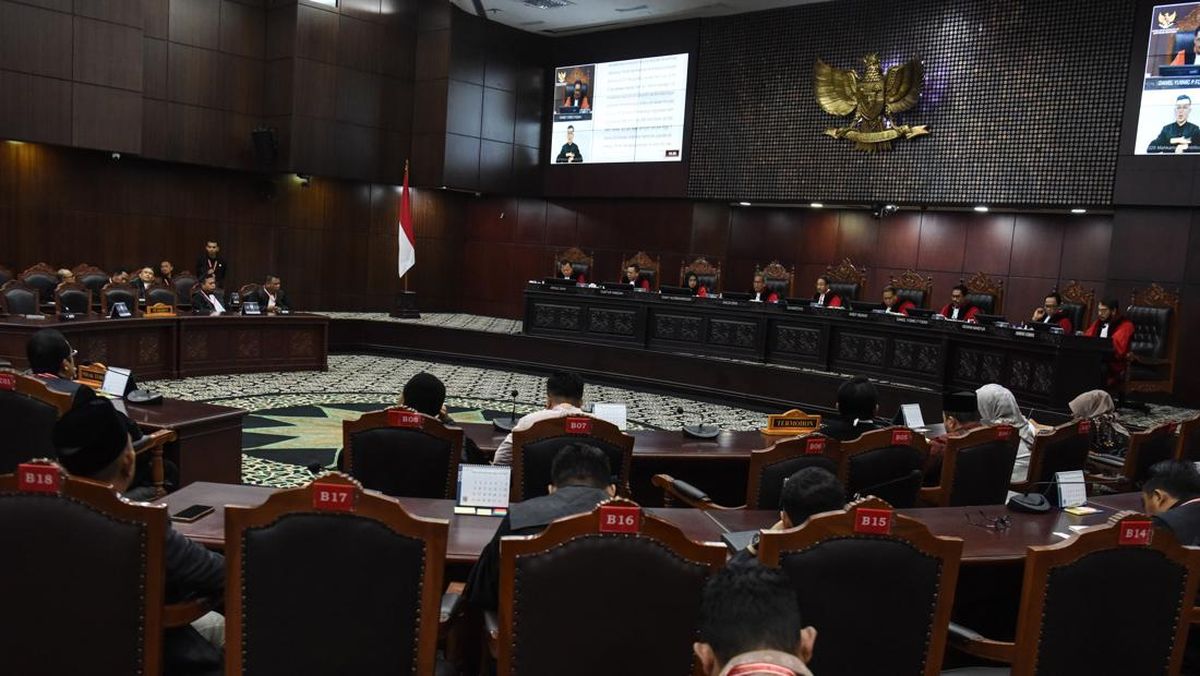
The Constitutional Court (MK) has partially granted a petition filed by online motorcycle taxi driver Didi Supandi, culinary lecturer Wahyu Triana Sari, and lecturer Rega Felix regarding the policy of internet quotas expiring even when not fully used.
“The verdict. Adjudicating: one, grant the Petitioners’ petition in part,” said Chief Justice Suhartoyo while reading the verdict at the MK building, Jakarta, Thursday (23/7).
The MK ordered that the interpretation of Article 71 point 2 of Law 6/2023 on Job Creation (UU Ciptaker) must include the obligation for telecommunication service providers to ensure that remaining data quotas belonging to consumers remain active and usable.
In the court’s consideration, Constitutional Justice Adies Kadir stated that the norm in Article 28 paragraph 1, within Article 71 point 2 of the Job Creation Law, had not yet regulated a guarantee for the property rights of telecommunication service users over unused internet quota benefits. On that basis, he said, the a quo norm must be declared conditionally contrary to the 1945 Constitution.
The a quo norm must also be declared conditionally lacking binding legal force as long as it is not interpreted to mean that ‘The amount of tariff for the provision of telecommunication networks and/or telecommunication services is determined by the telecommunication network and/or service provider based on a formula determined by the Central Government with the obligation to provide telecommunication service options that guarantee the remaining quota belonging to telecommunication service users remains active and can be used.’
“The Petitioners’ argument is a well-founded argument. However, because the Court’s interpretation is not as petitioned, the Petitioners’ petition is legally grounded in part,” Adies stated.
Previously, the Petitioners, represented by legal counsel Viktor Santoso Tandiasa, filed a material review of the telecommunication article in the Job Creation Law with the MK. The Petitioners felt disadvantaged by the policy of internet quotas expiring at the end of the package period even if not fully used.
The petition targeted Article 71 point 2 of the Job Creation Law, which amended the provisions of Article 28 of Law Number 36 of 1999 on Telecommunications. This article regulates the mechanism for setting telecommunication tariffs by operators.
“The norm provision of Article 71 point 2 of the Job Creation Law has given a blank cheque to operators to set the expiring quota scheme without any obligation for accumulation to consumers,” Didi said during the preliminary hearing in Jakarta, Tuesday, 13 January 2026, as quoted from Antara.
Article 71 point 2 of the Job Creation Law contains two provisions. First, the tariff amount for network and telecommunication service provision is set by the provider based on a formula determined by the central government. Second, the central government can set upper and/or lower tariff limits by considering public interest and fair business competition.
Viktor, as the petitioners’ legal counsel, stated that the article contained multi-interpretive norms and lacked clear limiting parameters. Consequently, operators were deemed to have full discretion to conflate service tariffs with quota ownership duration.
“This creates legal uncertainty for telecommunication service users as consumers because they never know for certain why a data commodity that has been fully paid for can disappear simply because of a unilaterally determined time variable,” Viktor said.
The Petitioners also assessed that the article created injustice because it allowed operators to receive advance payments, while consumer rights could be unilaterally terminated through the expiring quota policy. On that basis, the Petitioners requested the MK to declare Article 71 point 2 of the Job Creation Law conditionally contrary to the constitution and lacking binding legal force as long as it is not interpreted to mean that the determination of tariffs and telecommunication service schemes must guarantee the accumulation of remaining data quotas or data rollover that have been paid for by consumers.