
Constitutional Court partially grants application to test requirements for KPK leadership candidates
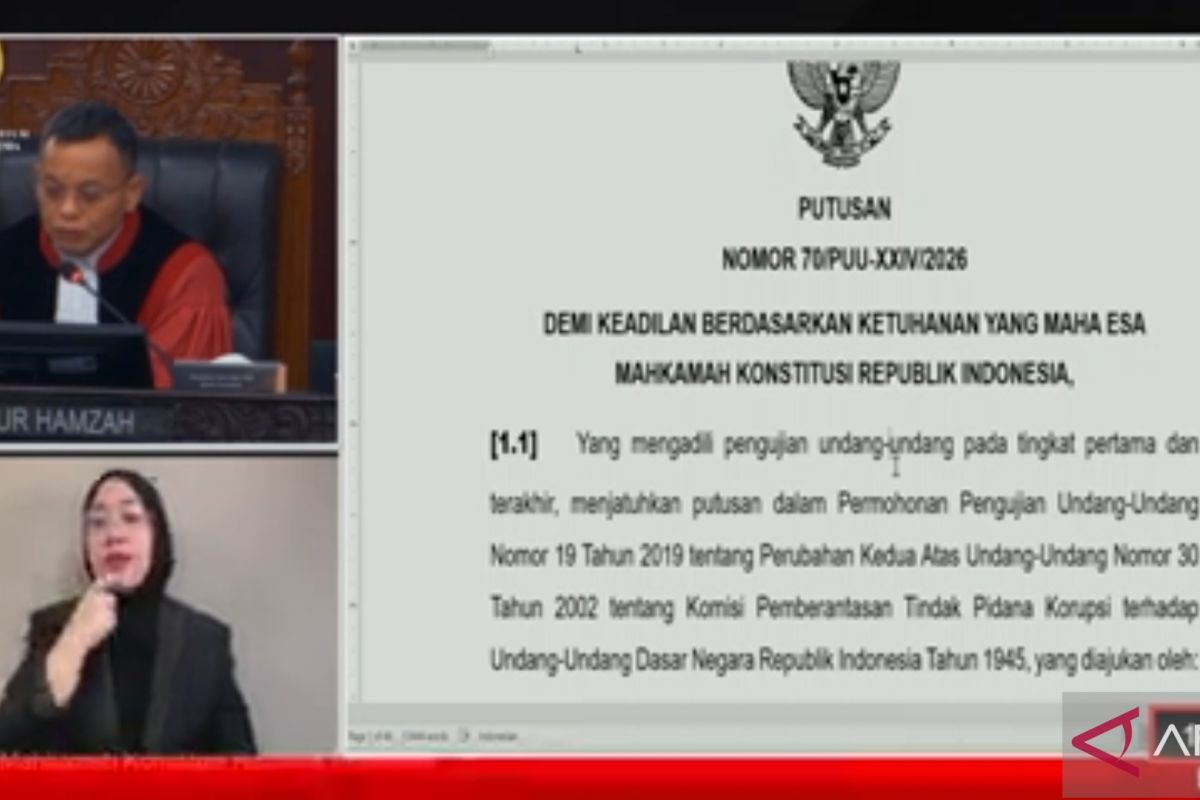
Jakarta (ANTARA) - The Constitutional Court (MK) has granted the applicants’ petition in part in the verdict pronunciation for Case Number 70/PUU-XXIV/2026 concerning the requirements for KPK leadership candidates to “relinquish” structural positions and/or other positions while in office.
In the decision read by MK Chief Justice Suhartoyo in Jakarta on Wednesday, the applicants challenged Article 29 letters i and j of Law Number 19 of 2019 on the second amendment to Law Number 30 of 2002 on the KPK, claiming they contradict constitutional rights guaranteed under Article 27 paragraph (1), Article 27 paragraph (3), and Article 28D paragraph (1) of the 1945 Constitution.
“The verdict rules one, granting the applicants’ petition in part,” said MK Chief Justice Suhartoyo.
In its operative part, the MK declared that the word “melepaskan” in Article 29 letter i of the KPK Law (State Gazette of the Republic of Indonesia Year 2019 Number 197, Supplement to the State Gazette of the Republic of Indonesia Number 6409) contradicts the 1945 Constitution and has no binding legal force conditionally insofar as it is not interpreted as “nonaktif dari”.
The MK also declared that the phrase “tidak menjalankan” in Article 29 letter j of the KPK Law contradicts the 1945 Constitution and has no binding legal force conditionally insofar as it is not interpreted as “nonaktif dari”.
In the considerations read by Constitutional Justice Guntur Hamzah, it was stated that the position of KPK leadership is obtained through a selection and appointment mechanism (selected officials), differing from the filling of public positions elected through general elections (elected officials) such as the president, regional heads, and members of the DPR/DPRD.
It was conveyed that such public positions obtain direct legitimacy from the people for a certain period, thus conceptually demanding a total severance from previous positions or professions, unless specifically regulated in the relevant law.
“In such a context, the obligation to resign permanently or retire is a reasonable and professional consequence because continuity or return to the original position after the tenure ends is not possible,” said Guntur.
In contrast, the KPK leadership position does not stem from a direct political mandate given by voters/the people, but from a selection process based on competence and professionalism.
Therefore, even though it has a certain tenure, the nature of the position is not intended to permanently sever the official’s relationship with their original position or profession.
Thus, he continued, positions like KPK leadership should not be qualified as periodic positions in the sense of requiring permanent severance from previous positions or professions, but rather more appropriately understood as temporary public assignments, which conceptually still allow the official to return to their original position or profession after the tenure as KPK leader ends.
“As long as the service in the original institution has not entered retirement age,” he said.
The Constitutional Justice also stated that while holding the KPK leadership position, effective from the inauguration or oath-taking, the official must focus on the task of eradicating corruption.
In assessing the constitutionality of the norm in Article 29 letters i and j of the KPK Law, the Court considered that the purpose of the law requiring KPK leaders to relinquish positions and not carry out their original professions is to avoid conflicts of interest and prevent the potential for dual positions.