
Constitutional Court Orders Separation of Free Nutritious Meals Budget from Education Spending by 2028
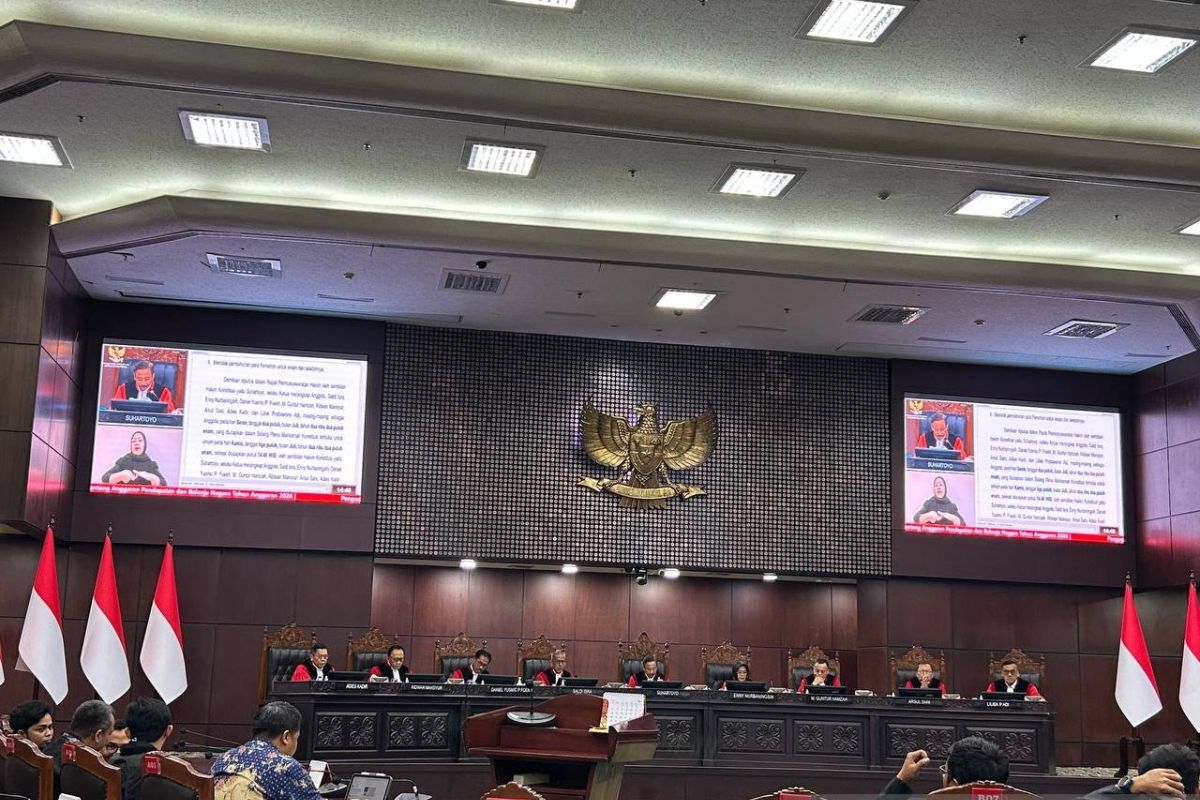
The Constitutional Court (MK) has partially granted a judicial review petition concerning the inclusion of the Free Nutritious Meals (MBG) programme budget within the education budget of the 2026 State Budget (APBN). In its ruling, the court stated that the MBG budget must be separated from the education budget in the APBN, no later than the 2028 fiscal year or within two years of the verdict being pronounced. “Adjudicating. One, grant the petitioners’ request in part,” said Chief Justice Suhartoyo while reading the ruling in the Plenary Courtroom of the MK Building in Jakarta on Thursday.
In its decision, the court declared that the elucidation of Article 22 paragraph (3) of Law Number 17 of 2025 concerning the 2026 State Budget is not contradictory to the 1945 Constitution and has conditionally binding legal force, provided it is interpreted as “only applicable to the 2026 Fiscal Year State Budget, so that for subsequent state budgets, the nutritious meal programme budget is not a main component of education and is separated or not part of the operational budget for education providers, and this separation applies no later than the 2028 Fiscal Year State Budget or at the latest two years after this decision is pronounced.”
Constitutional Justice Enny Nurbaningsih stated in the court’s considerations that the norm of Article 22 paragraph (3) of Law Number 17 of 2025 had been declared to provide a guarantee of fair legal certainty as guaranteed in Article 28D paragraph (1) of the 1945 Constitution, contrary to the petitioners’ arguments. The court found the petitioners’ argument regarding the norm of Article 22 paragraph (3) to be legally unfounded.
However, regarding the judicial review of the elucidation of Article 22 paragraph (3), the court found it did not provide a guarantee of fair legal certainty and was not in line with the government’s obligation to meet the priority allocation of education funds of at least 20 per cent of the APBN and APBD, as argued by the petitioners. “However, because the court’s decision is not as the petitioners requested, the petitioners’ argument is partially legally grounded,” Justice Enny stated.
The court declared that the elucidation of Article 22 paragraph (3) had created legal uncertainty but affirmed that the MBG programme is substantively constitutional as a priority programme of the government resulting from the 2024 General Election. Consequently, the budget for implementing the MBG programme must be structured as a separate budget allocation, distinct from the education budget in the State Budget Law.
“However, this does not necessarily imply the loss of the legal basis for the MBG programme budget allocation in the 2026 State Budget as regulated in Law Number 17 of 2025,” she said. The court understood that removing the MBG allocation from the education budget already set in the 2026 APBN would result in the non-fulfilment of the 20 per cent education budget threshold, causing the 2026 APBN to contradict Article 31 paragraph (4) of the 1945 Constitution.
Conversely, if the education budget allocated for the MBG programme is separated, the government must adjust the education budget allocation not assigned to the MBG programme to meet the mandatory education spending requirement before the 2026 fiscal year ends. “At the same time, the government must also seek other budget allocations outside the education budget to support the operational implementation of the MBG programme,” Enny added.
The court also considered various legal issues that could potentially cause legal uncertainty and constitutional violations. Therefore, the 2026 APBN must remain declared constitutional even though the elucidation of Article 22 paragraph (3) has been declared contradictory to the 1945 Constitution and has no conditionally binding legal force as long as the material is no longer used for subsequent state budgets.
Regarding these legal considerations, Enny continued, because the State Budget Law has a characteristic of being applicable once in a specific period (einmalig) and its existence will be replaced by the following year’s State Budget Law, the court determined that these legal considerations remain valid for state budgets established for subsequent years. “That is, the MBG programme or other designations in the form of a nutritious meal distribution programme within the scope of the education budget must be removed or separated from the definition of operational education providers, so that it no longer uses the education budget allocation in the APBN,” Enny concluded.
Source: jawawa.id (https://jawawa.id/newsitem/constitutional-court-orders-separation-of-free-nutritious-meals-budget-from-education-spending-by-2028-1785412498)
Originally published by Antara (Indonesian) (https://www.antaranews.com/berita/5672864/mk-kabulkan-sebagian-permohonan-gugatan-mbg-dalam-anggaran-pendidikan), translated from Indonesian