
Constitutional Court: Mining Permits Must Not Erode Universities' Oversight Function
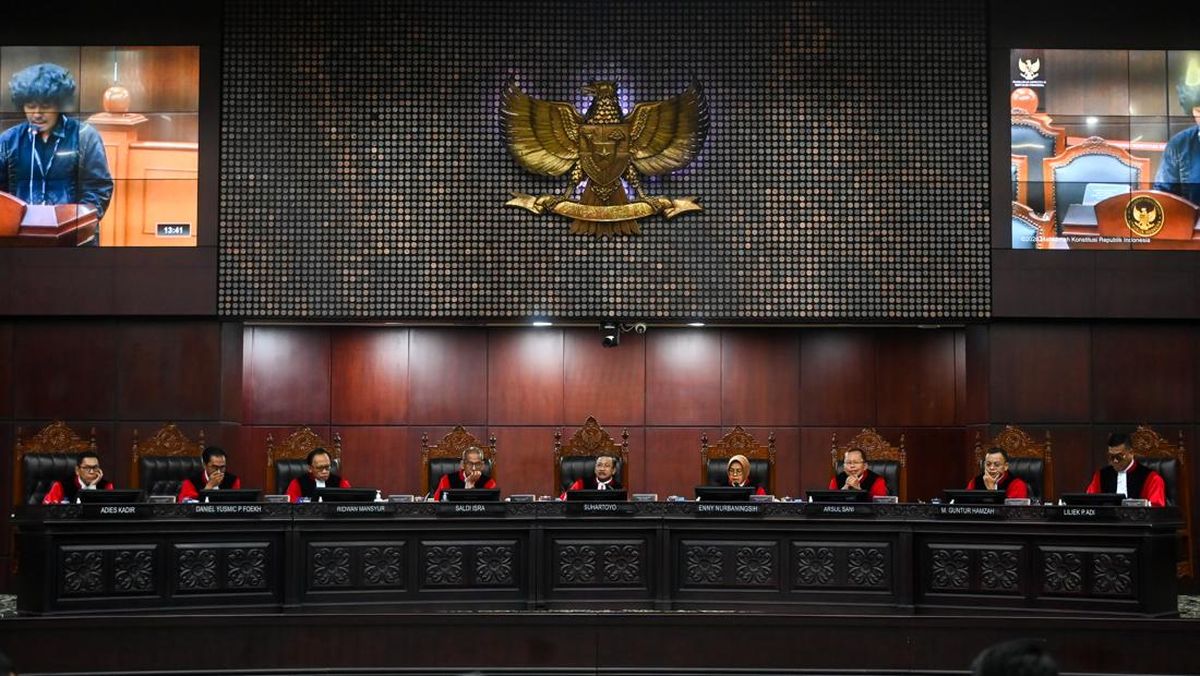
The Constitutional Court (MK) has issued a warning to campuses or universities granted priority Mining Business Permits (IUP) for minerals and coal, urging them not to lose the control function of the academic community in safeguarding environmental sustainability in Indonesia.
The warning is contained in Constitutional Court Decision Number 160/PUU-XXIII/2025, petitioned by several individuals and two students challenging Law Number 2 of 2025 on the Fourth Amendment to Law Number 4 of 2009 on Mineral and Coal Mining (the Mining Law).
The Court explained that the 1945 Constitution of the Republic of Indonesia does not prohibit universities from engaging in profit-oriented activities.
This is intended to support the costs of operations, which in practice are not fully borne by the state. Nevertheless, the Court stressed that granting such permits must not sacrifice the independence of the academic community.
“In this context, such involvement must remain within the framework of the Three Pillars of Higher Education (Tri Dharma), namely to strengthen the mission of education, research and community service, not direct involvement as managers or operators of mining businesses,” said Constitutional Justice Enny Nurbaningsih in her deliberations on Thursday (16 July).
If a campus becomes directly involved as an operator, it will lose its strategic position as one of the institutions safeguarding the nation’s morals.
The Court also affirmed that granting IUPs must not become a trap for campuses resulting in weakened control and oversight of environmental sustainability.
“Moreover, in preserving the spirit of university independence, it is important for the Court to remind that the opportunities regulated in the norms under review must not become a trap for universities resulting in the paralysis of university control as one of the front lines in safeguarding environmental sustainability,” she asserted.
The petitioners challenged the constitutionality of Articles 51, 60 and 75 concerning priority allocation and mining area auctions under the Mining Law. The Court granted the petition in part.
Several of the articles challenged contain provisions on the granting of metal mineral or coal IUP areas to private entities through auction or through priority allocation. The petitioners took issue with the phrase ‘through priority allocation’, which they considered open to misinterpretation.
Following this ruling, the wording of several articles has changed, such that the phrase ‘through priority allocation’ must be assessed through an objective, transparent and accountable mechanism. Furthermore, the phrase must also not be misconstrued as a form of direct appointment.