
Constitutional Court: Mining Permits for Universities and Mass Organisations Cannot Be Direct Appointments
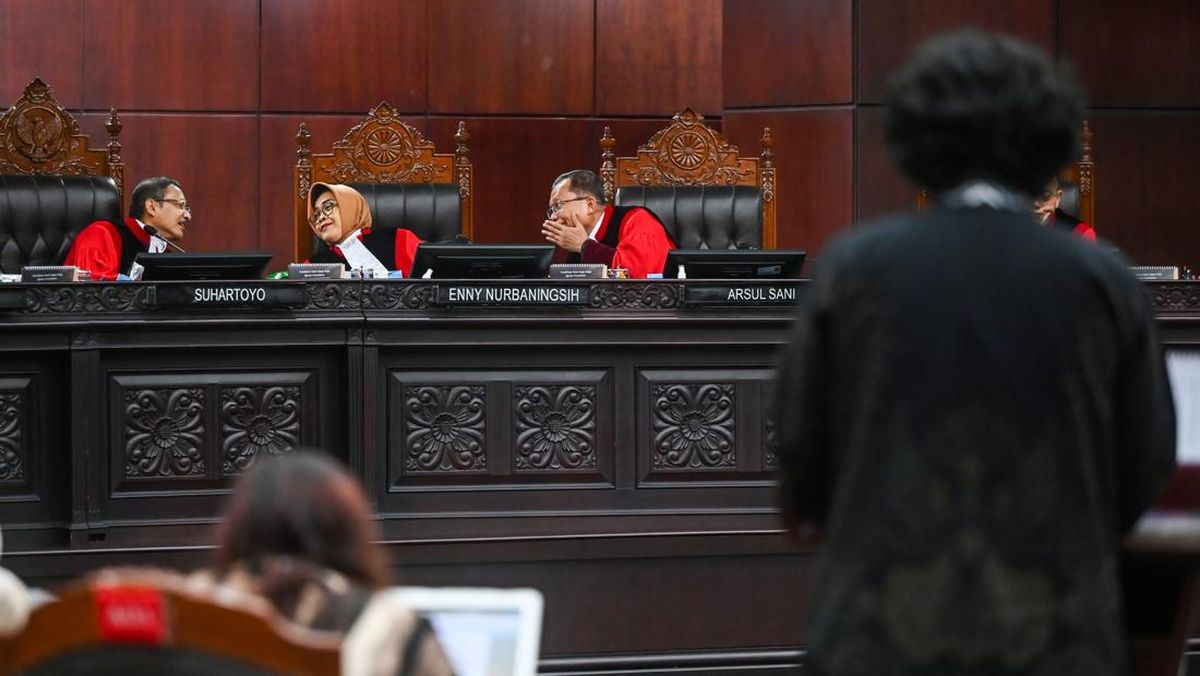
The Constitutional Court (MK) has ruled that the granting of Mining Business Permits (IUP) to universities, cooperatives and religious mass organisations must not be done through direct appointment.
The granting of IUPs must be carried out on a priority basis through an objective, transparent and accountable assessment.
This is set out in Constitutional Court Decision Number 160/PUU-XXIII/2025, petitioned by a number of individuals and two university students who challenged Law Number 2 of 2025 on the Fourth Amendment to Law Number 4 of 2009 on Mineral and Coal Mining (the Minerba Law).
The Petitioners challenged the constitutionality of Article 51, Article 60 and Article 75 relating to priority rules and mining area auctions under the Minerba Law.
“The Petitioners’ request is granted in part,” said Chief Justice Suhartoyo when reading the ruling on Thursday (16/7).
Several of the articles under review contained provisions on the granting of metal mineral or coal IUP areas to private entities through auction or through priority allocation. The Petitioners took issue with the phrase ‘through priority allocation’, which they considered open to misinterpretation.
Following this ruling, the wording of several articles has changed, such that the phrase ‘through priority allocation’ must be assessed through an objective, transparent and accountable mechanism. Furthermore, the phrase must not be misinterpreted as a form of direct appointment.
In its considerations, the Court found there was ambiguity in the clear parameters regarding which business entities receive priority for IUP areas.
The Court considered this to be at odds with the original intent of the priority policy, which aimed to strengthen the role of private entities such as cooperatives, Micro, Small and Medium Enterprises (MSMEs) and religious mass organisations.
“Within the bounds of reasonable reasoning, a certain selection process should be carried out in the WIUP priority track so that fairness and equal treatment can be realised for every party applying to obtain a WIUP, because not all WIUP applicants are at an equivalent level of capability or capacity to compete in mining ventures, and so forth is deemed stated,” said Constitutional Justice Arsul Sani.
“Based on these legal considerations, underpinned by the spirit of equitable prosperity for all the Indonesian people, the government, in carrying out this affirmative priority allocation policy, may only grant it with clear parameters through an objective, transparent and accountable assessment process, so that such priority allocation is not immediately understood as an act of direct appointment,” he continued.
Nevertheless, such priority allocation must be accompanied by a commitment to avoiding environmental damage in mineral and coal management.
Therefore, periodic evaluations are needed to determine whether the intended purpose of the priority allocation empowers communities and boosts the regional economy.
If the priority permits breach certain principles and result in environmental damage, the business permits must be reviewed or revoked so as not to harm the public.
“This is because the prosperity referred to in Article 33 of the 1945 Constitution of the Republic of Indonesia is not momentary or short-term prosperity or welfare, but sustainable welfare, both for society and for a clean and healthy living environment, for the present and the future,” said Arsul Sani.
He stated that the phrase ‘people’s prosperity’ is a constitutional concept that cannot be reduced merely to macroeconomic measures, because people’s prosperity cannot be judged solely by increases in Gross National Product and per capita Gross Domestic Product, or the rate of economic growth reflected in statistical data.
Constitutional Justice Enny Nurbaningsih added that, in the constitutional sense, people’s prosperity must be understood as a condition reflecting the substantive fulfilment of societal welfare: the equitable distribution of benefits from natural resource management, the protection of citizens’ rights, and the realisation of social justice, as enshrined in the goals of the state set out in the Preamble to the 1945 Constitution.
“In this context, the use of aggregate statistical measures has the potential to create an illusion of prosperity, because an increase in average economic growth, whilst also important to know, does not necessarily reflect the welfare of all the people,” said Enny.