
Constitutional Court: Military Courts Law Conditionally Unconstitutional
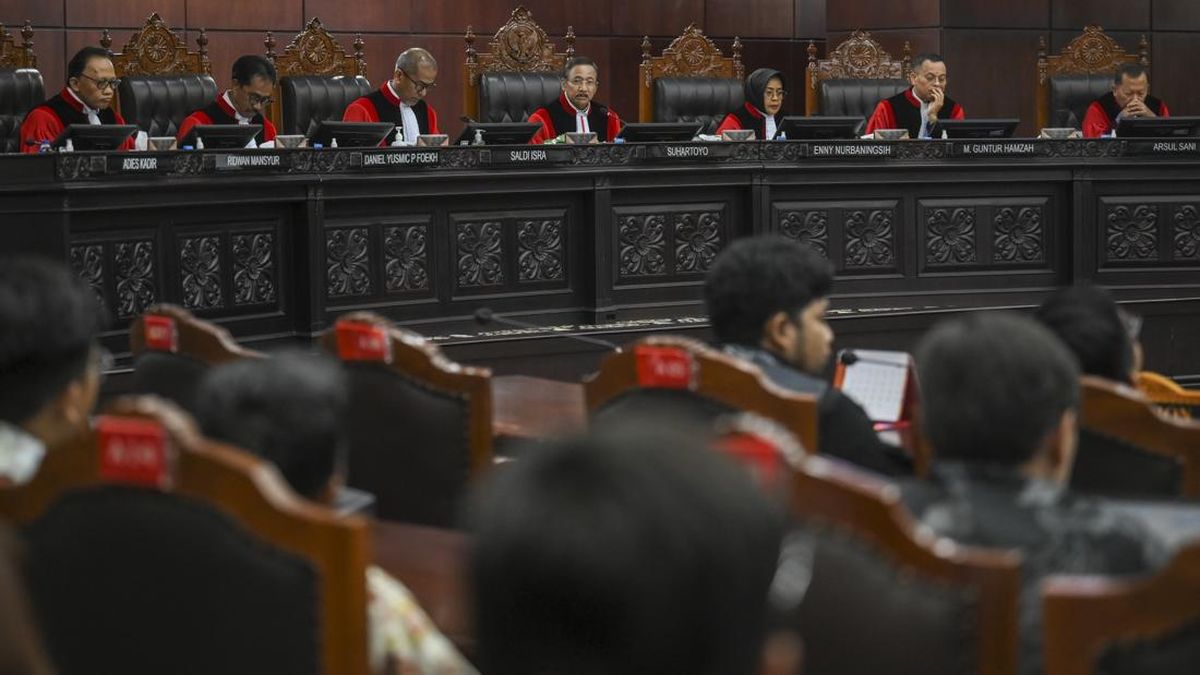
The Constitutional Court (MK) has declared Law No. 31 of 1997 on Military Courts conditionally unconstitutional, finding it contrary to the Constitution unless it is amended within a maximum of two years from the reading of the ruling.
“Declares Law No. 31 of 1997 on Military Courts (State Gazette of the Republic of Indonesia 1997 No. 84, Supplement to the State Gazette of the Republic of Indonesia No. 3713) contrary to the 1945 Constitution of the Republic of Indonesia and conditionally without binding legal force insofar as it is not amended within a maximum period of two years from the pronouncement of this ruling,” the Court said in its decision on case No. 260/PUU-XXIII/2025, read out by Chief Justice Suhartoyo at a hearing in Jakarta on Thursday (15 October).
The Court granted in full a petition challenging the law’s provision that TNI personnel who commit ordinary crimes are tried in military courts. In future, military personnel accused of ordinary crimes will no longer be tried solely by military courts.
“The Court grants the petitioners’ application in its entirety,” Suhartoyo said.
In its reasoning, the Court said Law No. 31/1997 remained unclear and imprecise about the distinction between military offences and ordinary crimes committed by service members, and therefore needed to be amended.
“The Court considers that Law No. 31/1997 must be amended to include clear and precise provisions defining military offences and ordinary crimes, and setting out the jurisdictional boundaries of military and general courts in relation to ordinary crimes committed by TNI personnel,” the Court said in its ruling.
The Court said military courts’ jurisdiction over military offences derives from the specific nature of those cases, not simply from the offender’s status as a member of the TNI. Ordinary crimes committed by military personnel should be tried in general courts.
“Accordingly, the justification for military courts’ jurisdiction over military offences lies in the specific nature of the cases, not solely in the offender’s status as a service member. In this context, the jurisdiction of general courts concerns ordinary crimes, as regulated by the Criminal Code, committed by TNI personnel, which should fall under the jurisdiction of general courts,” Constitutional Court Justice Arsul Sani said while reading the Court’s opinion.
The Court said that the further a crime is from the distinct character of military service, the weaker the case for retaining it within military court jurisdiction. It added that using general courts would help ensure accountability and judicial independence, and guard against the risk of impunity for ordinary crimes committed by TNI personnel.
“Based on the foregoing legal reasoning, the petitioners’ argument concerning the phrase ‘criminal offences’ in Article 9 point 1 of Law No. 31/1997—that it is contrary to Article 24 paragraph (1) and Article 28D paragraph (1) of the 1945 Constitution unless interpreted to mean military offences—is well-founded,” the Court said in its reasoning.
The Court also said the Military Courts Law should be amended because it was enacted before the 1998 Reformasi, which led to amendments to the 1945 Constitution.
The Court said the ruling went beyond the definition of the phrase ‘criminal offence’, which it found raised constitutional concerns. Other provisions of Law No. 31/1997 also needed to be reviewed in light of the constitutional amendments.
“Furthermore, Law No. 31/1997 was enacted within the constitutional framework before the Reformasi era, when the 1945 Constitution had not yet been amended. The subsequent constitutional amendments strengthened the rule of law, the independence of judicial power, equality before the law and various guarantees of citizens’ constitutional rights,” the Court said.
“In practice, the meaning and application of ‘ordinary crimes’ and ‘military offences’ committed by TNI personnel are often subject to differing interpretations. This has also become a crucial problem in applying procedural law and determining which judicial body has the proper jurisdiction to try the offences concerned,” it added.
The judicial review petition against the Military Courts Law was filed by Lenny Damanik and Eva Meliani Br Pasaribu. Lenny is the mother of a 15-year-old junior secondary school pupil, identified by the initials MHS, who died after being assaulted by First Sergeant Riza Pahlivi.
Eva Meliani is the daughter of journalist Rico Sempurna Pasaribu, who was killed in a fire. TNI personnel were suspected of involvement in the arson attack on the family’s home, which resulted in deaths.
The petitioners challenged Article 9 point 1, Article 43 paragraph (3) and Article 127 of Law No. 31 of 1997 on Military Courts against Article 1 paragraph (3), Article 24 paragraph (1), Article 27 paragraph (1) and Article 28D paragraph (1) of the 1945 Constitution.
Source: jawawa.id (https://jawawa.id/newsitem/constitutional-court-military-courts-law-conditionally-unconstitutional-1792108267)
Originally published by CNN Indonesia (https://www.cnnindonesia.com/nasional/20261015153544-12-1415737/putusan-mk-uu-peradilan-militer-inkonstitusional-bersyarat), translated from Indonesian