
Constitutional Court Justice Questions Government Oversight of Airline Services
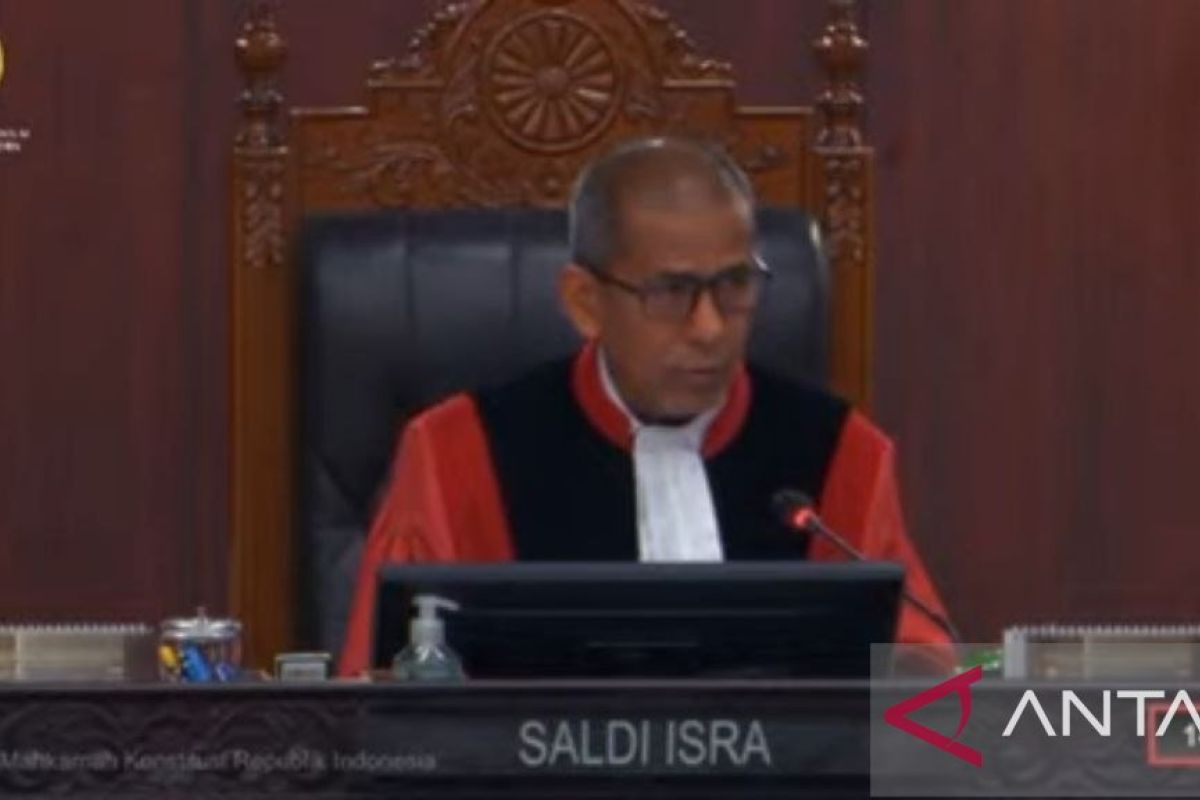
Jakarta (ANTARA) - Constitutional Court judge Saldi Isra, during a judicial review hearing of the Aviation Law on Tuesday, questioned the government’s supervisory role over airlines in air transport services.
Saldi asked whether the Ministry of Transport had carried out its oversight function regarding problems occurring in aviation services, such as departure delays and the transfer of flights to other airlines within the same airline group.
“To the government, what control do you (the government’s legal counsel) exercise over problems like these? Issues like these cannot be measured by Rp300,000, sir,” Saldi said.
Saldi raised the question after hearing testimony from Lion Group, a related party in the judicial review of Law Number 1 of 2009 on Aviation concerning flight delays.
The petitioners are challenging the norms in Article 146, the elucidation of Article 146, Article 170 and Article 176 of the Aviation Law.
According to Saldi, the norms being challenged by the petitioners contain a role that the government must fulfil to protect consumers.
“Please explain what the government has done to align compensation with the losses or potential losses suffered by consumers,” Saldi asked.
Saldi highlighted the management of compensation for flight delays by airlines.
The hearing revealed the compensation mechanism, including compensation of Rp300,000 if a flight is delayed by 240 minutes. Additionally, compensation in the form of snacks and drinks is provided for delays of 30 minutes to one hour.
In his view, the amount of compensation received by consumers is not proportionate to the losses suffered as a result of flight delays.
He gave an example: someone plans to fly at 08.00 Western Indonesia Time to Yogyakarta, arriving at 09.00, then travels to a city expected to be reached by 12.00 in order to meet a client, attend a seminar, speak at a seminar, or sit as an examiner at a forum.
“It makes no sense if the compensation given is only Rp300,000, or is merely replaced with cake, light snacks, or bottled water,” he asserted.
Therefore, Saldi asked the government to add to its explanation to the court regarding the determination of compensation for delays received by consumers, and whether the government has involved consumer protection bodies or aviation consumer associations.
He said the amount of compensation currently provided by airlines is not commensurate with the losses suffered by consumers due to flight delays.
“Because this is unreasonable, because the losses and potential losses are far greater than this,” he stressed.
Saldi also reminded airlines not to use ministerial regulations as an excuse for having implemented the law, when in fact the compensation given for delays does not match the value of consumers’ losses.
“That is what the government needs to explain. So airlines cannot argue by saying, ‘the law mandates that this be regulated by a lower regulation, a ministerial regulation, and the ministerial regulation already exists, so it is correct!’ It cannot be like that,” he said.
Saldi also highlighted the testimony of the related party Lion Group, which said it had carried out orders in accordance with the delegation of regulations, but consumers’ losses were never taken into account.
According to Saldi, it is entirely possible that the Constitutional Court will later rule similarly to the case of expiring internet quota.
The Court ordered that any adjustment in the calculation of losses suffered by consumers must involve consumer representatives and consumer protection institutions.
“So the government must not only be pro-airline companies; consumers must also be protected,” he emphasised.
Case number 190/PUU-XXIV/2026 was filed by nine lawyers and two students challenging the constitutionality of Article 146, the elucidation of Article 146, Article 170 and Article 176 of the Aviation Law.
The petitioners said they had experienced flight delays. They argued that Article 146 of the Aviation Law has created legal uncertainty and an unbalanced position.
On one hand, the article exempts the carrier (airline) from responsibility; on the other, it does not regulate a mechanism for airlines to submit evidence of delays, such as the obligation to attach an official statement from the relevant authorities.
Source: jawawa.id (https://jawawa.id/newsitem/constitutional-court-justice-questions-government-oversight-of-airline-services-1785865851)
Originally published by Antara (Indonesian) (https://www.antaranews.com/berita/5680093/hakim-mk-pertanyakan-pengawasan-pemerintah-di-layanan-penerbangan), translated from Indonesian