
Constitutional Court Hears Testimony on MBG's Domino Effect on Teachers
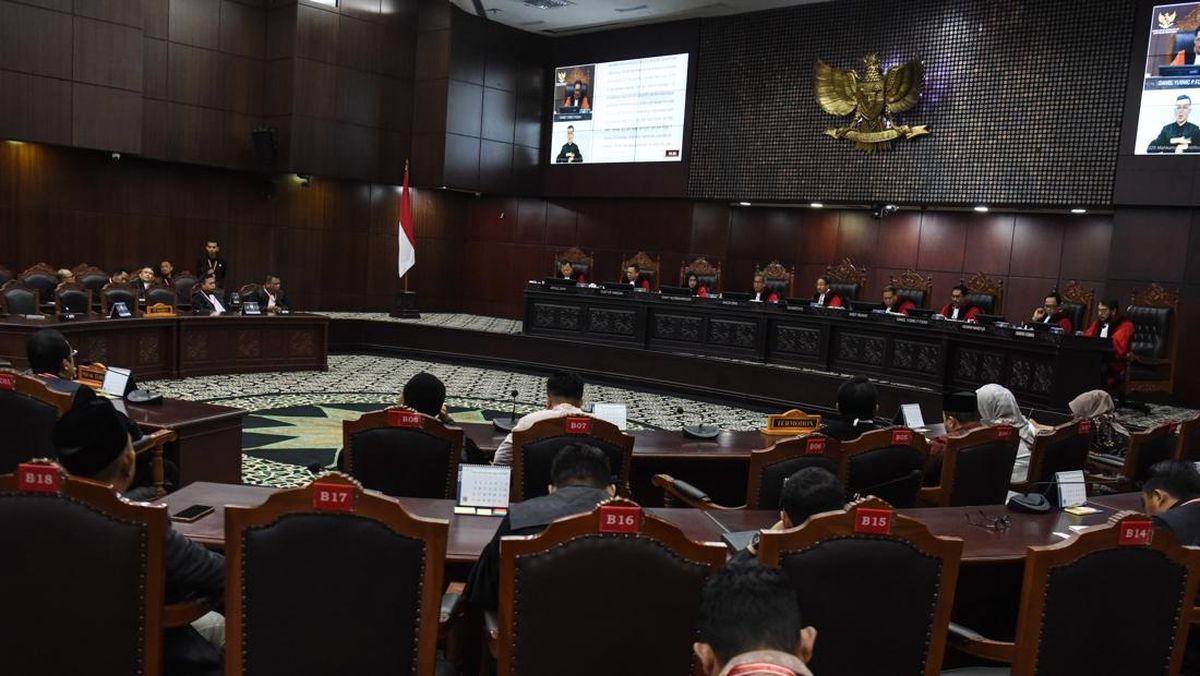
A teacher serving as a witness in the judicial review of Law 17/2025 on the 2026 State Budget (APBN) detailed the domino effect of the Free Nutritious Meal (MBG) programme on teachers’ conditions and workloads across Indonesia. The hearing took place at the Constitutional Court (MK) in Jakarta on Monday (15/6).
Two petitions, numbered 52/PUU-XXIV/2026 and 55/PUU-XXIV/2026, both challenge the placement of the MBG programme within the education budget under the provisions of the 2026 State Budget Law.
Iman Zanatul Haeri, a history teacher at Madrasah Aliyah Al-Tsaqafah under the Said Aqil Siroj Foundation’s Islamic boarding school, testified as a witness. He also serves as Head of Teacher Advocacy for the Education and Teachers Association (P2G). He presented various impacts of the MBG programme compiled from numerous complaints and reports from teachers.
He noted the difficulty in persuading fellow teachers to attend the hearing due to security concerns and fear of structural intimidation from school principals, supervisors, education offices, and other parties who felt this testimony would incriminate the MBG programme.
“After MBG was implemented in 2026, there were mass layoffs of PPPK (Government Employees with Work Agreements) teachers who were considered already prosperous, and also honorary teachers. Honorary teachers who were promoted to part-time PPPK status now receive salaries lower than their previous honorary wages,” Iman stated during the session, as quoted from the MK website.
He explained that the mass dismissals involved PPPK teachers whose contracts were not renewed or who were furloughed. Part-time PPPK teachers, after receiving their appointment decrees, found their salaries were lower than those of honorary teachers. Meanwhile, some honorary teachers were either dismissed or retained with a choice between salaries from School Operational Assistance (BOS) funds or Professional Teacher Allowance (TPG)/certification. Additionally, private madrasah teachers who were promised appointment as PPPK with TPG ultimately had their appointments suspended.
Iman cited an example of a part-time PPPK teacher in Cianjur, West Java, who received a salary of around Rp300,000. He further noted a teacher in Sumedang who was paid Rp50,000—before BPJS deductions.
Iman also shared results from a survey of 239 teachers, comprising 62 honorary teachers and 62 part-time PPPK teachers. The survey revealed increased workloads, reduced teaching time due to non-instructional programmes, insufficient income, delayed salary or honorarium payments, reduced educational facilities, unpaid or delayed professional allowances, and diminished opportunities for PPPK appointments. Some part-time PPPK respondents had not received any salary since their inauguration in December 2025.
Teachers are now required to supervise food distribution, record meal handouts, and manage container returns, often during class hours, making learning time ineffective. Iman stated that the MBG programme’s impact affects teachers’ careers, welfare, and psychological well-being, and he lamented the lack of accessible channels to report the programme’s negative aspects.
“This constitutional effort is our most fundamental step, perhaps the last resort. Because access to evaluate so that the teacher welfare budget within the education budget is not taken by MBG, there is no channel. Honestly, if we wanted to report to the police, the police have SPPG kitchens. If we wanted to report to the TNI, the TNI have SPPG kitchens. If we wanted to report to the DPR, many DPR members have SPPG kitchens,” Iman said.
Muhammad Zidan Ramdani, a student from the Faculty of Da’wah and Communication Sciences at Syarif Hidayatullah State Islamic University Jakarta, also testified. As chairman of the university’s Student Executive Board, he explained that UIN is a state Islamic higher education institution with Public Service Agency (BLU) status under the Ministry of Religious Affairs, making its operations heavily reliant on state budget support. Any policy affecting education budget allocations directly or indirectly impacts the quality of educational services students receive.
“Your Honours, before the MBG policy, the problems faced by universities and students were already quite complex,” Zidan said. He noted fundamental issues requiring adequate budget support, including limited scholarship access, the need for improved learning facilities, strengthening lecturer quality, and support for student research and development. “All of this requires a large and sustainable budget commitment. In this context, reducing or shifting the education budget has the potential to deepen various unresolved problems. The ultimate impact will be felt directly by students as recipients of educational services.”
In addition to these two petitions, a third petition, Number 40/PUU-XXIV/2026, also challenges the same issue. The three petitions contest Article 22 paragraph (3) of the 2026 State Budget Law, which states that the education budget includes funding for the operational delivery of education.
Source: jawawa.id (https://jawawa.id/newsitem/constitutional-court-hears-testimony-on-mbgs-domino-effect-on-teachers-1781661103)
Originally published by CNN Indonesia (https://www.cnnindonesia.com/nasional/20260617074509-12-1369842/sidang-di-mk-saksi-pemohon-beber-efek-domino-mbg-pada-guru), translated from Indonesian