
Constitutional Court Hears Expert Testimony on Six Judicial Review Petitions Against New Criminal Code
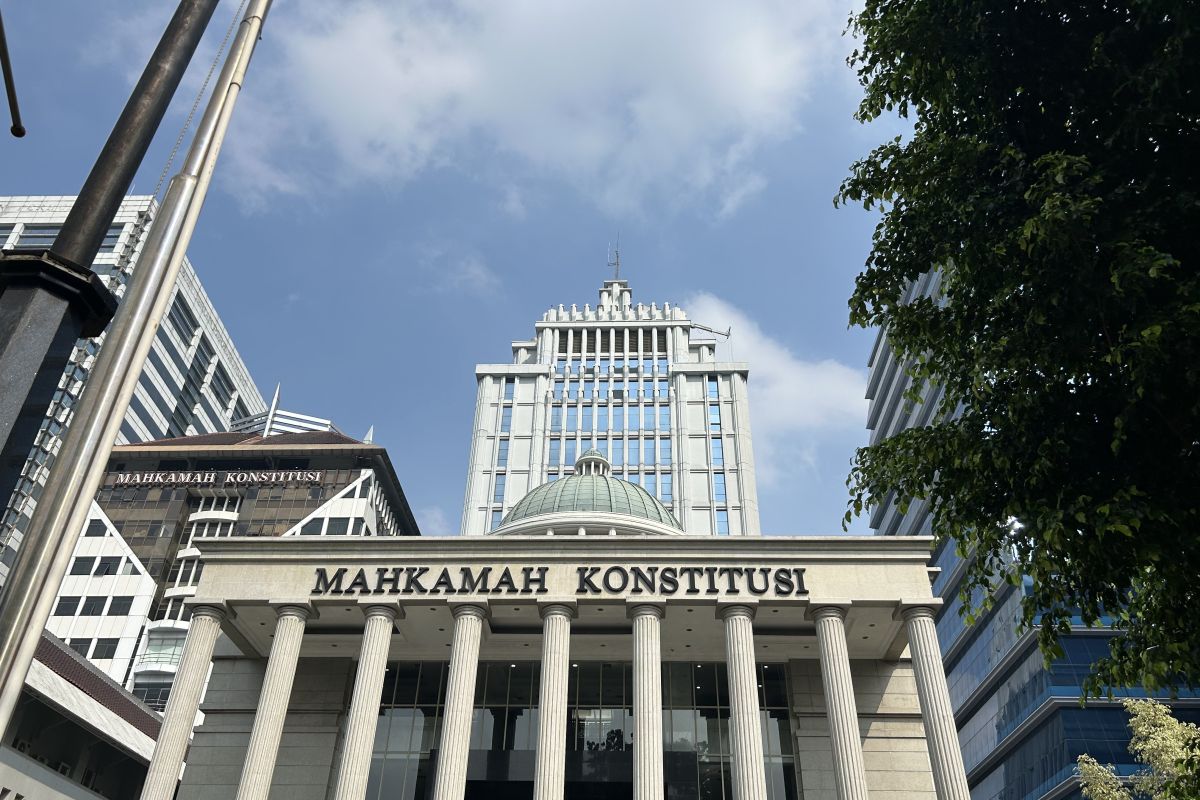
Jakarta (ANTARA) - On Monday, the Constitutional Court (MK) held a follow-up hearing for the judicial review of the Criminal Code (KUHP) filed by several petitioners. A total of six cases regarding the judicial review of Law Number 1 of 2023 concerning the Criminal Code are currently undergoing expert testimony.
Among the six petitions is Case Number 27/PUU/XXIV/2026, filed by Atrid Dayani and others, regarding the testing of Articles 237 (b) and (c) of the new KUHP concerning national symbols. The petitioners argue that these articles could infringe upon their constitutional rights because the norms are formulated broadly and are open to multiple interpretations, potentially leading to the criminalisation of the use of national symbols in academic, cultural, and national expression contexts.
Furthermore, Case Number 29/PUU-XXIV/2026, filed by Zico Leonard Djagardo Simanjuntak, which was merged with Case Number 26/PUU-XXIV/2026 by Bernita Matondang and others, concerns the criminalisation of insults against the President and Vice President. The petitioners challenge Article 264, arguing it contradicts the 1945 Constitution and is identical to Article 15 of Law Number 1 of 1946, which was previously declared unconstitutional by the Constitutional Court.
Additionally, Case Number 280/PUU-XXIII/2025, filed by Susi Lestari, and Case Number 282/PUU-XXIII/2026, filed by Tania Iskandar, relate to Article 411, paragraph (2) of the new KUHP regarding adultery, which is alleged to violate Article 28B of the 1945 Constitution. The petitioners argue that this article creates a paradoxical and distressing situation, particularly for interfaith couples who are unable to marry due to existing legal restrictions. They contend that the state simultaneously prevents interfaith marriage and punishes individuals for sexual relations outside of marriage, representing a fundamental contradiction and a violation of legal justice. They also argue that Article 411, paragraph (2) contradicts Article 27, paragraph (1) of the 1945 Constitution by creating a discriminatory reporting system based on marital status; while married individuals can only be reported by their spouses, unmarried individuals can be reported by parents or children, making the latter more vulnerable to criminalisation.
Finally, Case Number 275/PUU-XXIV/2026, filed by student Afifah Nabila Fitri, seeks a judicial review of Articles 218, paragraphs (1) and (2) regarding the defamation of the President. The petitioner argues that these articles create legal uncertainty by providing special protection (privilege) to the President and Vice President, which fundamentally contradicts the principle of equality before the law guaranteed under Article 27, paragraph (1) of the 1945 Constitution.
Lawyer Priskila Oktaviani has been appointed to represent the petitioners in these six cases. The Constitutional Court has previously requested testimony from the lawmakers, namely the House of Representatives (DPR) and the President. The President’s legal counsel, Deputy Minister of Law Edward Omar Sharif Hiariej, appeared on 9 March, while the DPR was represented by the DPR Expert Body team, including Adjie Jalu and Wildan, who provided testimony on 13 April 2026.