
Constitutional Court Declares Articles on Insulting Government and DPR Unconstitutional
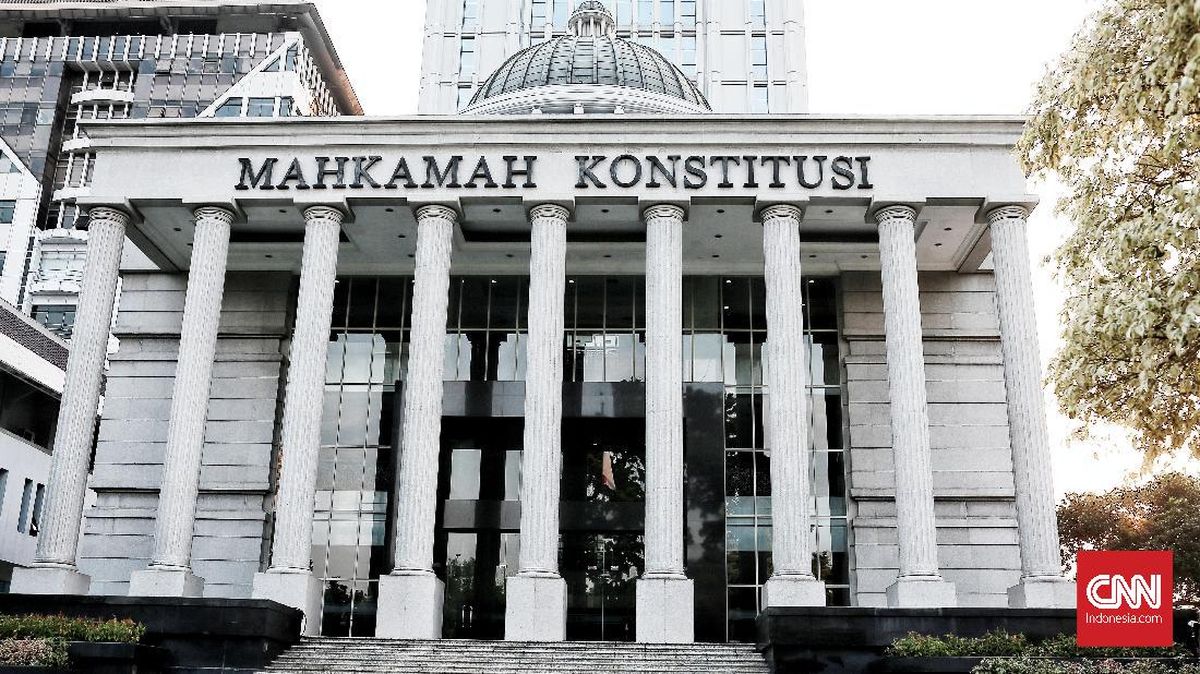
The Constitutional Court (MK) has declared the articles on insulting the government and other state institutions unconstitutional, on the grounds that they could eliminate and reduce citizens’ constitutional rights to voice their opinions or aspirations.
This was set out in the ruling for case Number 282/PUU-XXIII/2025, which reviewed the constitutionality of Articles 240 and 241 of Law Number 1 of 2023 concerning the Criminal Code (KUHP).
“The petitioners’ request is granted in its entirety,” said Chief Justice Suhartoyo as he read out the ruling at the MK building in Jakarta on Friday (28/8).
The MK stated that the new Criminal Code should not have reintroduced articles whose substance was similar to Articles 134, 136 bis and 137 of the colonial-era KUHP.
“In this case, for the Court, maintaining that substance or its similarity is tantamount to negating the principle of equality before the law, freedom of expression, freedom of opinion, freedom of information and the principle of legal certainty,” said constitutional justice Adies Kadir.
The MK understands that a person’s honour and reputation must still receive legal protection. However, protection of an individual’s honour cannot be equated with the honour, dignity and reputation of the government or other state institutions.
The MK again underlined its ruling Number 105/2024, which affirmed that legal entities cannot be complainants or reporters because defamation can only be directed at individuals.
The same applies to the President or Vice President, where only the head of state may lodge a complaint regarding such defamation or insult, or through an advocate with a special power of attorney.
Moreover, the government or other state institutions have an obligation to be accountable to the public.
Accordingly, criticism from the public must be viewed as part of a democratic state.
“In this regard, in carrying out their duties and authority, the government and/or state institutions must be open to oversight, criticism and the opinions of the people as holders of sovereignty,” he said.
The MK stated that maintaining the substance of Articles 134, 136 bis and 137 of the old KUHP would in fact risk reducing and eliminating citizens’ constitutional rights.
“In accordance with the principle of popular sovereignty, the voice or aspirations of the people must serve as a guide for every state institution in carrying out its constitutional duties and functions in line with the 1945 Constitution of the Republic of Indonesia,” the MK said.
The MK again stressed that the lawmakers, namely the Government and the DPR, must not revive norms that have been declared unconstitutional.
“This means that the declaration that Articles 134, 136 bis and 137 of the old KUHP are unconstitutional must not be interpreted as the annulment of an article (in the form of a number or letter), but must be interpreted as the annulment of the material or substance contained in the norms in question,” the MK emphasised.
This judicial review was filed by nine students on behalf of Tania Iskandar, Sila Fide Novira Nggebu, Muhammad Restu, Yuli Wulan Ningsih, Ika Minawati, Putra Muhammad Fadilla, Tasya Ayu Hapsari, Mawar Prasiska Nur Rizki, and Riesa Zhafirah.