
Constituent Assembly: Democracy Interrupted
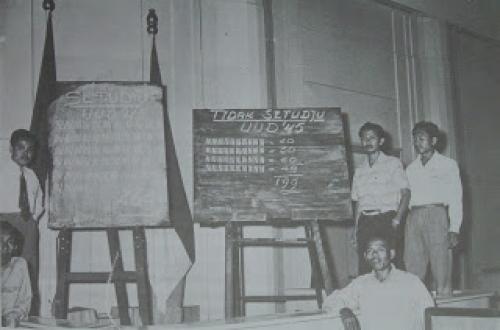
On the morning of 5 July 1959, a single decision altered the course of Indonesian history. With a decree, President Soekarno dissolved the Constituent Assembly and reinstated the 1945 Constitution. From that moment, the forum that had for nearly three years been the site of the republic’s greatest constitutional debate ceased to convene. But was it democracy that ended? Or merely the space where that democracy was practised?
Behind that event lies a chapter of history that seems to have faded from our collective memory: the story of the Constituent Assembly. For decades, this institution has been remembered primarily as a body that failed to draft a constitution and was therefore dissolved. This narrative has been so dominant that it appears as though the Assembly produced nothing at all.
Yet, the records of its sessions reveal a different reality. The Assembly was an arena of political contestation, a meeting place for grand ideas about Indonesia’s future. What ended in 1959 was merely the institution; the ideas it generated continue to flow to this day.
The Constituent Assembly was the offspring of the 1955 general election, the first direct, free, and competitive election after independence. The people not only chose members of the House of Representatives but also elected representatives specifically mandated to draft a definitive constitution to replace the Provisional Constitution of 1950. Expectations for this body were immense. Indonesia needed a constitution born from the deliberations of the people’s representatives, not a product of political compromise among the independence activists who founded the republic.
When the first session opened in Bandung in November 1956, more than five hundred members gathered, bringing with them highly diverse political, religious, regional, and ideological backgrounds—a true reflection of Indonesia’s face.
At Gedung Merdeka in Bandung—the building that a year earlier had hosted the Asia-Africa Conference—these five hundred plus members convened, carrying the people’s mandate from the 1955 election. In that room, one of the richest intellectual conversations in Indonesian history took place. Aristotle, Rousseau, Montesquieu, the Charter of Medina, the United States Constitution, and the experiences of India and Pakistan were all present in the members’ arguments as they debated the foundation of the state, human rights, the system of government, and the republic’s future.
Interestingly, the Assembly’s sessions were not filled with slogans or political agitation as is often imagined. The debates were conducted with philosophical, historical, and comparative rigour. Reading the session records today feels like following a grand seminar on constitutional law that lasted almost three years. The figures involved were not merely defending party interests; they were staking their life’s convictions on what they believed was best for Indonesia. It is no exaggeration to say that the Constituent Assembly was the greatest intellectual laboratory the republic has ever possessed.
However, democracy does not always succeed in forging consensus. The debate over the foundation of the state revealed how two major streams of thought in the nation both commanded strong support. The Pancasila faction viewed Indonesia’s plurality as requiring an inclusive state ideology. On the other hand, the Islamic faction argued that the aspirations of the Muslim majority deserved a more explicit place in the constitution. Neither side could secure the two-thirds majority required by the Provisional Constitution of 1950. This was the crux of the problem. It was not the process of thinking that reached a dead end, but the mechanism of decision-making. Democracy was functioning, but the numbers never favoured one camp decisively.
The deadlock ultimately gave birth to a political decision. On 5 July 1959, Soekarno issued a Presidential Decree dissolving the Constituent Assembly and reinstating the 1945 Constitution, with the note that the Jakarta Charter of 22 June 1945 ‘inspires’ the 1945 Constitution and is an integral part of it. With that, the journey of the Constituent Assembly as an institution came to a halt. Indonesia entered a new chapter that would later be known as Guided Democracy. Whether the decree was a statesmanlike solution or a constitutional deviation remains a subject of debate among legal experts to this day. One thing is undeniable: from that day forward, the open constitutional dialogue that had taken place in the Assembly was closed before reaching the finish line.
So, did the Constituent Assembly truly fail? This question has been sporadically raised by historians and constitutional law experts. Adnan Buyung Nasution demonstrated that most of the draft constitution’s substance had actually been completed. Based on his research into the session records, the majority of the constitutional material had been successfully formulated. What remained unresolved was primarily the issue of the state’s foundation—the very point that had been the most sensitive from the start. In this sense, the deadlock was not over the entire constitution-making process, but over the search for consensus on one fundamental issue. Ahmad Syafii Maarif saw the failure as stemming more from the hardening of political compromise than from the intellectual incapacity of its members. Jimly Asshiddiqie even assessed the Assembly’s sessions as one of the pinnacles of Indonesian constitutional thought. These perspectives invite us to reread our history more carefully. What failed was not the Constituent Assembly, but the political process that was supposed to support it.