
Consistently Driving the People's Economy, BRI Posts Profit of Rp31.2 Trillion
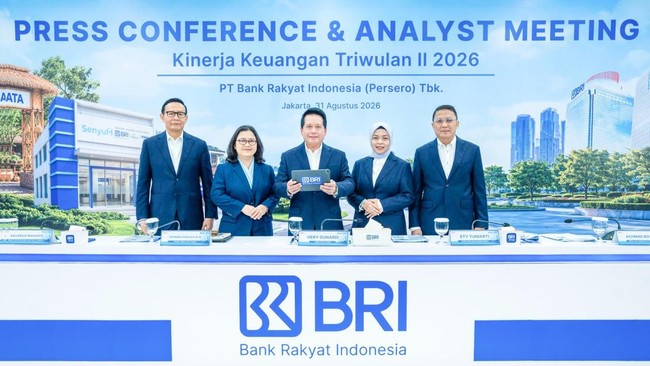
PT Bank Rakyat Indonesia (Persero) Tbk, or BRI, posted positive performance through the end of the second quarter of 2026. Amid the dynamics of the economy and the banking industry, BRI managed to maintain its business growth momentum, accompanied by strengthened fundamentals, improved asset quality and increased profitability.
Through the end of the second quarter of 2026, BRI Group’s net profit reached Rp31.2 trillion, growing 17.5% year-on-year (yoy) compared with the same period the previous year.
This performance was also supported by BRI’s core business characteristic of focusing on the micro, small and medium enterprise (MSME) segment. As of the end of June 2026, 75.1% of BRI Group’s total loan and financing portfolio was channelled to the MSME segment, affirming the company’s consistency in carrying out its role as a driver of the people’s economy.
This was conveyed by BRI President Director Hery Gunardi, accompanied by BRI Deputy President Director Viviana Dyah Ayu R.K., BRI Director of Network & Retail Funding Aquarius Rudianto, BRI Director of Finance & Strategy Achmad Royadi and BRI Director of Risk Management Ety Yuniarti, during a performance presentation held at BRI Head Office in Jakarta (31/8/2026).
BRI President Director Hery Gunardi explained that BRI’s positive achievements through the second quarter of 2026 were attained amid Indonesia’s resilient economic conditions. Indonesia’s economic growth in the second quarter of 2026 was in the range of 5.30%, while inflation was recorded at 3.34%.
On the other hand, MSME business activity also showed strengthening, reflected in the MSME Business Index, which increased from 102.5 at the end of 2025 to 104.7 in the first quarter of 2026. An index position above 100 indicates that MSME players in general are still in an expansion phase and optimistic about their business activities.
“These conditions provide optimism for BRI because MSMEs are the core business as well as an important part of the national economic fundamentals. Amid the transformation that we continue to carry out, one thing that has not changed is BRI’s commitment to continue growing together with MSMEs and Indonesia’s people’s economy,” said Hery, quoted from a written statement, Monday (31/8/2026).
From the industry side, national banking also continued to show solid fundamentals. Banking industry credit through the second quarter of 2026 grew 12.7% year-on-year (yoy), while Third-Party Funds (DPK) grew 10.2% yoy and low-cost funds, or CASA, increased 11.0% yoy.
Asset quality also showed improvement, with the industry’s Loan at Risk (LaR) falling to 8.5%, while the Loan to Deposit Ratio (LDR) stood at 88.3% and Return on Assets (ROA) was maintained at 2.5%.
In maintaining growth momentum, BRI continues to carry out transformation through BRIVolution Reignite. The transformation is directed at two major agendas carried out simultaneously: strengthening the funding franchise and revamping the existing core business while building a new core as a new source of growth.
From the funding side, BRI focuses on efforts to enlarge its low-cost funding base through an ecosystem-based approach. BRI also continues to maximise digital channel capabilities, from merchant acquisition, strengthening BRImo transactions, QRIS to BRILink Agents, while consolidating dominance in business clusters, value chain integration and One BRI Solution penetration.
At the same time, BRI continues to strengthen its micro business as the company’s main strength through business process refinement, strengthening the capabilities of its sales force, or mantri, and implementing increasingly granular risk management. These steps are taken to ensure that micro business growth goes hand in hand with improved asset quality.
In addition to strengthening its core business, the company is also developing new sources of growth through value chain and ecosystem acquisition, refining product value propositions and targeting to acquire quality customers, as well as expanding bullion bank services.
“The transformation we are carrying out is not solely to pursue high growth. Our focus is to ensure that BRI has a growth engine that is increasingly diversified, healthy, quality and sustainable. We have executed these various agendas and they have begun to have a positive impact on BRI’s fundamentals and financial performance,” said Hery.
The implementation of the various transformation agendas is reflected in BRI’s performance through the end of the second quarter of 2026. On a consolidated basis, BRI’s assets reached Rp2,352 trillion, growing 11.7% yoy. This growth was mainly supported by loans and financing, which increased 16.2% yoy to Rp1,646 trillion.
This expansion was supported by DPK, which reached Rp1,581 trillion, growing 6.7% yoy. In line with business growth, BRI’s net interest income increased 9.9% yoy from Rp73.3 trillion to Rp80.5 trillion. Pre-Provision Operating Profit (PPOP) also increased 12.8% yoy to Rp65.7 trillion.
“These achievements show that we have begun to convert the transformation into performance. For us, what matters most is not only how fast BRI grows, but how that growth is generated from increasingly healthy fundamentals and at the same time provides increasingly broad benefits for the economy,” said Hery.
BRI’s increased profitability also went hand in hand with strengthened fundamental quality. Cost of Funds (CoF) on a bank-only basis fell from 3.0% in the second quarter of 2025 to 2.4% in the second quarter of 2026.
In terms of efficiency, the Cost to Income Ratio (CIR) improved from 41.9% to 39.2%. Asset quality also became healthier, with the Non-Performing Loan (NPL) ratio falling from 3.0% to 2.9%, while Cost of Credit (CoC) improved from 3.4% to 3.1%.
The strengthening of fundamentals also supported the company’s ability to generate solid returns. BRI’s ROA was maintained at around 2.7%, while Return on Equity (ROE) increased significantly from 16.6% in the second quarter of 2025 to 18.8% in the second quarter of 2026.
“These various indicators show that the growth we have achieved is of increasingly high quality. Funding is more efficient, operational efficiency is improving, asset quality is healthier, and BRI’s ability to generate returns is also stronger,” Hery continued.
Amid increasingly diversified business expansion, BRI continues to maintain MSMEs as the company’s core business. Through the end of the second quarter of 2026, loans to the MSME segment reached Rp1,235.4 trillion, growing 8.6% yoy.
Thus, around 75.1% of BRI Group’s total loan and financing portfolio was channelled to the MSME segment. According to Hery, the large proportion shows that the diversification of BRI’s growth sources has not changed the company’s DNA as a bank that grows together with the people’s economy. Strengthening the consumer, small-medium-commercial and corporate segments, as well as developing a new core, is carried out to create an increasingly diversified business structure, while MSMEs remain the main foundation of BRI’s business.
“BRI remains consistent in making MSMEs its core business. We believe BRI’s growth must go hand in hand with the growth of business players and the community’s economic activity. Therefore, the business expansion we carry out will continue to be based on efforts to expand financing access and strengthen the capacity of Indonesian MSMEs,” said Hery.
BRI’s commitment to the people’s economy is not only realised through financing. BRI has built an end-to-end MSME empowerment approach, starting from the village level, business communities, to individual business players.
As of June 2026, the Desa BRILiaN programme reached more than 5,700 assisted villages. At the business community level, the Klasterku Hidupku programme reached more than 44,000 business clusters.
BRI also expanded empowerment through the LinkUMKM digital platform, which reaches around 17.3 million MSME players. Meanwhile, mentoring through Rumah BUMN involved around 596,000 MSME players as of June 2026.
This empowerment ecosystem complements BRI’s role in expanding financing, including through KUR. From January to June 2026, BRI channelled KUR of Rp103.8 trillion to more than 2 million debtors. Cumulatively, from 2015 to June 2026, BRI’s KUR distribution reached Rp1,539 trillion to 48.4 million customers.
Hery emphasised that this approach reflects BRI’s role not only as a financial intermediary, but also as an enabler of people’s economic growth.
“For BRI, financing and empowerment are one unit. We want to create a sustainable growth cycle: MSMEs gain access to finance, receive empowerment and mentoring, increase their business capacity, then move up a class and become increasingly integrated into the larger economic ecosystem,” said Hery.
“Ultimately, BRI’s success is not only measured by growth in assets, credit or profit. What is also important is how much that growth is able to create value, open opportunities for business players to develop, and drive the community’s economy. With increasingly strong fundamentals and an ongoing transformation, BRI will consistently grow together with Indonesia’s people’s economy,” Hery concluded.
Source: jawawa.id (https://jawawa.id/newsitem/consistently-driving-the-peoples-economy-bri-posts-profit-of-rp31-2-trillion-1788162699)
Originally published by CNBC Indonesia (https://www.cnbcindonesia.com/market/20260831134052-17-763653/konsisten-jadi-penggerak-ekonomi-kerakyatan-bri-bukukan-laba-rp312-t), translated from Indonesian