
Connected Vessels of Islamic Finance Drive the Real Sector
In the midst of an increasingly uncertain global economy, Indonesia needs a growth engine that is not only large in figures but also strong in supporting the small people’s economy. In this context, Islamic finance should no longer be viewed merely as an alternative to the financial system, but as a strategic instrument for developing the real sector.
The key lies in the interconnectedness of three main pillars: sharia banks, Sharia Rural Banks (BPRS), and Sharia Microfinance Institutions (LKMS), the most well-known of which is Baitul Maal wat Tamwil (BMT).
These three are like “connected vessels” that are interrelated with one another. When one grows, the others move along. When one weakens, the impact spreads throughout the community’s economic ecosystem.
This relationship can actually serve as the foundation for strengthening UMKM, the halal industry, pesantren economy, and other sectors, up to national economic resilience. Unfortunately, so far, these three institutions have operated in a fragmented ecosystem.
Development of Islamic Financial Institutions
National sharia banks have grown rapidly in terms of asset scale and financing. The Financial Services Authority (OJK) records that total sharia banking assets at the beginning of 2026 have exceeded Rp1,028 trillion, with double-digit annual growth.
Even the total assets of the national Islamic finance industry at the same time reached around Rp3,508 trillion. However, this large growth has not automatically reached the lowest layers of business. This is where the role of BPRS and BMT becomes very important.
Meanwhile, OJK data shows that by the end of 2025, there were 174 BPRS in Indonesia. The BPR/BPRS industry also continues to show resilience with relatively strong capital ratios.
Meanwhile, BMT has developed as a community-based microfinance institution close to traditional markets, pesantren, small traders, and ultra-micro businesses, often facing capital and liquidity limitations. BMT is estimated to number in the thousands across Indonesia.
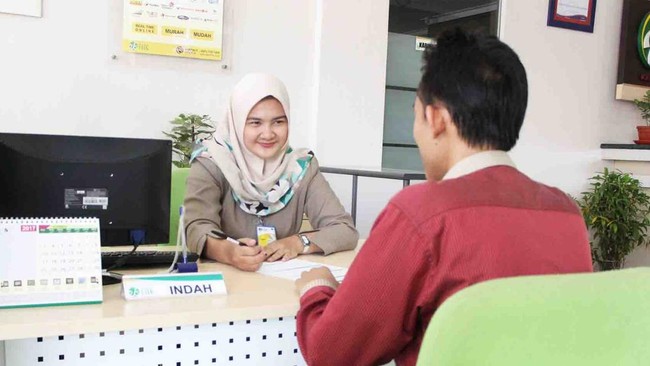
Unlike conventional sharia banks which focus more on medium-scale and corporate financing, BPRS and BMT are at the forefront of the people’s economy. They finance shopkeepers, small farmers, home-based entrepreneurs, and micro-business actors who often lack access to formal banking.
In practice, the real sector does not move merely because of large liquidity, but because of accessible, fast financing that understands the community’s character. This advantage is possessed by LKMS and BPRS.
It cannot be denied that currently many large sharia banks are growing institutionally, but not yet fully connected to the pulse of the micro economy. Conversely, many BMT have strong social closeness, but face limitations in capital, technology, and governance.
BPRS is in the middle, more formal than BMT, but not as strong as conventional sharia banks in funding access and digitalisation. In fact, if the three are connected systemically, Indonesia can have a complete sharia financing chain.
The Role of Connected Vessels in Islamic Financial Institutions
The connected vessels scheme will strengthen each sector. Sharia banks can serve as sources of liquidity and large financing. BPRS acts as an intermediary that expands regional and UMKM financing access. Meanwhile, BMT becomes the spearhead of community economic empowerment down to the ultra-micro level. Such a scheme will create an Islamic finance ecosystem that truly drives the real sector, not just enlarges financial asset figures.
The fundamental problem so far has been a development paradigm in finance that is too oriented towards the financial sector alone. Success is often measured by the size of assets, profits, and financing expansion.
In fact, the most important measure of Islamic economics should be how much impact it has on community production activities. Therefore, the relationship between sharia banks, BPRS, and BMT should be directed towards strengthening food production, the halal industry, small trade, pesantren cooperatives, and UMKM manufacturing sectors.
Another challenge is digitalisation. Many BMT still face technology and data standardisation limitations. As a result, access to financing integration and supervision becomes weak. On the other hand, national sharia banks are increasingly digital and modern.
Therefore, the technology integration agenda becomes urgent. Sharia banks and BPRS need to become partners in digital transformation for BMT. Integration of payment systems, financing, and customer data will strengthen efficiency and accountability in the micro Islamic finance industry.
The momentum of strengthening One Data Indonesia should also be utilised for national Islamic economic data integration. So far, BMT data is scattered and not standardised, making it difficult for the state to accurately map the health and capacity of this sector.
In addition, the state needs to start viewing BMT not merely as ordinary cooperatives. BMT is the social-economic infrastructure of the ummah. In many cases, BMT serves as an economic buffer for the community when access to formal institutions is closed.
Conclusion
Amid threats of global economic slowdown, strengthening the real sector based on UMKM becomes increasingly important. Experiences from various crises show that the people’s economy is relatively more resilient than an economy overly reliant on the financial sector and large commodities. Therefore, the future of Indonesia’s Islamic economy cannot rely solely on giant sharia banks. The true foundation lies in the micro economic network: BPRS and BMT.
When sharia banks, BPRS, and BMT are positioned as connected vessels in one national ecosystem, what moves is not only the financial sector, but also traditional markets, small industries, farmers, fishermen, pesantren, and so on.