
Conglomerate Shares Weigh on JCI as Financing for Bayan Acquisition Draws Attention
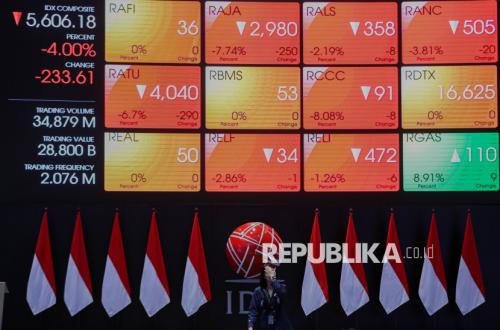
PT Mirae Asset Sekuritas Indonesia said pressure on the domestic stock market continued after the Jakarta Composite Index (JCI) fell 2.59 per cent to 5,936. The decline was led by sharp falls in several conglomerate-linked shares, including DSSA, BREN, TPIA and CUAN.
Eleven sectors fell, with 632 shares declining and only 118 gaining. Despite the index’s drop, foreign investors recorded net purchases of Rp 81 billion on the regular market.
Rully Arya Wisnubroto, Head of Research and Chief Economist at PT Mirae Asset Sekuritas Indonesia, said market sentiment remained fragile amid the risk of index concentration, rising oil prices and uncertainty over market supervision.
In global markets, US stocks closed mixed. The Dow Jones rose 0.4 per cent, while the S&P 500 fell 0.1 per cent and the Nasdaq declined 0.4 per cent. Brent crude jumped 1.8 per cent to US$106.65 a barrel amid rising geopolitical tensions, while gold fell 0.6 per cent.
The US Dollar Index (DXY) strengthened to around 102.6, while the yield on 10-year US government bonds was last at 5.24 per cent, with the US bond market closed for a holiday. Domestically, the rupiah weakened to around Rp 17,900 per US dollar.
“The main catalysts to watch going forward are US inflation data on Wednesday and Bank Indonesia’s Board of Governors Meeting next week. In these conditions, a selective approach to stocks remains relevant, rather than taking broad exposure to the index,” Rully said.
Beyond overall market conditions, investors also need to consider the fundamental risks and financing structures of individual listed companies. One area of focus is the financing of the Jhonlin business group’s acquisition of shares in PT Bayan Resources Tbk (BYAN), and the implications for the credit risk of PT Bank Mandiri (Persero) Tbk (BMRI).
Muhammad Nurkholis Syafruddin, a research analyst at PT Mirae Asset Sekuritas Indonesia, said debt repayment capacity should be the basis for credit assessment, rather than simply the value of assets pledged as collateral.
“Following the transaction, PT Jhonlin Baratama holds 30.25 per cent of BYAN. In the 2021–2025 financial years, BYAN distributed an average of US$960 million in dividends a year, including US$500 million for the 2025 financial year,” Nurkholis said.
Based on that ownership stake, Jhonlin’s historical share of dividends could amount to around US$290 million a year. That would represent a dividend yield of about 20 per cent against an assumed financing facility of Rp 26.1 trillion, or around US$1.45 billion, funded entirely by debt. The figure is well above the assumed borrowing cost of 8 per cent.
“With repayments structured over seven to eight years, BYAN’s average dividends could potentially support repayment of the loan. Annual interest costs of around US$116 million could be covered 2.5 times by the average dividends over five years and 1.3 times by the 2025 financial-year dividend. Annual instalments of US$252–279 million could be covered around 1.04–1.15 times, potentially allowing the loan to be repaid in about 6.6 years,” Nurkholis said.
This repayment capacity is also supported by BYAN’s operating performance. In the first half of 2026, the company posted net profit of US$410 million, up 17 per cent year on year, and held cash of US$934 million.
Source: jawawa.id (https://jawawa.id/newsitem/conglomerate-shares-weigh-on-jci-as-financing-for-bayan-acquisition-draws-attention-1791942658)
Originally published by Republika (https://ekonomi.republika.co.id/berita/tmvitb490/saham-konglo-tekan-ihsg-pembiayaan-akuisisi-bayan-jadi-sorotan), translated from Indonesian