
Concern! Much Indonesian Tin Smuggled to Malaysia-Singapore
Jakarta, CNBC Indonesia - Coordinating Minister for Law, Human Rights, Immigration, and Corrections Yusril Ihza Mahendra has revealed a serious problem in national tin governance. One of the issues is the continued prevalence of tin smuggling from Indonesia to neighbouring countries, especially Malaysia and Singapore.
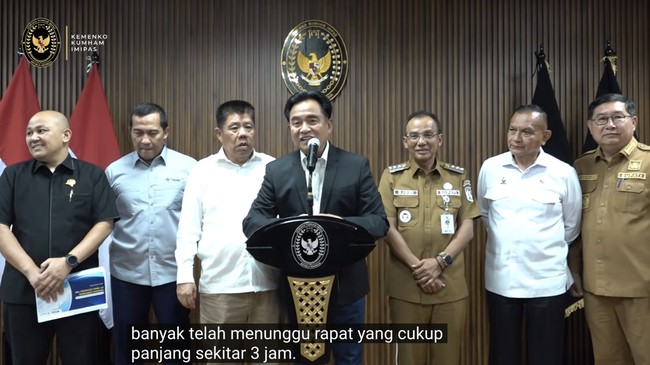
Yusril conveyed this during a press conference on the integrated resolution of legal issues and the operational area of PT Timah at the office of the Coordinating Ministry for Law, Human Rights, Immigration, and Corrections on Tuesday (18/8/2026).
Yusril explained that the geographical conditions of the Bangka Belitung Islands, which have open waters, pose one of the government’s challenges in eradicating tin smuggling. According to him, people can easily take tin out through sea routes using small boats. This situation is increasingly difficult to monitor because Bangka Belitung is relatively close to Malaysia and Singapore.
“The waters of Bangka Belitung are open. It is an island where people from anywhere can go. Just by taking a small boat, one can smuggle tin, especially since Singapore and Malaysia are very close to Bangka Belitung,” said Yusril.
He said the government has actually made various efforts to prevent smuggling, including involving task forces, the police, and elements of the Indonesian Navy. However, the vastness and characteristics of the Bangka Belitung waters make monitoring all smuggling routes a challenge in itself.
Yusril believes the government needs to adopt realistic policies to deal with this problem. One of them is by providing room for PT Timah to purchase tin that has already circulated in the community. Although this rule is only temporary, until there is a Presidential Regulation on tin commodity governance.
According to him, if PT Timah does not purchase the tin, the government only has two options. First, take action against all people who possess tin and confiscate the commodity for the state. Second, tin that is not officially absorbed could continue to be smuggled abroad.
“If we do not decide on that, there are only two options. We arrest people who have tin, process them legally, and confiscate the goods for the state. Or the second option, we do not buy the tin, and smuggling continues,” he said.
On that occasion, Yusril assessed that in the future Indonesia should have a stronger position in the global tin trade. Moreover, according to him, several countries that were previously tin producers, such as Bolivia, Malaysia, and Thailand, have stopped production.
“Imagine, in this world, the only country that produces tin is Indonesia. Bolivia has stopped, Malaysia has stopped, Thailand has also stopped,” he said.
According to Yusril, Indonesia’s tin production is also concentrated in the Bangka Belitung Islands Province. This potential should be managed more strategically so that it provides added value and greater benefits for the community.
Therefore, the government wants to carry out a comprehensive overhaul of tin industry governance. One of the issues of concern is the practice of smuggling, which is considered to be detrimental to Indonesia.
Yusril also highlighted the existence of a neighbouring country that is now a producer and exporter of tin in the world, even though it is said not to have adequate tin reserves or mines.
“Let there be no more smuggling. Currently, there is a neighbouring country that is a tin producer and a world tin exporter, even though it has no tin mines. Where does it get tin? From the smuggled goods in our country,” he asserted.