
Computational Thinking Should Be Applied in Early Childhood Education in Indonesia
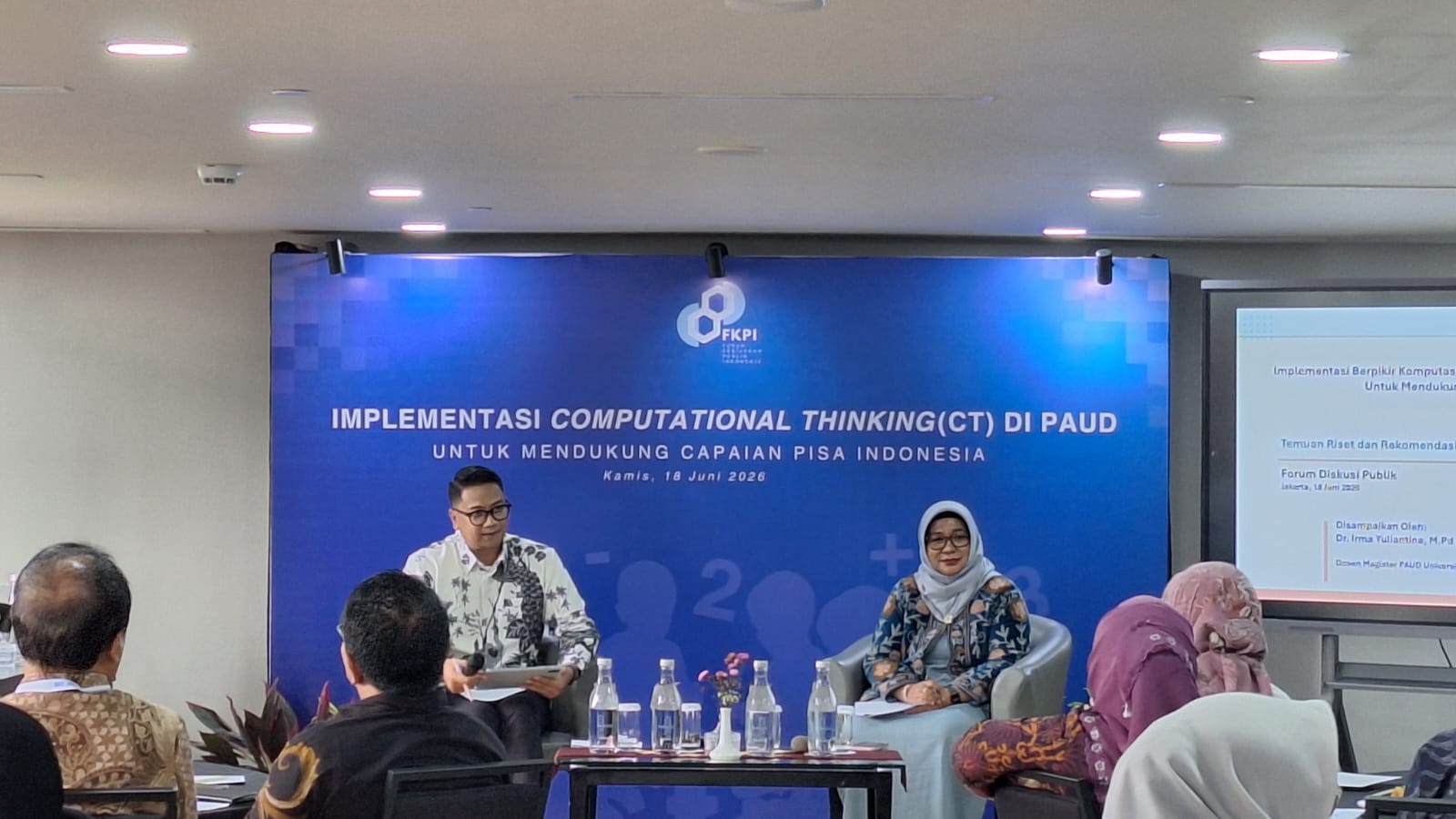
Guru Besar Universitas Trisakti and Chairman of the Indonesian Public Policy Forum (FKPI), Prof. Dr. Trubus Rahardiansyah, stated that early childhood education (PAUD) has a strong foundation for instilling character related to social environments and self-awareness. He noted that PAUD can shape courage, achievement, innovation, and creativity, making this educational phase highly strategic for child development.
“I think the role of teachers is crucial, because educators are the key where PAUD children emulate what their teachers do. So, teachers occupy a position that is not just strategic, but decisive in shaping habits, behaviour, and also children’s self-development patterns in learning, socialising, and controlling their emotions. It all depends heavily on how teachers set an example,” he said at an FKPI event in Jakarta on Thursday (18/6).
He therefore believes the government needs to provide support for the implementation of PAUD. Trubus assessed that so far, PAUD is still largely run by the private sector, and while the government is present, its involvement has not been optimal.
“It is still far from expectations, so the state’s presence, in this case through the instrument of the Ministry of Primary and Secondary Education, must pay serious attention to PAUD and its future direction, because this concerns not only short-term matters but also future-related issues,” Trubus said.
He added that synergy is needed to maximise the implementation of PAUD to support the future of Indonesian children. One aspect that can be encouraged is corporate involvement through Corporate Social Responsibility (CSR) funds.
“So, state-owned enterprises (BUMN) and regionally-owned enterprises (BUMD) should also provide substantial support for the implementation of PAUD, including material support and infrastructure support, such as school premises, playgrounds, equipment, and so on,” he said.
According to Trubus, one thing that can be promoted in PAUD is Computational Thinking (CT), a process of training children to solve problems logically, systematically, and structurally through educational games or daily activities.
“This is developed not only across different regional contexts, but also by introducing local wisdom games, many of which have now disappeared. In my village, there used to be a game called gobak sodor. So, local wisdom needs to be introduced, including types of dances, songs, and also respect for parents and ancestors,” he explained.
At the same event, Irma Yuliantina, a PAUD lecturer at Panca Sakti University Bekasi, emphasised that CT can help build children’s thinking patterns from an early age.
“When we want to build a child’s way of thinking, automatically we must first build the teacher’s capability so that the teacher can provide support on how to build computational thinking,” Irma said.
Irma acknowledged that there are currently obstacles in encouraging teachers to support the application of CT to children, especially given that the welfare of PAUD teachers is still very low.
“Only 13 percent of our teachers have a bachelor’s degree in PAUD. Another 50 percent have a bachelor’s degree but not in PAUD, and the rest do not yet have a bachelor’s degree. So, we really need to work together so that good practices, like those in Kudus which have provided continuous training, can be implemented in other places as well,” she elaborated.
Irma believes that through CT, the issue of low child literacy reflected in PISA scores can also be addressed.
“Computational thinking invites children, when writing, to think about what they want to write and what the meaning is. So, we are more focused on getting the child to understand more deeply. This actually connects with the current deep learning approach, because we want the child to better understand the meaning and what they are doing. It really is connected,” she concluded.