
Complete: Macro Assumptions in 2027 State Budget Draft Target 6% Growth, Rupiah at 17,500 per US Dollar
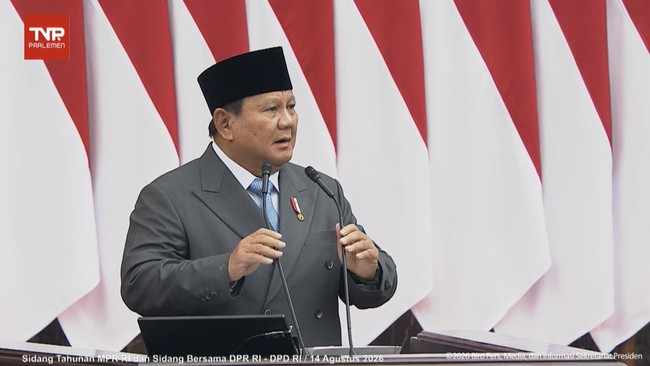
Jakarta, CNBC Indonesia - President Prabowo Subianto has delivered the Introductory Speech for the Financial Note and the 2027 State Budget Draft (RAPBN). In the draft, the government has proposed seven basic macroeconomic assumptions.
The 2027 RAPBN will be the second state budget draft formally submitted by the Prabowo administration after his inauguration in October 2024. The draft also provides an overview of the fiscal policy direction of the Prabowo-Gibran government in its third year.
Economic growth is targeted to reach 6% in 2027. This figure is well above Indonesia’s average economic growth of around 4.24% throughout 2016-2025.
Statistics Indonesia (BPS) shows that Indonesia’s economy grew by 5.29% year-on-year (yoy) in the second quarter of 2026. This growth slowed compared to the first quarter of 2026, which reached 5.61% (yoy).
Meanwhile, inflation in 2027 is estimated to be at 2.5%.
The rupiah exchange rate against the US dollar is assumed to be around Rp17,500/US$. The yield on 10-year government bonds (SBN) is estimated at 6.9%.
For reference, based on Ministry of Finance data, the average rupiah exchange rate throughout the first half of 2026 stood at Rp17,197/US$.
The Indonesian Crude Price (ICP) is estimated at US$75 per barrel. Meanwhile, the average realised ICP up to May 2026 has reached US$91.87 per barrel. The rise in oil prices has been influenced by supply disruptions and geopolitical conflict dynamics in the Middle East.
Oil lifting in the 2027 RAPBN is targeted at 610 thousand barrels per day. Gas lifting is estimated at 954 thousand barrels of oil equivalent per day.
For reference, the 2027 RAPBN will be deliberated in the House of Representatives (DPR) for 30 working days and ratified in a Plenary Session.