
Complete! BI Decision to Hold Key Interest Rate at 4.75% Again in April 2026
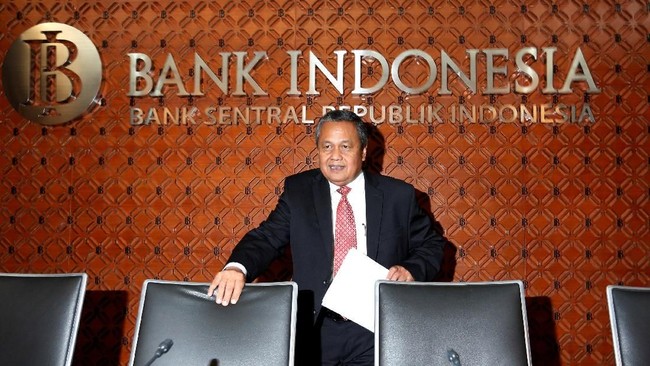
Jakarta, CNBC Indonesia - Bank Indonesia (BI) has again decided to maintain the key BI Rate at 4.75% in April 2026. This is accompanied by holding the deposit facility rate at 3.75% and the lending facility rate at 5.5% in April 2026.
“The Board of Governors meeting of Bank Indonesia on 21 and 22 April decided to keep the BI Rate steady at 4.75%,” said BI Governor Perry Warjiyo during an online press conference on Wednesday (22/4/2026).
Perry explained that this decision is consistent with efforts to enhance the effectiveness of adjusting the interest rate structure of monetary operation instruments to strengthen the stabilisation of the Rupiah exchange rate amid the deteriorating global economic conditions due to the war in the Middle East.
Going forward, Bank Indonesia is prepared to pursue further strengthening of monetary policy as needed to maintain Rupiah exchange rate stability and keep inflation for 2026 and 2027 within the 2.5±1% target.
Meanwhile, macroprudential policy continues to be strengthened to encourage economic growth through increased credit/financing to the real sector while maintaining financial system stability.
Payment system policy continues to be directed to support economic activities through the expansion of digital payment acceptance, strengthening the payment system industry structure, and improving the reliability and resilience of payment system infrastructure.
The direction of the policy mix of monetary, macroprudential, and payment systems in maintaining stability and supporting sustainable economic growth is also backed by the following policy measures:
- Strengthening the effectiveness of monetary policy implementation to maintain Rupiah exchange rate stability and keep inflation for 2026 and 2027 within the 2.5±1% target, by:
strengthening Rupiah exchange rate stabilisation through interventions, both Non-Deliverable Forward (NDF) transactions in the foreign market and spot and Domestic Non-Deliverable Forward (DNDF) transactions in the domestic market;
strengthening the interest rate structure of monetary instruments that are pro-market to continue attracting foreign portfolio investment inflows into domestic financial assets to support Rupiah exchange rate stabilisation; and
maintaining Primary Money growth above 10% in line with monetary expansion to ensure adequate liquidity in the money and banking markets, including through measured secondary market transactions of Government Securities (SBN).
- Strengthening the effectiveness of accommodative macroprudential policy implementation to encourage credit/financing growth to support economic growth while maintaining financial system stability, by:
maintaining: (i) Countercyclical Capital Buffer (CCyB) ratio at 0%; (ii) Macroprudential Intermediation Ratio (RIM) in the range of 84-94%; (iii) Foreign Funding Ratio (RPLN) maximum of 35% of bank capital; (iv) Macroprudential Liquidity Buffer (PLM) ratio at 5% with 5% repo flexibility; and (v) Sharia PLM ratio at 3.5% with 3.5% repo flexibility;
publishing transparency assessments of the Base Lending Rate (SBDK) with deepening on lending rates based on priority sectors covered by KLM (Attachment 1) and synergising with the Government and other stakeholders to encourage high credit/financing through the Indonesia Intermediation Acceleration Programme (PINISI);
- Strengthening the implementation of payment system digitalisation measures in accordance with the Indonesia Payment System Blueprint (BSPI) 2030 to support the acceleration of the national digital economy-finance through:
launching the Indonesia Digital Innovation Centre (PIDI): Hackathon and Digdaya (Empowered and Productive Digital Talent) and Indonesia-China Cross-Border QRIS on 30 April 2026;
synergising the Capacity Building and Literacy Synergy Programme (KATALIS) Acceleration and Expansion of Regional Digitalisation (P2DD) 2026 with PIDI-Hackathon-Digdaya through expanding the latest payment system innovations to improve local government (Pemda) transaction efficiency.
- Strengthening the implementation of money market and foreign exchange market deepening measures in accordance with the Money Market Deepening Blueprint (BPPU) 2030 to support national economic stability and financing through:
exemption from the prohibition on selling foreign currency NDF transactions against the Rupiah in the foreign market for certain Primary Dealers of the Money Market and Foreign Exchange Market (PUVA) that meet Bank Indonesia’s requirements to support Rupiah exchange rate stability and domestic financial market deepening;
expanding foreign currency monetary operation instruments with spot and swap instruments in Offshore Chinese Renminbi (CNH) against the Rupiah to support Rupiah exchange rate stabilisation and expansion of trade and investment transactions using local currencies (Local Currency Transactions, LCT).
Bank Indonesia continues to strengthen policy coordination with the Government, including close synergy between monetary and fiscal policies to mitigate the impact of global uncertainties due to the Middle East war on the domestic economy so that stability and economic growth remain well-maintained.
Policy synergy with the Financial System Stability Committee (KSSK) is also tightened to maintain financial system stability and encourage financing for the Government’s Asta Cita programme.
In addition, Bank Indonesia is strengthening and expanding international cooperation in central banking, including payment system connectivity and local currency transactions, as well as facilitating the organisation of investment and trade promotion in priority sectors in collaboration with relevant agencies.