
Competency in Medical Education Must Be Viewed Holistically
The Covid-19 pandemic brought lessons not only for the health sector but also for the world of education. At that time, the activities of students and lecturers were heavily restricted due to health protocol rules.
As a result, higher education curricula, including at medical and health education institutions in Indonesia, were enriched through the Outcome-Based Education (OBE) evaluation system, via a book titled ‘Programmatic Assessment in Outcome-Based Education (OBE): Concepts and Implementation Guidelines’.
This book was compiled by around 78 medical and non-medical lecturers, edited by Mora Claramita, Nur Afrainin Syah, and Tri Nur Kristina. Published by Gadjah Mada University Press (UGM Press), the book enriches competency assessment in the modern era.
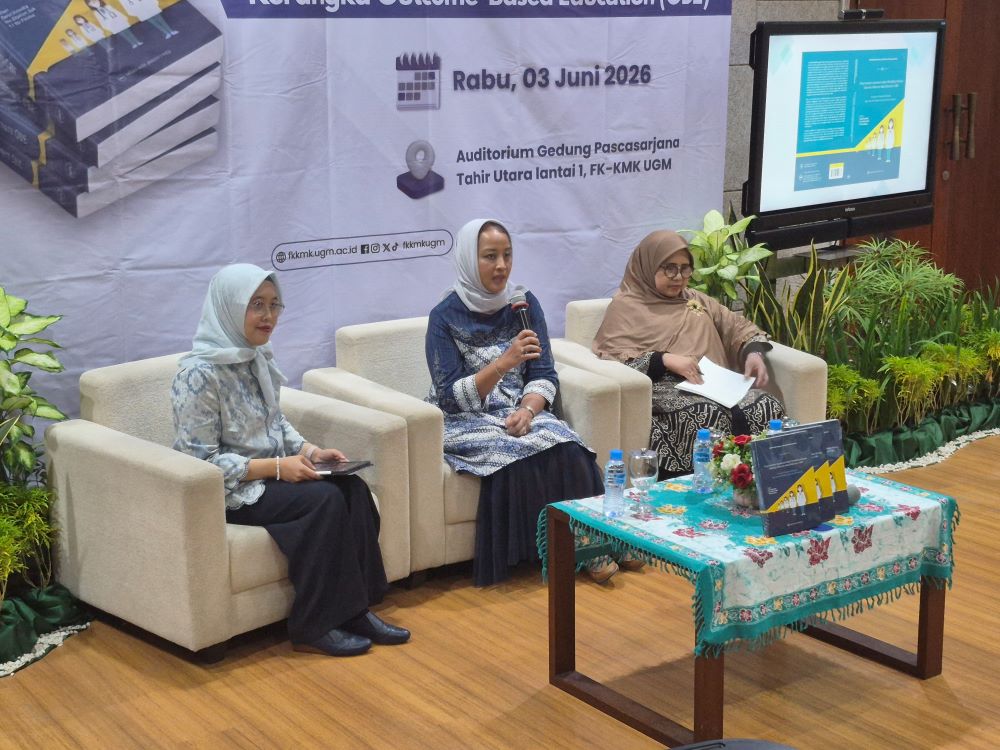
During a book discussion held at the Faculty of Medicine, Public Health, and Nursing, author and editor Mora Claramita conveyed a paradigm shift in competency assessment in the health world. “Previously, the education world relied heavily on a single high-stakes testing final exam; now there is a more humane and accurate approach: Programmatic Assessment,” she stated.
The lecturer from the Department of Medical Education and Bioethics at FK-KMK UGM emphasised the integration of various low-stakes assessment instruments continuously throughout the study period. This approach aims to provide a complete, fair, and longitudinal picture of a student’s competency development.
“We cannot say someone is competent or not just from one or two assessments. From an educational perspective, assessment must be viewed holistically. It must be done by a team, a committee, that looks at all the evidence showing the person concerned has achieved the outcome,” she explained.
She stressed the importance of a blueprint for OBE to become a practical step that can be implemented by educational institutions.
Longitudinal monitoring aims to see the gradual growth of student competence, rather than just a snapshot at the end of the semester. Clinical Context and Professionalism aims to provide measurable instruments to assess difficult aspects such as medical reasoning and professional ethics.
Lecturer from the Department of Medical Education and Bioethics at FK-KMK UGM, Titi Savitri Prihatiningsih, stated that the book ‘Programmatic Assessment in Outcome-Based Education (OBE): Concepts and Implementation Guidelines’ has academic validity, with Mora Claramita as one of the editors ensuring the book’s content is highly relevant to the educational climate in Indonesia.
The book does not only dwell on cognitive theory but is structured as an operational guide. Its content structure is designed to answer technical needs in the field, covering models, steps, procedures, and cycles, step by step.
Moreover, there are real examples of principle application, practical points in each chapter, as well as benchmark implementations in several countries. “Examples of errors, misperceptions, supporting factors and inhibiting factors of implementation, and unavoidable repetitions are also conveyed,” she said.
Vice Dean for Academic and Student Affairs at FK-KMK UGM, Ahmad Hamim Sadewa, stated that the implementation of the Programmatic Assessment system in Outcome-Based Education (OBE) is a strategic step to maintain the quality of medical graduates amidst curriculum changes. “This concept has been very maturely developed and can be implemented optimally to boost the quality of health education in the country,” he said.