
Comparing Progress on Nuclear Power Plants in Singapore and Indonesia
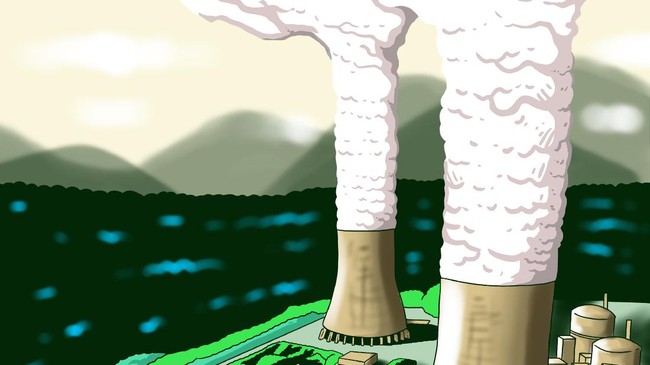
Jakarta, CNBC Indonesia — Singapore is stepping up preparations to develop nuclear energy amid its heavy reliance on natural gas, including supplies from Indonesia. The move comes as the Indonesian government trims some of its pipeline gas exports to the neighbouring country.
On Monday (26 October 2026), the Singaporean government announced three programmes to develop nuclear expertise in preparation for the possible use of the technology as a future source of electricity.
Although it has yet to decide whether to build a nuclear power plant, the move signals Singapore’s efforts to diversify its energy sources and reduce its reliance on fossil fuels.
Indonesia cuts gas exports to Singapore
Indonesia’s Minister of Energy and Mineral Resources, Bahlil Lahadalia, said the reduction in gas exports to Singapore remained within the limits of the agreed contracts.
Bahlil said Indonesia’s total pipeline gas exports to Singapore amounted to 409.5 million standard cubic feet per day (MMSCFD). Of that volume, the government cut 31 MMSCFD: 15 MMSCFD from Natuna and 16 MMSCFD from Sumatra.
“Our minimum contractual limit is around 91–92. We have only cut 8%; it would breach the contract only if we cut 10%,” Bahlil said, as quoted by CNBC Indonesia on Monday (26 October 2026).
In addition to pipeline gas, Indonesia also exports liquefied natural gas (LNG). Bahlil said the government continued to honour its energy-trade commitments to Singapore.
Historically, the value of Indonesia’s natural gas exports has trended downwards. Data from the Trade Ministry’s Satu Data portal show that exports of natural gas under HS code 27112190 were worth US$2.73 billion in 2021, rising to US$2.98 billion in 2022 before falling to US$1.63 billion in 2025.
Singapore begins preparing nuclear experts
The Singaporean government is stepping up preparations to develop nuclear energy as a possible alternative source of electricity in the future.
The Ministry of Energy, Trade and Industry (METI) and the Energy Market Authority (EMA) announced three programmes on Monday (26 October 2026) to strengthen national expertise in nuclear energy, spanning government, industry and energy policy-making.
The programmes are intended to build human-resource capacity and prepare Singapore to assess the feasibility of nuclear technology for electricity generation.
Speaking at the opening of Singapore International Energy Week (SIEW) 2026, Minister for Energy and Industry Tan See Leng emphasised the importance of strengthening national nuclear expertise.
“We are redoubling our efforts to build a pool of nuclear experts and professionals in Singapore,” Tan See Leng said, according to a translation of his speech.
Alongside the three programmes, the National University of Singapore (NUS) and Nanyang Technological University (NTU) are preparing a joint master’s programme in nuclear engineering, which is expected to launch in 2027.
Tan said the expertise would be beneficial even if Singapore ultimately chose not to use nuclear energy, particularly as interest in the technology grows in Southeast Asia and around the world.
The move is also part of preparations for the International Atomic Energy Agency’s (IAEA) Integrated Nuclear Infrastructure Review (INIR) in 2027, which will assess Singapore’s nuclear infrastructure and institutional readiness.
Singapore has not yet decided to build a nuclear power plant. The government is focused on building national capacity and assessing feasibility before determining nuclear power’s role in its long-term energy mix.
More than 90% of Singapore’s electricity depends on gas
Singapore’s reliance on natural gas is a major challenge to maintaining national energy security. Most of the country’s electricity needs are met by gas, including imports from Indonesia and Malaysia.
According to data from Singapore’s Energy Market Authority (EMA), natural gas’s share of electricity generation rose significantly over the past two decades, from 60.8% in 2003 to 93.11% in 2025.
Gas’s dominance peaked in 2020, when it accounted for 95.76% of Singapore’s total electricity generation.
By contrast, the share of petroleum products fell sharply, from 36.4% in 2003 to just 0.29% in 2025. Other energy sources accounted for 6.60%.
To meet its needs, Singapore relies on pipeline gas from Indonesia and Malaysia, as well as LNG imports from international markets.
Its dependence on foreign supplies leaves Singapore’s electricity sector vulnerable to disruptions and fluctuations in global gas prices.
With electricity demand rising, including from data centres and industry, diversifying energy sources is increasingly important to ensure a stable power supply while reducing carbon emissions.
One technology under consideration is the small modular reactor (SMR), a smaller nuclear reactor with a capacity of up to around 300 megawatts (MW) per unit.
Nuclear power has been developed around the world for decades. According to the World Nuclear Association (WNA), global nuclear electricity generation rose rapidly from the 1970s and reached around 2,700 terawatt-hours (TWh) in 2025, as the technology expanded across regions, particularly in Asia.
Despite this development, neither Singapore nor Indonesia has a commercial nuclear power plant in operation, leaving both countries’ contributions to global nuclear electricity generation at zero.
Singapore has also not set a nuclear capacity target in gigawatts (GW). It remains at the feasibility-assessment stage, with key challenges including limited land, safety, construction costs, and the readiness of infrastructure and regulation.
Indonesia also prepares to build nuclear power plants
Unlike Singapore, which is still assessing feasibility, Indonesia has included nuclear power plants in its 2025–2034 Electricity Supply Business Plan (RUPTL).
The government aims to bring its first 250 MW nuclear power plant into operation in the Sumatra-Bangka area in 2032, followed by a further 250 MW in Kalimantan in 2033.
In the long term, the 2025–2060 National Electricity General Plan (RUKN) projects nuclear capacity rising to 35 GW by 2060.
Overall, the share of new and renewable energy (NRE), which includes nuclear under this classification, is projected to rise from 15.9% in 2025 to 73.6% of the national electricity generation mix by 2060.
On 19 October 2026, Russian nuclear company Rosatom also announced an agreement to develop two floating nuclear power plants with a combined capacity of 200 MW in North Maluku.
Indonesia is also strengthening its nuclear preparedness. On 22 October 2026, the National Research and Innovation Agency (BRIN) held a nuclear emergency simulation in Serpong, including responses to sabotage and radioactive contamination.
Nevertheless, developing nuclear power plants will require feasibility studies, regulatory readiness, financing, and stringent safety and environmental-protection standards.
Nuclear power is low-emission, but feasibility is key
From a sustainability perspective, nuclear energy has the advantage of generating electricity with far lower carbon emissions than fossil-fuel power plants.
Unlike coal and gas, nuclear reactors do not burn fossil fuels to generate electricity and therefore produce almost no direct carbon emissions during operation.
An assessment by the Intergovernmental Panel on Climate Change (IPCC) puts the median lifecycle emissions of nuclear power at around 12 grams of carbon dioxide equivalent per kilowatt-hour (gCO₂e/kWh), well below coal at 820 gCO₂e/kWh and gas at 490 gCO₂e/kWh.
This means nuclear’s emissions intensity is around 98.5% lower than coal’s and 97.6% lower than gas’s.
However, nuclear power is not without risks. Radioactive waste management, reactor safety, high upfront investment and lengthy construction times all need to be considered.
For Singapore, nuclear power could reduce reliance on imported gas. For Indonesia, the technology could support energy diversification and cut emissions from an electricity sector still dominated by coal.
But developing nuclear power in either country requires comprehensive feasibility studies covering electricity costs, site safety, infrastructure readiness, environmental impacts and public acceptance.
Ultimately, the success of the energy transition will depend not only on how low-emission the power generated is, but also on the ability to provide electricity that is safe, affordable and sustainable over the long term.