
Commuters and drivers raise concerns as enhanced Singapore-Malaysia taxi service launches
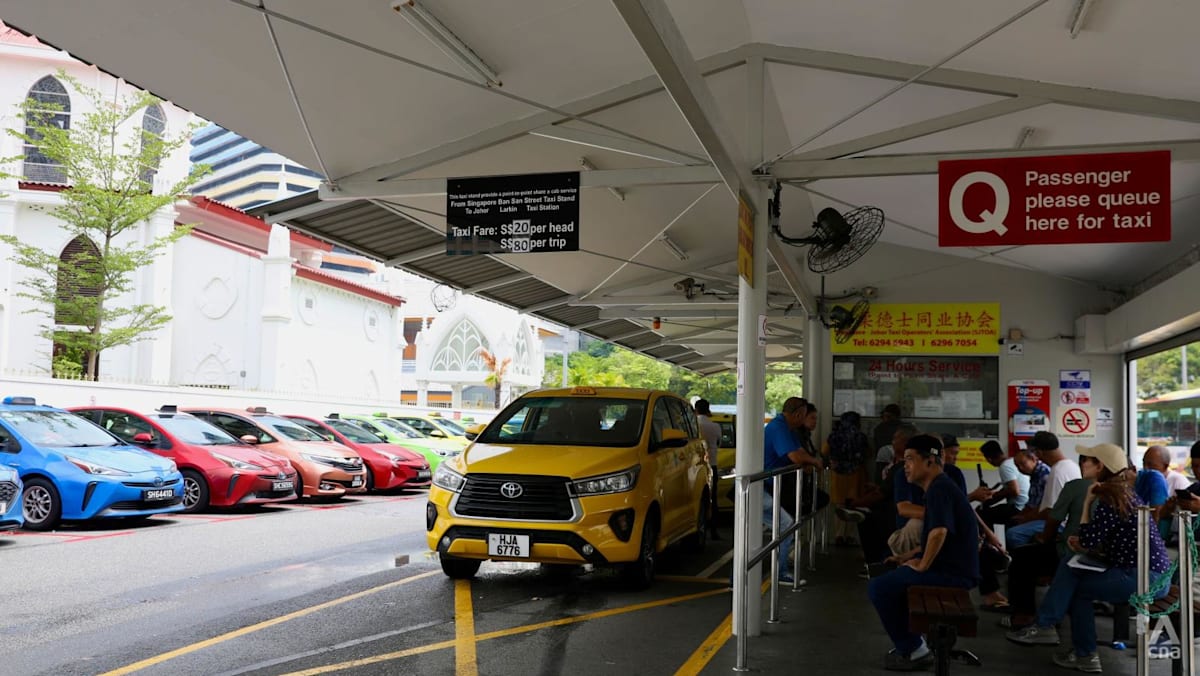
Commuters, drivers flag concerns as enhanced Singapore-Malaysia taxi service kicks off
Commuters and drivers on both sides of the Causeway say the new service – with more pick-up and drop-off points among other features - offers more choices but at a higher cost, while experts say it would reduce the “first-mile and last-mile friction”.
JOHOR BAHRU/SINGAPORE: At 10am on Monday (May 4), 57-year-old Malaysian taxi driver Shaban Shawal was still waiting for his first passenger at Johor’s Larkin Terminal to take across the border to Singapore.
“Usually by this time, I would have made my first trip … Just this morning, I saw four people walk away because they were shocked by the new price,” he told CNA.
A new enhanced cross-border taxi scheme which took effect on Monday, has introduced a range of new flexible drop-off points and additional pick-up locations. But the change comes at a cost.
Fares for street-hail rides from Ban San Street Terminal are now S$80 (US$63) for a standard four-seater, while trips from Larkin Terminal in Johor Bahru cost RM240 (US$61).
Previously, fares were S$60 or RM120 per trip, cross-border taxi drivers from both countries told CNA.
“While there are now more choices for passengers, it is too expensive for them so we have yet to see any positive impacts but it is only the first day. Maybe after a month, we can better assess,” said Shaban.
The enhancements to the cross-border taxi scheme were announced on Thursday by the transport ministries of both countries.
Under the new rules, Singapore taxis can now pick up passengers not only at Larkin Terminal, but also at Toppen Shopping Centre, Mid Valley Southkey Mall and Angsana Mall.
In Singapore, Malaysia taxis can now pick up passengers near VivoCity, Century Square Shopping Mall and Joo Koon MRT, in addition to Ban San Street Terminal.
Malaysian taxis can drop off passengers anywhere in Singapore, while Singapore-registered taxis can drop passengers anywhere in Johor Bahru, Iskandar Puteri, Forest City, Kulai and Senai.
Malaysian taxis are also allowed to drop off passengers anywhere in Malaysia, including areas outside Johor, such as capital Kuala Lumpur and Melaka, Mohd Suhaimi Saidi, the president of the Singapore-Johor Taxi Association who manages Malaysia-registered cabs at Larkin Terminal, told CNA.
For years, cross-border taxis travelling between the two countries could only pick up and drop off passengers at a single designated point in the other country - the Ban San Street Terminal in Singapore’s Bugis area and the Larkin Terminal in Johor Bahru.
The fact that taxis could not offer door-to-door services allowed illegal operators to fill the gap, drivers previously told CNA.
Both countries have acknowledged the demand for more convenient cross-border transport services, and the changes are part of efforts to increase transport connectivity between them.
But Suhaimi said that while his industry is “grateful” for the added flexibility, he expects some teething problems, especially as some passengers and drivers raise concern over higher fares and potential operational challenges.
“With any change, there may be some initial adjustment at the beginning, including the fare changes approved by both governments which may feel burdensome to passengers,” Suhaimi said.
COMMUTERS WORRY ABOUT HIGHER PRICES
CNA spoke to commuters, drivers and businesses at key pick-up points, including Larkin Terminal and Ban San Street Terminal, as well as newly designated locations such as Mid Valley Southkey Mall and VivoCity, on the first day of the enhanced scheme.
For 39-year-old Singaporean Hartini Hamzah, the new rules could make cross-border travel more convenient.
“We don’t have to come all the way here to Ban San (Street Terminal) and we may also be able to drop off nearby our location,” she told CNA, adding that she would prefer to be picked up at Century Square mall in Tampines, which is among the additional drop-off points.
The same fares of S$80 or RM240 for a standard four-seater will apply for trips up to 35km, with an additional $20 charge for longer journeys.
However, some other travellers CNA spoke to felt the price hike was too high to make the cross-border trip worthwhile.
Singaporean librarian, Faizah Sulaiman, 59, who used to accompany her sister to get groceries at the market at Larkin Terminal said that the price increase was too steep, after she was told by the licensed taxi drivers that her ride back to Tampines would cost about $100, as it is located more than 35km from Larkin.
“Even if I have the money, I think it is expensive … it might be more worth it to get groceries at NTUC (a supermarket in Singapore) than to come here,” she told CNA.
Singaporean Benson Hariman, 68, is a regular at Ban San Street Terminal and a familiar face to cross-border taxi drivers – but instead of waiting his usual 30 minutes for a cab, he found himself waiting nearly two hours on Monday morning.
While there were plenty of taxis at the terminal, there were no passengers arriving who could share the S$80 fare to Larkin Terminal, and he attributed this to the price hike.
“The increase is not a little bit, it is a lot. What is the reason to increase the price?” he said.
He eventually left for Larkin Terminal in a shared two-person cab and paid S$40. If all four seats are filled, the lowest possible fare comes to S$20 per passenger.
Larkin Terminal and Ban San Street Terminal are the only two locations where passengers can share a ride and split the cost, as long as they are going to the same destination.
For trips beyond 35km, which can go up to around S$100, drivers are not allowed to make multiple drop-offs along the way. So passengers who want to share and split the fare for these longer journeys would not be able to do so.
While some passengers bemoaned the increased fares, some drivers whom CNA spoke to defended the hike.
Malaysian taxi driver Mohd Rizal said the price increase is reasonable due to the increasing cost of operati