
Colombia Earthquake Provides Insight into Risks for Urban Building Structures
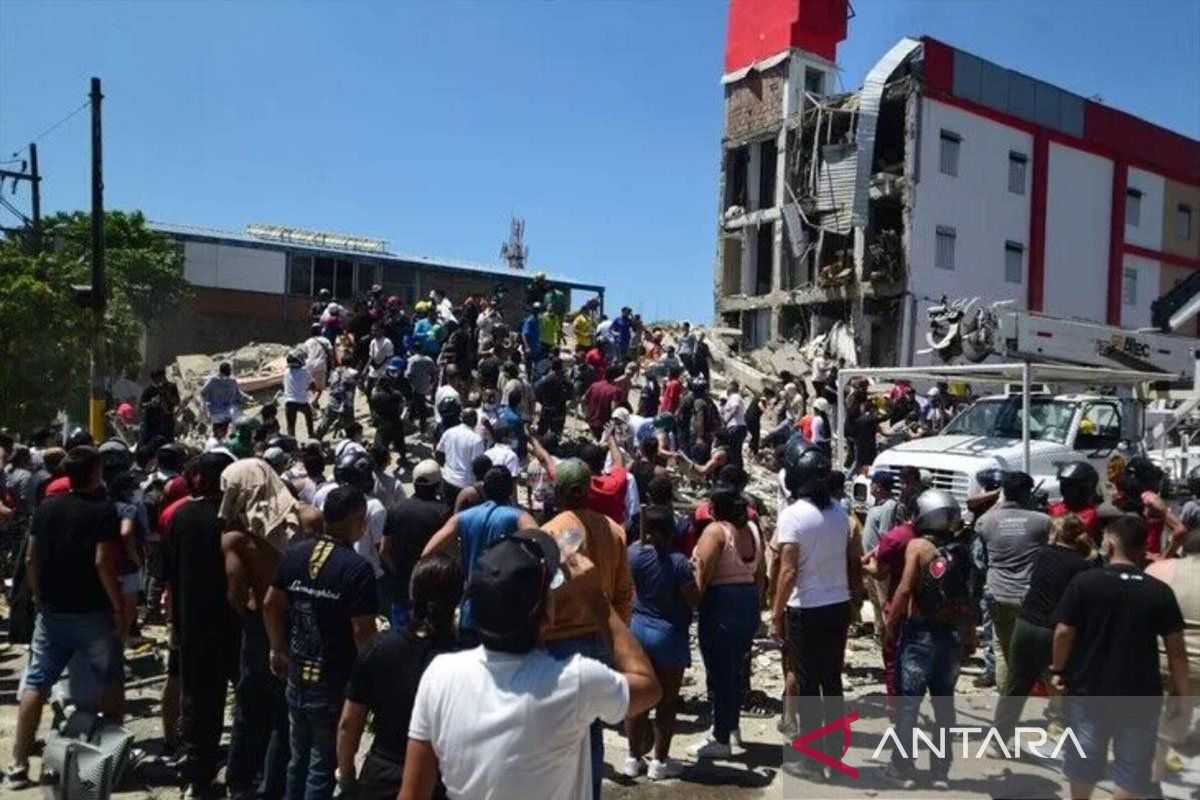
Jakarta (ANTARA) - An expert from the Indonesian Association of Disaster Experts (IABI), Daryono, has stated that the seismotectonic phenomena of the magnitude 7.4 earthquake in Colombia provide a comprehensive understanding of subducting plate mechanisms and their risks for structural failure in urban areas.
In a statement in Jakarta on Tuesday, he said that the seismic wave shocks from within the intraslab triggered high Peak Ground Acceleration (PGA), which had a fatal impact on multi-storey buildings in urban areas.
“This sudden inertial force acts directly on the mass of multi-storey buildings and masonry structures, triggering a soft-story failure phenomenon due to lateral loads exceeding the capacity of the main supporting elements,” he said.
He explained that the structure’s inability to withstand inter-storey drift leads to progressive collapse or total pancake collapse, hurling brittle concrete debris onto roadways.
The sudden building collapse generated a massive, thick dust plume that blanketed residential areas and crippled visibility, triggering secondary hazards such as fires caused by damage to energy networks.
Parametrically, the Chocó earthquake that shook Colombia on 10 August 2026 at 19:34 Western Indonesian Time was centred on land at an intermediate depth of 110.3 kilometres, precisely 5 kilometres south of San José del Palmar, with a provisional toll of 132 fatalities.
Daryono explained that the source of the quake was the tearing of the Nazca Plate subducting beneath the South American Continental Plate along the Colombia-Ecuador-Peru-Chile subduction system, rather than a megathrust event on the plate interface.
Internal deformation within the subducting plate released high-frequency seismic waves that propagated very efficiently through the cold, dense plate material, resulting in highly destructive ground shaking at the surface even though it did not trigger a tsunami.
The series of physical damages to the built environment in Colombia is considered an important lesson for other countries, including Indonesia, which has a similar plate subduction setting along the Indian Ocean to eastern Indonesia.
“The efficiency of wave propagation that damages non-standard buildings and triggers structural failure underscores the importance of strict audits of earthquake-resistant building codes, seismic risk mapping, and strengthening preparedness for secondary hazards in dense urban areas,” Daryono stressed.