
Collapse of Nepal Glacier Triggers Massive Landslide at China's Gyirong Port
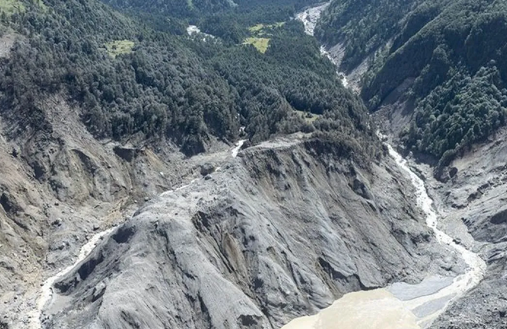
A massive landslide hitting Gyirong Port, the primary border crossing between China and Nepal in the Xizang Autonomous Region, was triggered by the collapse of a glacier in the Nepalese highlands. The disaster, which occurred on Wednesday (26/8) morning local time, highlights the serious threat of increasingly frequent glacial disasters caused by global warming.
According to the latest official data as of Friday (28/8) at 15:00 local time, five people have been confirmed dead, while 558 others remain missing. Rescue efforts are facing severe challenges as the mud layer in the core disaster area has reached depths of more than 1.5 metres.
Satellite imagery analysis by Chinese geological experts shows that glaciers at altitudes of 5,200 to 5,400 metres experienced severe cracking. Kang Shichang, Director of the Institute of Mountain Hazards and Environment at the Chinese Academy of Sciences (CAS), explained that the collapsing ice dragged rock debris with it, forming a glacial debris flow.
CAS academic Yao Tandong described this phenomenon as a “classic disaster chain effect”. According to experts, once the glacier collapsed, it was not just ice sliding down. Large amounts of ice and rock debris slid down mountain riverbeds, continuously gathering material and momentum as they moved downstream.
“The further it slides downstream, the greater its destructive power and the more evident the secondary risks become,” said Yao.
The highland ice slide evolved into a high-speed debris flow that gathered material and momentum while descending mountain riverbeds. The flow speed is estimated to have reached 50 metres per second, leaving residents at Gyirong Port with practically no time to react.
“Precisely, this is a chain disaster formed through the continuous evolution of highland ice slides into high-speed debris flows and landslides,” added Guo Zhaocheng, an expert from China’s Ministry of Natural Resources.
Ouyang Chaojun, a mountain hazard expert at CAS, summarised the three main factors that made this disaster so deadly:
First, Gyirong Port is a national first-class land port with intense trading activity. The incident, occurring during midday working hours, exacerbated the risk of casualties due to the high number of people present when the landslide material struck.
Second, the Qinghai-Tibet Plateau, known as the Earth’s “Third Pole”, holds the largest concentration of glaciers outside the North and South Poles. Scientists warn that global climate warming since the 1990s has led to widespread glacier shrinkage.
Third, continuous melting has made glacier structures unstable and more sensitive to external disturbances. Kang Shichang emphasised that reducing greenhouse gas emissions is the long-term key to suppressing the frequency and severity of similar glacial disasters in the future.
Source: jawawa.id (https://jawawa.id/newsitem/collapse-of-nepal-glacier-triggers-massive-landslide-at-chinas-gyirong-port-1788083526)
Originally published by Media Indonesia (https://mediaindonesia.com/internasional/927633/runtuhnya-gletser-nepal-picu-longsor-dahsyat-di-pelabuhan-gyirong-tiongkok), translated from Indonesian