
Collaboration Strengthens Sustainable Forest Management
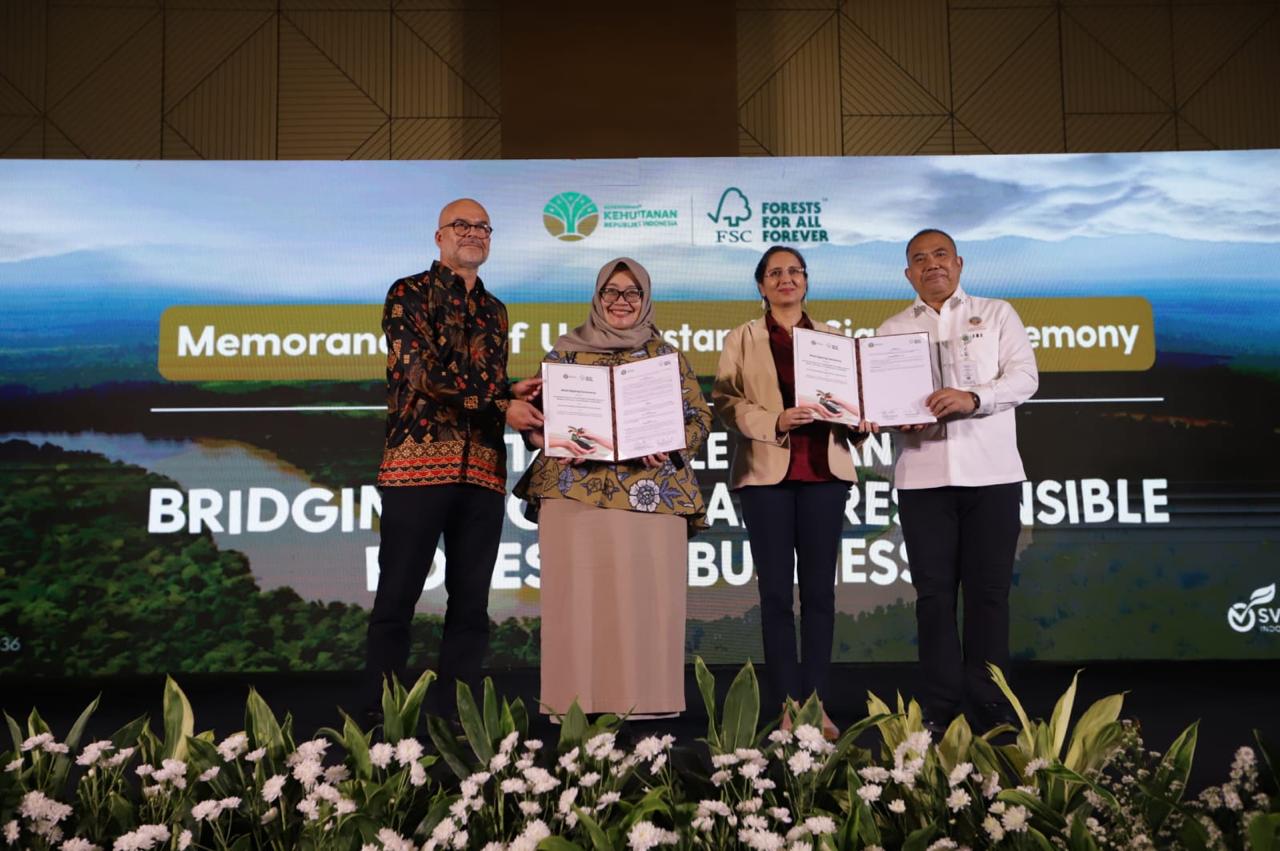
Driven by the increasing global demand for forest products and the necessity of environmental preservation, stakeholder collaboration is seen as key to strengthening sustainable forest management. With global demand for wood products projected to rise by more than 40% by 2050 compared to 2020, the need to balance conservation efforts with the sustainable use of forest resources has become increasingly vital.
In response to these conditions, the Directorate General of Sustainable Forest Management (Ditjen PHL) of the Ministry of Forestry and the Forest Stewardship Council (FSC) are strengthening their cooperation to promote sustainable forest management while increasing the long-term benefits of forests for both society and the environment. This commitment was formalised through the signing of a Memorandum of Understanding (MoU) between Ditjen PHL and FSC on Tuesday (30/6).
The agreement aims to strengthen the synergy between Indonesia’s Timber Legality and Sustainability Verification System (SVLK) and FSC certification to increase efficiency, strengthen forestry governance, and expand market access for Indonesian forest products. The MoU was signed by the Director General of Sustainable Forest Management, Laksmi Wijayanti, and the Director General of FSC International, Subhra Bhattacharjee. The signing ceremony was attended by government representatives, business actors, civil society organisations, certification bodies, industry associations, and various forestry stakeholders from both Indonesia and abroad.
Through this partnership, both parties will develop a joint audit mechanism between SVLK and FSC. This scheme will allow both certification systems to be assessed simultaneously by a single audit team in one process, thereby saving time and costs, reducing duplication, and maintaining the credibility and integrity of each system.
The scope of cooperation also includes developing joint audits ranging from forest management levels to exporters and importers, improving forest management performance, aligning the remedy framework to support the Forestry and Other Land Use (FOLU) Net Sink 2030 targets, increasing human resource capacity, strengthening networks and the promotion of sustainable forest management, exchanging market data and information, and expanding market access for Indonesian forest products that meet SVLK and FSC standards.
Laksmi Wijayanti, Director General of Sustainable Forest Management at the Ministry of Forestry, stated that the partnership is expected to strengthen synergy in improving Indonesian forestry governance and boosting the competitiveness of the national forestry sector in both domestic and international markets. “Through this collaboration, we want to strengthen the synergy between national and international approaches to sustainable forest management to provide real benefits for the environment, society, and forestry-based businesses,” she said in an official statement.
She expressed hope that the development of the joint audit mechanism between SVLK and FSC could drive improvements in forestry governance and strengthen global market confidence in Indonesian forest products, ultimately creating greater added value for sustainable forest managers in Indonesia.
Meanwhile, the Director General of FSC International, Subhra Bhattacharjee, noted that Indonesia holds a strategic position in global forestry, through its tropical natural forests, plantations, and community-managed forests, which are vital parts of the global supply chain. Indonesia is described as occupying a unique position in our global strategy, with vast tropical forests, indigenous communities protecting culturally significant landscapes, and great potential to meet the rising demand for sustainably sourced forest products.
The partnership between SVLK and FSC is considered strategic in demonstrating the benefits of responsible forest management. Through the development of the SVLK–FSC joint audit mechanism, FSC seeks to align various certification schemes so that the audit process becomes more efficient and non-overlapping. This approach also opens wider economic opportunities for Indonesian forestry businesses by increasing the competitiveness of certified wood products in domestic and international markets.
“We believe the synergy between the Indonesian Government, the business community, and FSC will serve as a collaboration model that can inspire other parties in realising the vision of resilient forests capable of sustaining life on Earth,” said Subhra.
Following the MoU signing, FSC and the Ministry of Forestry are scheduled to conduct a field visit to Katingan Regency, Central Kalimantan, to review FSC-certified rattan management practices carried out by the Katingan Rattan Farmers Association (P2RK). This visit serves as an example of implementing sustainable forest management that focuses not only on timber production but also on the utilisation of non-timber forest products and environmental services that create economic and social value while preserving environmental sustainability.