
Collaboration Realises Renewable Energy: Pasar Kepandean Serang Becomes an Energy-Independent Market
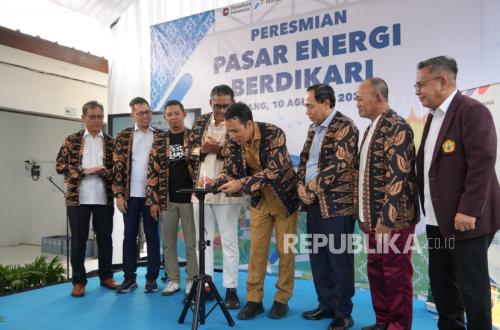
The sun that shines daily on Serang City now not only illuminates residents’ activities but is also harnessed to support economic activity at Kepandean Market. Through a solar power plant (PLTS), solar energy is converted into clean energy used to support traders’ activities while encouraging the creation of a more comfortable and sustainable market.
The initiative was delivered through the Self-Reliant Energy Market Programme (PEB), a traditional market empowerment model based on renewable energy that integrates the use of clean energy with capacity building and economic strengthening for micro, small, and medium enterprise (MSME) players. The presence of PEB at Kepandean Market is a form of collaboration between Pertamina, Pertamina Foundation, universities, the Serang City Government, and other partners to bring the benefits of renewable energy to the community level.
Pertamina Foundation President Director Agus Mashud S. Asngari said that the Self-Reliant Energy Market is an innovation that not only provides clean energy installations but also connects the use of renewable energy with strengthening the community’s economy, carried out through collaboration.
“The Self-Reliant Energy Market is a Pertamina innovation. In its implementation, this PLTS has a capacity of 4 kWp and is able to provide benefits in electricity savings for traders at Kepandean Market. We want clean energy to be closer to the community and become part of daily economic activity. Therefore, this programme does not stop at installing the PLTS, but is also complemented by clean energy education and strengthening traders’ capacity so that its benefits can continue to be felt and managed sustainably,” said Agus.
In developing the PEB at Kepandean Market, Pertamina Foundation also involved Pertamina University in the PLTS installation process.
The PEB programme has three main outputs: clean energy installation, clean energy education, and the use of clean energy to support the market economy. With this approach, the PLTS is not only energy infrastructure but also an educational tool and part of efforts to create more sustainable market economic activity.
Furthermore, in order to welcome National MSME Day, Pertamina through Pertamina Foundation collaborated with the Serang City Government to hold PLTS operational training for culinary traders at Kepandean Market.
The training provided an understanding of the safe and proper operation and use of the PLTS. Traders are expected to be able to use PLTS energy well in supporting their daily business activities.
In addition to clean energy education, MSME capacity building was also carried out through collaboration with Tugu Insurance in the form of business financial literacy training. The material was aimed at improving traders’ ability to manage business finances so as to support the sustainability and growth of MSMEs.
Also present was Deputy Mayor of Serang Nur Agis Aulia, who welcomed the collaboration between companies, universities, and the Serang City Government in delivering benefits to the community.
“We very much welcome the collaboration between companies, universities, and the Serang City Government. This programme not only provides renewable energy through the PLTS, but also provides education and capacity building to traders. It is hoped that the existence of this PLTS can be used and maintained sustainably so that it provides long-term benefits and helps improve the economy of traders at Kepandean Market,” said Nur Agis.
The activity was also part of the series of events marking the 19th Anniversary of Serang City, while strengthening the spirit of collaboration in encouraging sustainable development and strengthening MSMEs as one of the drivers of the community’s economy.
To ensure the PLTS can be utilised optimally in the long term, Pertamina Foundation involved Pertamina’s Sobat Bumi (Sobi) from Sultan Ageng Tirtayasa University in monitoring and evaluating the use and operation of the PLTS at Kepandean Market.
The involvement of Sobi is part of efforts to maintain the sustainability of clean energy use in the market. Through monitoring and evaluation activities, the condition and use of the PLTS can be monitored regularly so that the equipment can be maintained and used properly.
Student involvement also provides space for the younger generation to contribute directly to the application of renewable energy as well as community empowerment. This broadens the meaning of PEB collaboration, not only between corporations and government, but also involving universities and the younger generation.
For traders, the benefits of the PLTS can be felt directly in daily business activities. Haryati, one of the traders at Kepandean Market, said that the use of the PLTS helps save electricity usage at her stall.
“The existence of this PLTS is very helpful in saving electricity usage at the stall. We also gained knowledge about how to use PLTS energy better. Hopefully this programme can continue and provide benefits for traders at Kepandean Market,” said Haryati.
Through the Self-Reliant Energy Market, collaboration between various parties is key to delivering renewable energy that provides real benefits to the community. From PLTS installation, clean energy education, MSME capacity building, to monitoring and evaluation, the entire programme series is directed at building a clean energy ecosystem that can operate sustainably.
Kepandean Market is expected to become an example that renewable energy can grow side by side with community economic activity, while being part of efforts to create a traditional market that is more comfortable, efficient, and sustainable.