
Collaboration in Facing the Impacts of Climate Change in Indonesia
Tidal flooding in the coastal areas of Pekalongan, changing rainfall patterns threatening the agriculture of the Kajang indigenous community in Bulukumba, declining Toraja coffee productivity due to extreme weather, and increasing urban flood risks in Samarinda demonstrate that climate change has become a reality for the Indonesian people.
Although the impacts vary by region, experiences from these various areas show a commonality: climate resilience requires collaboration between the government, society, local communities, the private sector, and development partners to create solutions tailored to community needs.
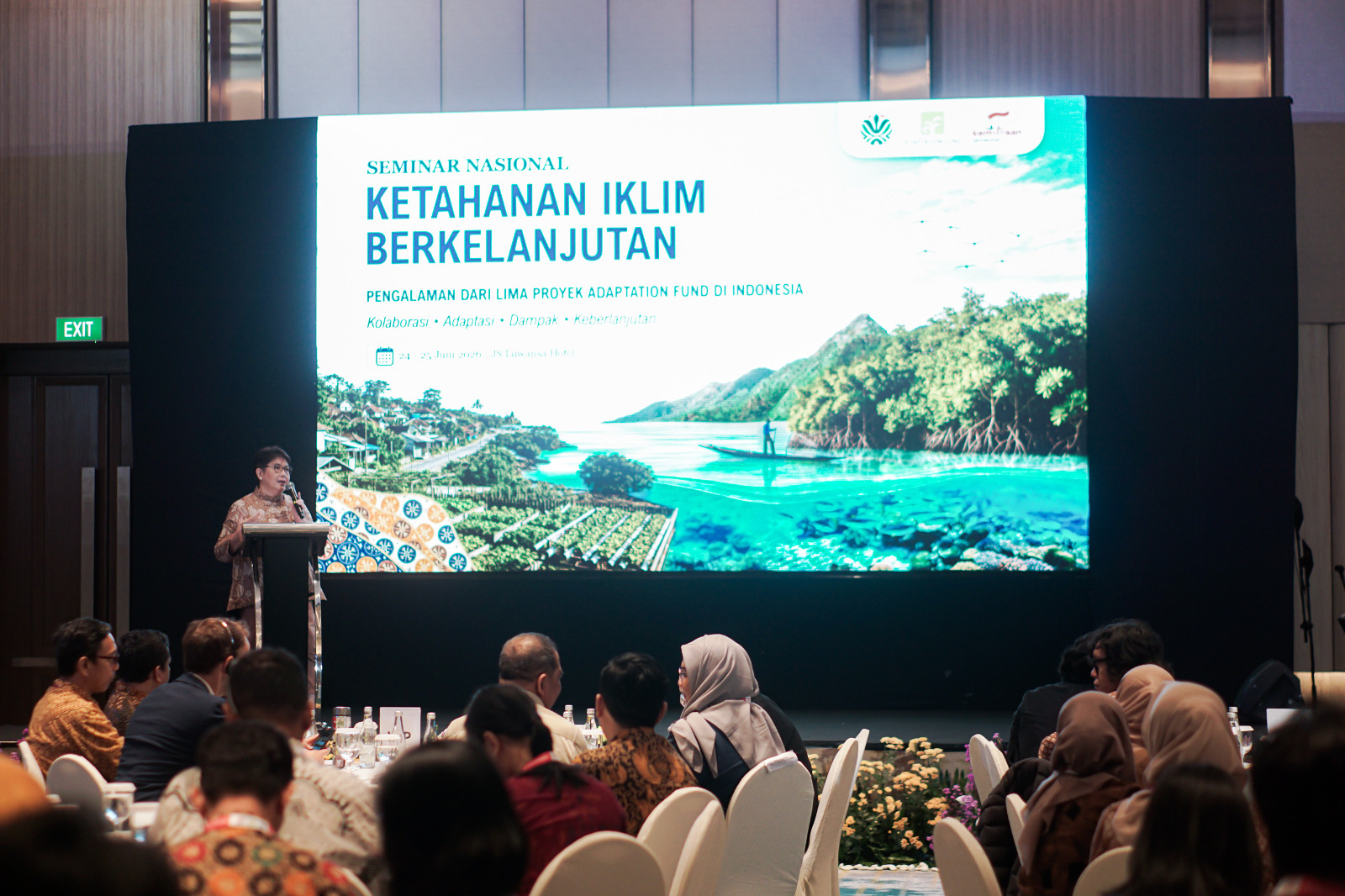
This lesson was a primary focus of the National Seminar on Climate Change Adaptation, organised by KEMITragan in collaboration with the Ministry of Environment and supported by the Adaptation Fund (AF). Franky Zamzani, Director of Climate Change Adaptation at the Ministry of Environment/Environmental Management Agency, stated that the ministry has made climate change issues a priority in national development programmes.
“The national government, through Asta Cita, places climate change issues as a strategic pillar in national development, particularly through green economy and climate resilience missions. Therefore, the government, through various national development policies, continues to encourage the strengthening of regional and community capacity in facing the impacts of climate change, including through the development of various community-based adaptation initiatives,” he said. According to Franky, good practices developing in the regions need to become part of the national solution in facing the climate crisis. “What is being done by the communities in Pekalongan, Bulukumba, Toraja, or Samarinda shows that adaptation solutions born from local needs are often the most effective. Our challenge is to strengthen, replicate, and integrate these lessons into broader development policies,” he added.
Since 2019, the Ministry of Environment, through the Deputy for Climate Change Control and Carbon Economic Value Governance, and KEMITRAAN, with support from the Adaptation Fund (AF), have implemented climate change adaptation programmes in five Indonesian regions with different climate impacts. In Pekalongan City, communities face the threat of tidal flooding and rising sea levels affecting residential areas and the economic activities of coastal communities.
In Bulukumba Regency, changes in weather patterns impact the agricultural sector and the livelihood security of the Kajang indigenous people. Meanwhile, in four regencies within the Saddang River Basin in South Sulawesi Province, extreme weather has reduced the production of the world-renowned Toraja Coffee commodity. In Samarinda City, the risk of urban flooding and extreme weather presents a challenge that must be anticipated through the strengthening of governance and community capacity.
Through this programme, various parties are encouraged to strengthen community adaptation capacity, improve development planning that is responsive to climate change, and build collaboration between central government, regional government, village government, community groups, and vulnerable groups.
Hugo Remaury, a representative of the Adaptation Fund, emphasised that his organisation supports various initiatives aimed at strengthening community resilience to the impacts of climate change worldwide, including in Indonesia. The Adaptation Fund (AF) is an international funding mechanism established as part of the global commitment to support various community initiatives in adapting to climate change.
“The Adaptation Fund was established based on the decision of the Conference of the Parties (COP) to the United Nations Framework Convention on Climate Change (UNFCCC), with the aim of financing projects and programmes that help vulnerable communities in developing countries adapt to climate change. This funding is based on the needs, views, and priorities of each respective country,” he explained.
According to Hugo, the success of climate change adaptation depends heavily on the ability to provide solutions that meet the needs of local communities. “Communities on the front lines facing the impacts of climate change are not just beneficiaries, but also sources of knowledge and innovation. Experience in Indonesia shows that when climate funding is combined with local ownership, community leadership, and strong collaboration, the resulting impact is more inclusive, sustainable, and responsive to the real needs of the community.”
He added that various lessons from project sites in Indonesia can serve as examples of how investment in climate change adaptation can produce social, economic, and environmental benefits simultaneously.
Meanwhile, the Executive Director of KEMITRAAN, Nurina Widagdo, emphasised that every region faces different climate challenges, requiring a contextual approach. “There is no one-size-fits-all solution for all regions, and what we have learned from Pekalongan, Bulukumba, Tana Toraja, three other areas in South Sulawesi, and Samarinda is that adaptation success arises from the ability to bring together community needs, government commitment, local knowledge, and the support of various partners into a single collaborative space,” she explained.
According to Nurina, strengthening climate resilience must go hand in hand with strengthening community capacity and creating sustainable alternative livelihoods. “Adaptation is not just about surviving the impacts of climate change, but ensuring that communities have the capacity, resources, and opportunities to continue to thrive amidst change.”