
Coconut Farmers Switch to Palm Oil as Prices Fluctuate, Ministry Reveals
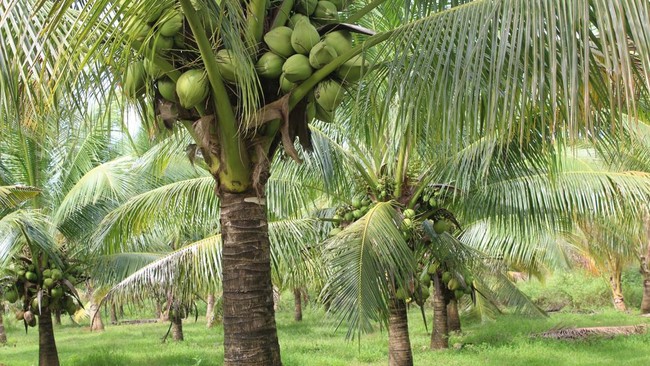
The Ministry of Agriculture has revealed one of the causes behind the continuous shrinking of national coconut plantations. Besides being affected by disasters and pest attacks, many farmers are beginning to abandon the coconut commodity and switch to planting oil palm because coconut prices have tended to be low and volatile.
Agricultural Product Quality Supervisor at the Directorate General of Plantations, Ministry of Agriculture, Agus Rosyid Wasingun, stated that the declining trend in coconut area and production has been ongoing for several years. This condition is triggered by various factors, ranging from land conversion to the switch from coconut plantations to other commodities deemed more profitable.
“The trend for area and production is indeed continuously declining. There are many factors, including conversion to infrastructure, then some areas were affected by disasters last year in three provinces, then there were pest attacks, and then the main issue is actually price stability, which sometimes makes farmers impulsively look at other commodities, in this case I would say a sibling commodity, for example oil palm, which tends to have stable prices. This is certainly concerning and we will address it,” Rosyid said during a Sinar Tani Coconut Downstreaming Webinar on Wednesday (22/7/2026).
Moreover, the price issue remains a task for the government. Agus revealed that although coconut prices began to improve in 2026, farmers have not fully enjoyed the increase because the price gap between the farm level and traders remains wide.
“Prices tend to fluctuate and I would say they have been low for quite a long time. For example, in 2025 the lag was quite high between the collector price and the farmer price, around Rp2,000. In 2026 it started to improve, the lag was not too far, but recently when I went down to the field it returned. When production is normal, the price at the farmer level lags far behind the traders and collectors again. This is certainly our task together,” he said.
According to Agus, the long supply chain is one of the causes of the wide price gap between farmers and traders. This condition reduces farmers’ motivation to maintain their coconut plantations and even encourages some to switch to other commodities.
“Then the long supply chain causes a wide price gap between farmers and traders or collectors. Then the limited availability of certified superior seeds, because with superior seeds, 30% of production success can be achieved, but they are still limited and many still use local superior seeds,” he explained.
“Then the decline in area and production certainly causes a decline in productivity. Then, for almost a decade, productivity has not been able to increase,” Rosyid continued.
Nevertheless, he assessed that the prospects for Indonesia’s coconut commodity remain very promising. Global demand continues to rise, and Malaysia still depends on coconut supply from Indonesia.
“The opportunity is that global demand is indeed large and several countries have already started. For example, Malaysia, where almost 89% of its coconut needs come from Indonesia. So, when there was a shortage two years ago, they came to the ministry to request that coconut exports not be stopped, but rather regulated. That is how high their concern is, that 89% of Malaysia’s coconut needs are met by Indonesia. Then the export opportunity is also quite large,” he revealed.
For this reason, the government continues to encourage downstream processing as an effort to increase added value while improving farmer welfare. Rosyid said that downstream processing not only aims to strengthen the domestic processing industry but also to create better partnerships between farmers and businesses, so that raw material supply is maintained while farmers receive more decent prices.
“Actually, this year the downstream processing is already underway. We are also collaborating with Danantara, targeting 500,000 hectares, but the state budget may only be able to cover around 221,000 hectares until 2027. The rest we will partner with the private sector, PTPN, and so on. Alhamdulillah, PTPN has also started working hard in East Java, building a core coconut plantation and will expand to plasma plantations,” he concluded.
Source: jawawa.id (https://jawawa.id/newsitem/coconut-farmers-switch-to-palm-oil-as-prices-fluctuate-ministry-reveals-1784721194)
Originally published by CNBC Indonesia (https://www.cnbcindonesia.com/news/20260722150506-4-752937/satu-per-satu-petani-kelapa-hilang-banting-setir-ke-sini-ada-apa), translated from Indonesian