
Cocoa sows new hope on the nation's frontier through agroforestry
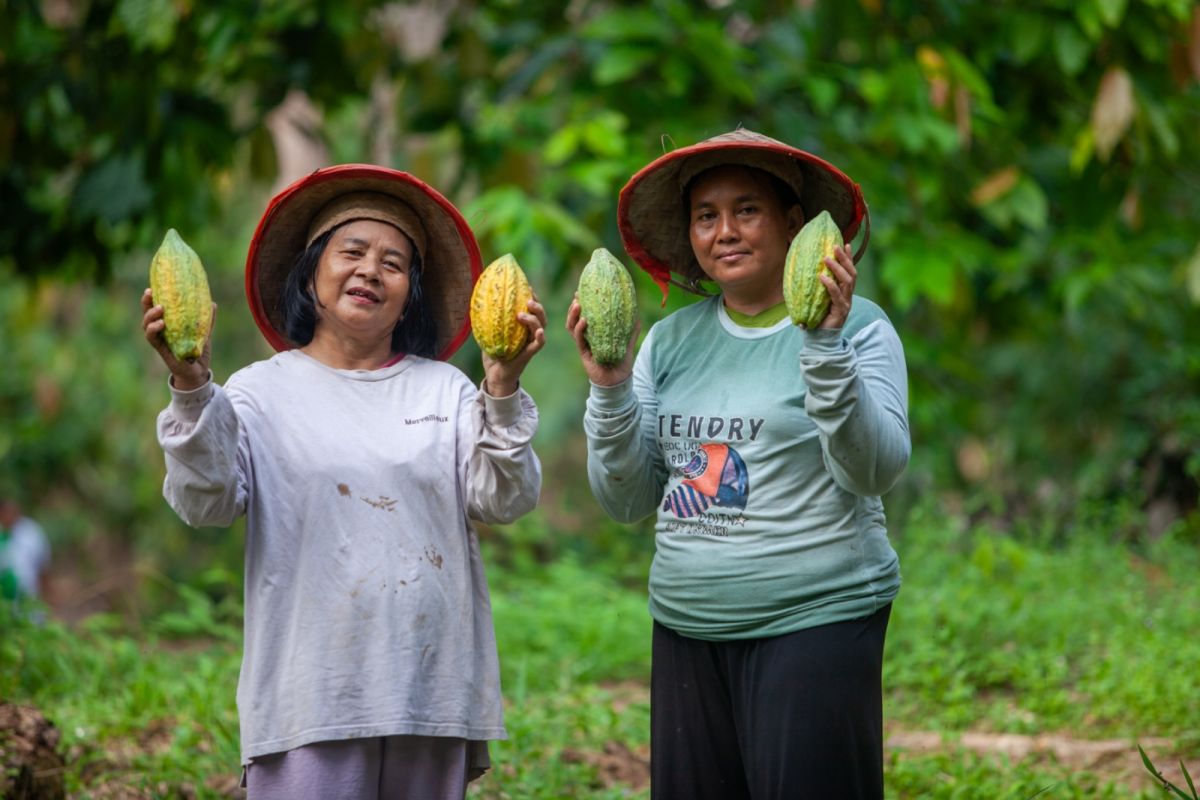
Slowly, Maria Tulia lifts a 30-centimetre wooden stick, two centimetres in diameter. She strikes the skin of the cocoa fruit piled in her harvest container.
For cocoa farmers in Nekan Hamlet, Sanggau, West Kalimantan, each strike to break the fruit is an effort to secure a livelihood from the plantation she has tended for years. The split skins reveal wet cocoa beans, ready to be separated and sold to a cooperative.
In this border region between Indonesia and Malaysia, this activity holds new hope. Cocoa is no longer just a shade plant in the backyard, but is beginning to become a promising economic mainstay.
Maria has been cultivating cocoa for about eight years. On a one-hectare plot, approximately 200 cocoa trees now grow. She has even begun expanding her plantation with an additional half-hectare of land. The ideal planting distance of about four metres between trees provides enough space for the plants to grow lushly and bear heavy fruit.
However, this journey has not always been smooth. Cocoa plants require consistent care. Fungal attacks and leaf drop are serious threats that can kill the plants if not handled correctly. For Maria, a deep understanding of cultivation techniques is key to keeping her plantation productive.
“The challenge lies in the maintenance. Fungi can cause leaves to drop and even kill the plants, so that must be controlled. We greatly need good cultivation knowledge so that the results can be maximised,” she said.
In a single harvest, Maria’s plantation can produce about 40 kilograms of wet cocoa beans. With a harvest frequency of twice a month and prices ranging from Rp15,000 to Rp20,000 per kilogram, the results are quite decent.
That figure might seem simple. However, for Maria, cocoa has become a valuable alternative income amidst the residents’ dependence on other commodities, particularly rubber.
Previously, rubber was the economic backbone for local farmers. When cocoa began to be introduced about eight years ago, not many took interest. Farmers planted haphazardly without adequate knowledge, compounded by plummeting prices.
“In the past, we just planted randomly and the prices were low. Even after being dried, they were only valued at around Rp19,000 per kilogram,” Maria recalled.
The situation is gradually improving thanks to assistance and improvements in the marketing chain. The presence of Kalara Borneo, alongside partner cooperatives, provides market certainty while boosting selling prices. Now, dried cocoa beans from farmers can even be valued at up to Rp60,000 per kilogram.
Maria and other farmers now prefer to sell wet cocoa beans because it is much more practical. After harvesting, they simply break the fruit and collect the beans to be deposited to the cooperative. Complex processes such as fermentation and drying are handled entirely by the cooperative.
“Previously, we did everything ourselves, but the price remained low. Now, we just harvest, break, and sell. The Kalara Borneo partner cooperative handles the fermentation process,” Maria said.
For Maria, this change is not just about the monetary value. Market certainty provides the motivation for farmers to diligently care for and expand their plantations. She hopes cocoa prices will continue to be stable and improve so that more residents are encouraged to engage in this business.
“The hope is that prices remain good and stable. Now, most residents are already planting cocoa. This is a new hope to increase income alongside rubber,” she said.
Maria’s story is just a small part of the larger effort to build a cocoa ecosystem in West Kalimantan. Behind the lushness of the farmers’ plantations, there is a long process to ensure local cocoa beans can meet market standards. One of the drivers behind this effort is Kalara Borneo.
The owner of Kalara Borneo, Yohana Tamara, revealed that the development of cocoa was officially pioneered by her company since 2021. However, her interest in this commodity has grown since 2018 when she was stationed in Sintang Regency.
At that time, she found that the majority of residents’ plantations still relied on a monoculture system. Dependence on a single type of crop makes the farmers’ economy very vulnerable when commodity prices plummet. This condition prompted her to seek a solution through crop diversification.
“I thought, why do we always rely on monoculture plantations? Once the price of the main commodity falls, farmers are immediately affected. From there, the thought arose: why not try crop diversification?” she said.
A turning point in this journey occurred when Yohana attended a conference in the Philippines in 2018. Her perspective opened up when she learned about cocoa development methods based on agroforestry. The concept of integrated land use is what inspired her to cultivate cocoa in West Kalimantan.
Currently, Kalara Borneo’s cocoa development has reached several areas, including Kapuas Hulu, Sintang, and most recently Sanggau. The model applied no longer leaves farmers to struggle alone with production and marketing issues.
Farmers receive intensive assistance to implement Good Agricultural Practices (GAP). After harvest, wet cocoa beans are sold to the cooperative to undergo post-harvest processes, including fermentation and drying. Once transformed into high-quality dried beans, Kalara Borneo purchases them to be processed and marketed to the downstream sector.
“The ecosystem has indeed been formed. Farmers sell wet beans to the cooperative, then the cooperative manages the post-harvesting. Once dried, they are then sold to Kalara Borneo,” Yohana explained.
According to her, this scheme provides two vital guarantees for farmers: market certainty and price stability. Currently, there are three cooperatives overseeing approximately 162 farmers within the ecosystem. In Sanggau alone, 45 farmers have joined the programme.