
Coastal Lands in Batang Become Productive Again Through Biosaline Rice Cultivation
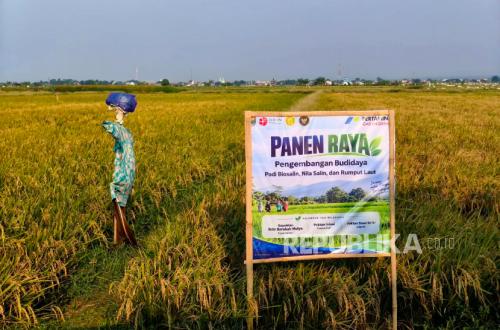
The challenges of El Niño and high salinity levels in coastal lands have not hindered agricultural productivity in Batang Regency, Central Java. A collaboration between PT Perusahaan Gas Negara (Persero) Tbk (PGN), Pertamina’s Gas Subholding, the National Research and Innovation Agency (BRIN), and the Batang Regency Government has successfully produced approximately 166.5 tonnes of harvested dry grain (GKP) through Biosaline rice cultivation, with an economic value reaching Rp 1.3 billion.
These results were showcased during the Grand Harvest of Biosaline Rice in Batang Regency on Friday (18/09/2026), as part of the CSR programme for the Development and Cultivation of Biosaline Rice Varieties and Saline Rice-Fish Farming in High Salinity Areas.
This achievement is particularly significant amidst challenging climatic conditions. According to data from the Meteorology, Climatology, and Geophysics Agency (BMKG), the average three-month ENSO index for the July–September 2026 period was recorded at 2.6, placing it in the very strong El Niño category. As of the first ten-day period of September, approximately 80.7 per cent of Indonesia’s seasonal zones had entered the dry season.
Such conditions pose a challenge to the agricultural sector, especially in coastal areas facing water scarcity and salinity caused by seawater influence and tidal flooding (rob). In Batang, these conditions had previously rendered parts of the coastal land unproductive for six years.
Indonesia’s Deputy Coordinating Minister for Food, Hanif Faisol Nurofiq, stated that climate change, abrasion, and tidal flooding are challenges to the sustainability of coastal agricultural land. He noted that integrated adaptation and mitigation steps are required, including agricultural innovations capable of adapting to saline land conditions.
He assessed that the development of Biosaline rice and saline aquaculture in Batang demonstrates that lands with high salinity levels can still be utilised productively through the application of innovation and technology. “The integration of rice, fish, and seaweed also has the potential to become a model that can be developed according to regional characteristics,” Hanif said in a statement on Friday.
The Regent of Batang, M. Faiz Kurniawan, added that the challenges of climate change and coastal environmental conditions require cross-sector collaboration. “Cooperation between the government, the business world, research institutions, and the community can provide solutions tailored to regional needs while providing economic, environmental, and social benefits, particularly for farmers,” said M. Faiz.
A member of the BRIN Steering Committee, Tri Mumpuni, stated that this harvest success is the result of mutual cooperation and collaboration between all parties, including the government, academics, businesses, and the community. Specifically, she expressed appreciation to the farmers who were persistent and willing to work together to apply these technological engineering results to bring real benefits to the community and food security in Batang.
Building a Sustainable Coastal Ecosystem
PGN Corporate Secretary Fajriyah Usman stated that the development of Biosaline rice is part of PGN’s commitment to conducting Corporate Social and Environmental Responsibility (CSR) programmes that create both economic and social benefits for the community.