
Coalition Launches Petition to Halt Remilitarisation
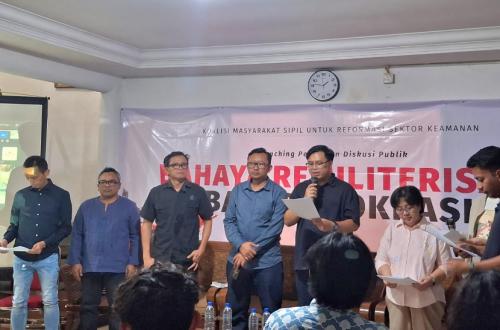
A number of academics, civil society activists, journalists, and civic elements have launched a petition titled ‘Stop Remilitarisation: Civilian Militarisation Threatens Democracy and the Rule of Law’. They assess that the increasingly broad involvement of the Indonesian National Armed Forces (TNI) in civilian affairs has the potential to threaten democracy, weaken the rule of law, and revive the practice of military dual function.
Chairperson of Centra Initiative Al Araf stated that the TNI’s current role has exceeded its primary function as a state defence instrument. According to him, the military no longer only carries out defence duties but is also involved in various government programmes outside its constitutional mandate.
The initiators of the petition are gathered in the Civil Society Coalition for Security Sector Reform. Among its members are Imparsial, KontraS, YLBHI, Amnesty International Indonesia, HRWG, WALHI, Centra Initiative, Raksha Initiatives, Indonesia Risk Center, and ICW. Also included are LBH Jakarta, SETARA Institute, LBH Pers, DeJure, LBH Masyarakat, ALDP, Public Virtue, ICJR, ELSAM, PBHI, AJI Jakarta, LBH APIK, KPI, LBH Medan, and AJI Indonesia.
In the petition released in Jakarta on Tuesday (29/7/2026), the initiators cited examples of TNI involvement in a number of programmes such as the Free Nutritious Meals (MBG) programme, the Red and White Village Cooperatives, the Forest Area Control Task Force, handling criminality, securing student demonstrations, and guarding national strategic projects.
‘The involvement of the military in non-defence functions contradicts the constitution. The military’s duty is as a state defence instrument, not a development tool or law enforcement apparatus,’ the petition stated.
The petition’s initiators assess that the increasingly broad involvement of the military has the potential to reduce the professionalism of the TNI as a defence force. They argue that soldiers are educated and trained to face the threat of war, not to carry out political interests or government projects.
The petition also highlights several policies that are considered to reflect the militarisation of civilian space. One of these is the implementation of basic military training within the Red and White Village Cooperatives programme. According to them, the death of five training participants serves as evidence of the negative impact of this approach. The initiators argue that cooperative participants should receive training in management, marketing, accounting, and corruption prevention, not basic military training.
Furthermore, they criticised the TNI’s involvement in managing the MBG programme. Based on data they presented, as of 23 October 2025, there were at least 452 Nutrition Fulfilment Service Units (SPPG) managed by the TNI across various regions. This condition is seen as demonstrating the politicisation of the military to support government programmes.
The petition also cited data from KontraS stating that from January to April 2026, there were 44 incidents of violence involving TNI members. From these incidents, there were 33 civilian victims, with 36 people injured and 22 people killed. The initiators stated that the increasing role of the military in civilian spaces actually heightens the risk of intimidation and human rights violations.
They also touched upon the case of the attack against activist Andrie Yunus, which is described as a reflection of the worsening democratic situation. In the petition, the initiators criticised the decision of the Jakarta Military Court II-08, which handed down a maximum sentence of 3.5 years to the perpetrators of the acid attack. They assessed that the verdict did not reflect accountability and further demonstrated the need for reform of the military justice system.
Additionally, the petition highlighted the plan to establish 750 Territorial Development Battalions (BTP). The initiators believe this policy has the potential to expand the TNI’s territorial command and revive the practice of military dual function that was once applied in the past.
According to them, the expansion of the territorial structure risks narrowing the space for civil liberties, increasing the potential for agrarian conflict, triggering intimidation against communities defending their land, and blurring the lines between defence affairs and civilian governance. They also assess that the formation of the BTP is not in line with the provisions regarding the posture and deployment of the TNI as regulated in the TNI Law.
Through this petition, the academics and civil society organisations conveyed four demands to the government and the House of Representatives (DPR). First, to stop the Basic Military Training (Latsarmil) programme and other forms of military training for civilians. Second, to evaluate all policies involving the TNI in the civilian domain and return the TNI’s focus to being a state defence instrument.
Third, to revise Law Number 31 of 1997 on Military Courts so that soldiers who commit general crimes are tried through general courts in accordance with the mandate of MPR Decree Number VII of 2000. Fourth, to halt the formation of Territorial Development Battalions and the expansion of territorial commands because they are deemed inconsistent with the spirit of TNI reform and the provisions of the TNI Law.
Source: jawawa.id (https://jawawa.id/newsitem/coalition-launches-petition-to-halt-remilitarisation-1785347490)
Originally published by Republika (https://news.republika.co.id/berita/tiy5tl393/koalisi-serukan-petisi-setop-remiliterisasi), translated from Indonesian