
Coal Prices Rebound This Week, Indonesian Supply Becomes Main Pillar
Thermal coal prices strengthened over the past week after touching a four-month low at the end of June. Refinitiv data showed the Newcastle contract closed at US$135.4 per ton on July 24, 2026, a 5.17% increase from the closing price of US$128.75 per ton on July 10. The increase was gradual throughout the week, moving from US$133.35 per ton on July 17 to US$133.75 on July 20, before holding in the US$134-135 per ton range until the end of the week, marking the highest level in about a month.
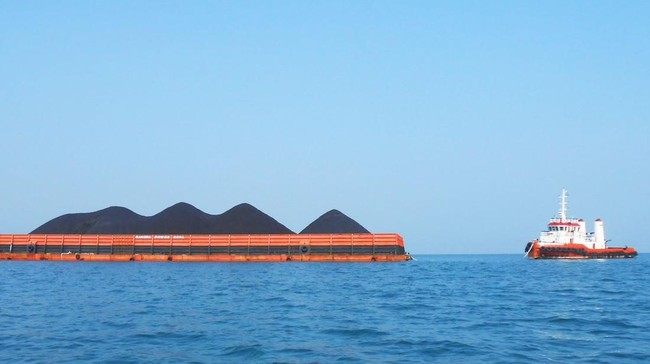
The strengthening was primarily triggered by supply disruptions from Indonesia, the world’s largest thermal coal exporter. Dry weather hampered coal transportation along the Barito River in Kalimantan, a critical distribution artery to export ports. Falling water levels prevented barges from operating at normal capacity, with several mining companies reportedly declaring force majeure on some shipment volumes. These logistical disruptions raised concerns about short-term export delays, prompting the market to price in the supply risk despite the absence of strong demand.
Additional support came from global energy markets, where oil prices surged due to heightened geopolitical tensions in the Middle East. The rise in oil typically strengthens sentiment across the energy commodity complex by increasing the perception of risk to global energy supplies, with capital flows into the sector also helping to underpin coal prices. However, the potential for further gains was limited by weak import demand from China, the world’s largest coal consumer. High stockpiles at power plants and ports have led utility companies to postpone new purchases, keeping import appetite subdued even as prices began to recover.
Looking further ahead, market participants are also monitoring developments in India, one of the fastest-growing coal consumers. A report from the Institute for Energy Economics and Financial Analysis (IEEFA) published on July 22 suggested India’s reliance on coking coal imports could face supply challenges in the coming years. The IEEFA noted that Australia, the largest coking coal supplier, continues to cut its export projections due to rising operational costs, higher strip ratios, and mine closures. Yancoal’s Ashton mine, for instance, is scheduled to cease operations in 2028 due to technical and operational constraints, while the New South Wales government has stated it will not approve new greenfield coal mines. This outlook is pushing India to accelerate the diversification of its steel industry raw materials, with increased use of scrap-based steel via electric arc furnaces and hydrogen-based direct reduced iron technology positioned as alternatives to reduce coking coal imports. While this shift has not yet affected daily thermal coal trading, it suggests long-term changes in coal demand for the steel sector.
Demand-side pressure is also evident in Europe. Reports indicate that barge operators on the Rhine River have cut loadings by up to 75% as water levels approach record lows, a condition that could theoretically disrupt coal deliveries to power plants in Germany and surrounding areas. However, this has not spurred new international demand, as utilities in the Amsterdam-Rotterdam-Antwerp region are opting to draw on existing stockpiles, which reached a six-week high of around 4 million tonnes, rather than purchase spot cargoes while river transport costs remain elevated.
Trade data suggests the coal price recovery is a correction rather than the start of a new upward trend. The CFD contract tracking the thermal coal benchmark was around US$130.6 per ton on July 24, down 8.8% from the previous month, though still approximately 14.8% higher year-on-year. The short-term price direction will largely depend on the normalisation of Indonesian export distribution following the Barito River disruptions and any change in China’s purchasing patterns as it continues to hold back imports due to high domestic inventories.