
Coal Prices Plunge as Indonesia's Policy Draws World Attention
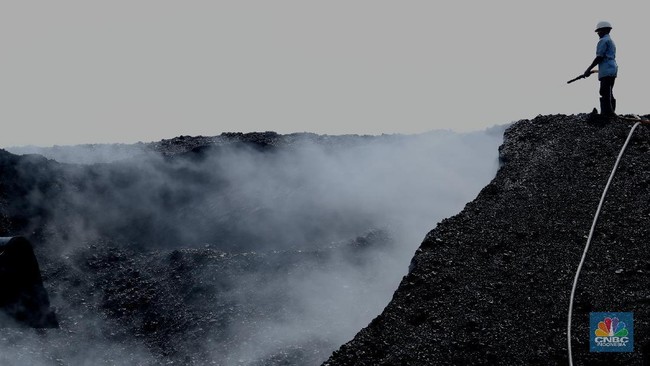
Jakarta, CNBC Indonesia - Coal prices plummet after rising for three straight days. Indonesia’s policy has become the main focus of the global coal market.
Refinitiv data show the June coal contract, traded on Wednesday, 20 May 2026, closed at US$137.45 per tonne, down 1.40%. This weakness breaks the positive run in coal prices, which had gained 4.4% over the previous three days.
The global coal market is watching Indonesia’s plans to centralise commodity exports. The government will implement a three-month transitional period, initially applying to coal, crude palm oil, and ferroalloys, with quarterly reviews to determine other commodities that could be added, said Coordinating Minister for Economic Affairs Airlangga Hartarto.
Exports will be conducted through government-designated trading companies and overseen by the Danantara Indonesia Wealth Fund, established during the presidency of Prabowo Subianto.
As an additional step, from 1 June all natural resource exporters will be required to hold 100% of their export proceeds in state-owned banks, Airlangga said, to support a rupiah that has continued to weaken.
The article discusses Indonesia’s plan to channel coal exports through state-owned enterprises, a move viewed as increasing uncertainty in global seaborne coal supply.
President Prabowo Subianto is planned to form a Special Export State-Owned Enterprise. The sale of all Indonesia’s natural resources—from palm oil to coal and ferroalloys—must be conducted through the Special Export SOE.
“Sales must be conducted through a state-owned enterprise designated by the Republic of Indonesia as the sole exporter. In other words, every export proceeds will be passed through the government-designated SOE to the business operators involved in those activities,” Prabowo said in a speech at the Parliament Building on Wednesday, 20 May 2026.
Prabowo stated that the aim of establishing this Special Export SOE could be described as a marketing facility, strengthening oversight and monitoring to combat practices such as under-invoicing, transfer pricing, and the leakage of export earnings.
“This policy will optimise tax revenue and state revenue from our natural resources, and with this policy we hope our revenue can reach levels seen in Mexico, the Philippines and neighbouring countries,” he added.
Global coal markets have responded cautiously because Indonesia is the world’s largest exporter of thermal coal. Market participants fear the policy could reduce trading flexibility, alter price mechanisms, disrupt export contracts, and tighten spot supply in Asia.
Previously, plans to cut Indonesia’s coal production quota for 2026 had already caused several miners to suspend spot sales amid regulatory uncertainty. This has reduced supply liquidity and raised concerns among buyers in Asia.
Indonesia’s major importers—such as the Philippines, Malaysia, Thailand, and Vietnam—are considered most vulnerable should Indonesian coal exports be disrupted, given their reliance on Indonesian supply.
Separately, China has reported higher inflows of water to the Three Gorges Dam due to heavy rainfall in southern and central China, which is expected to boost hydroelectric generation and reduce demand for coal.
Heavy rainfall along the Yangtze River and in southwest China has increased inflows to the Three Gorges Dam, the world’s largest hydroelectric plant.
This is improving the outlook for China’s hydroelectric generation ahead of the summer when electricity demand typically spikes as air-conditioning use rises.
Hydropower expansion is expected to dampen demand for thermal coal, reducing coal burning in power plants and potentially weakening coal prices domestically and globally.
Earlier, a prolonged drought in 2022-2024 reduced hydroelectric output in China, heightening dependence on coal-fired plants. Weather patterns are now reversing, with heavy rains filling major reservoirs.
Industry data show China’s hydropower generation rose by more than 40% year-on-year after rainfall increased and the flood season arrived earlier.
Chinese authorities are also tightening management of the Three Gorges reservoir to support water supply, navigation, flood control, and power generation.
Yet extreme rainfall also brings major risks. Floods and landslides in several provinces have killed dozens and disrupted transport and electricity supplies.