
Coal Prices in Limbo as European Coal-Fired Electricity Hits Historic Low
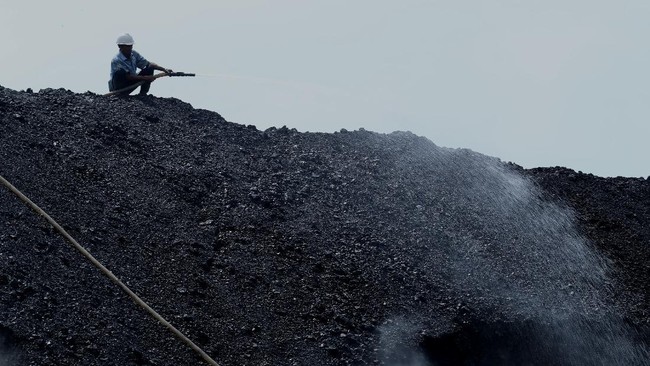
Jakarta, CNBC Indonesia - Coal prices weakened slightly but remained in the US$134 range.
Citing Refinitiv, coal prices in trading on Thursday (13/8/2026) closed at US$133.9 per tonne, down 0.15%.
Coal prices weakened amid softening oil prices and a raft of negative news.
In Thursday’s trading, Brent crude oil futures fell more than 2% to close at US$87.07 per barrel. Meanwhile, West Texas Intermediate (WTI) crude also slid more than 2% to US$81.25 per barrel.
Oil and coal are substitute commodities, so their prices influence one another.
Chinese coking coal prices strengthened again as buyers competed for limited prompt cargoes, particularly for certain grades of coking coal. Speculative demand also increased, prompting sellers to raise offer prices.
Supply was the main factor behind the price increase in China. Limited availability of cargoes for prompt delivery meant buyers were willing to pay a scarcity premium.
Speculative demand increased, intensifying competition for coking coal.
Domestic Chinese coking coal prices also showed gains. The Shanxi low-sulphur coking coal index reached CNY 2,037 per tonne, up CNY 53 per tonne in a day and CNY 66 per tonne in a week.
Coking coal inventories stood at around 1.019 million tonnes on 12 August, up 16.5% week-on-week and 101.5% year-on-year. This means that although total stocks increased, certain types and grades of coal remained scarce, particularly for immediate needs.
Conversely, thermal coal prices at northern Chinese ports began to stall after buying activity weakened. Profit-taking by sellers increased, but cost pressures and tight supply provided a floor for prices, preventing deeper declines.
After prices rose, buyers became more cautious and waited for price developments. This caused transactions at northern Chinese ports to slow.
The earlier price increase had prompted some traders to release stock to lock in profits, creating downward pressure on prices.
Tight supply and high coal procurement costs meant sellers were not free to lower prices. As a result, prices tended to move sideways rather than fall sharply.
On one hand, demand weakened. On the other, tight supply underpinned prices. Consequently, the upward momentum of thermal coal at northern Chinese ports began to lose steam.
China and India Simultaneously Cut Coal-Fired Power
Analysis by the Centre for Research on Energy and Clean Air (CREA) shows coal-fired power generation in China fell 1.6% and in India 3% last year. This marked the first simultaneous decline in both countries since 1973.
The decline was primarily driven by a surge in renewable energy generation that was able to meet rising electricity demand in both countries.
China added more than 300 GW of solar capacity and 100 GW of wind capacity, setting a new record. India added around 35 GW of solar, 6 GW of wind, and 3.5 GW of hydropower.
In India, clean energy growth accounted for around 44% of the reduction in coal and gas generation compared with the five-year trend. Cooler weather contributed around 36%, while slowing electricity demand accounted for around 20%.
However, analysts caution that weather factors remain a risk. Higher summer temperatures could increase air conditioning use and push coal-fired generation back up.
This development is significant because China and India accounted for more than 90% of the increase in global carbon emissions between 2015 and 2024.
If the downward trend in coal consumption continues, China and India could become key determinants of when global coal consumption and emissions peak.
However, the outlook could still change. Energy market shocks, such as the surge in gas prices after Russia’s invasion of Ukraine, previously led several countries to increase coal use again.
Europe Posts Record Low Coal Use
Europe tells a similar story. In 2025, hard coal accounted for 3.7%, or 105,601 GWh, of total gross electricity production in the European Union (EU). Meanwhile, lignite or brown coal accounted for 5.5%, or 154,186 GWh.
In 2024, coal’s total share of EU electricity production fell below 10% for the first time. In 2025, the share fell further to 9.2%, the lowest level in history.
In 1990, coal accounted for more than a third of EU electricity production. By 2000, its share had fallen to 30.4%. The downward trend continued, despite slight upticks in 2011-2012 and 2021-2022, until reaching its lowest point in 2025.
In 1990, hard coal and brown coal were the second and third largest sources of electricity respectively, contributing 19.8% and 15.3%. By 2025, both had fallen to the sixth and seventh largest electricity sources, behind nuclear, natural gas, and renewables.
Coal was overtaken by nuclear in 1994, natural gas in 2019, hydro and wind in 2023, and solar in 2024.
The decline in coal use for power generation coincided with coal production and consumption reaching historic lows.
In 2025, hard coal consumption in the EU is estimated to have reached a record low of 107 million tonnes, while brown coal consumption stood at around 184 million tonnes.
Several EU countries also continue to phase out coal, either entirely or for power and heat generation.
In 2021, Portugal stopped using hard coal for power generation. Then in 2024, Slovakia halted brown coal production, leaving only eight EU countries still producing brown coal.
Source: jawawa.id (https://jawawa.id/newsitem/coal-prices-in-limbo-as-european-coal-fired-electricity-hits-historic-low-1786672327)
Originally published by CNBC Indonesia (https://www.cnbcindonesia.com/research/20260814071457-128-759157/harganya-mati-suri-listrik-batu-bara-eropa-terendah-dalam-sejarah), translated from Indonesian