
Coal, CPO and Ferro-alloy Exports via DSI: Business Reaction
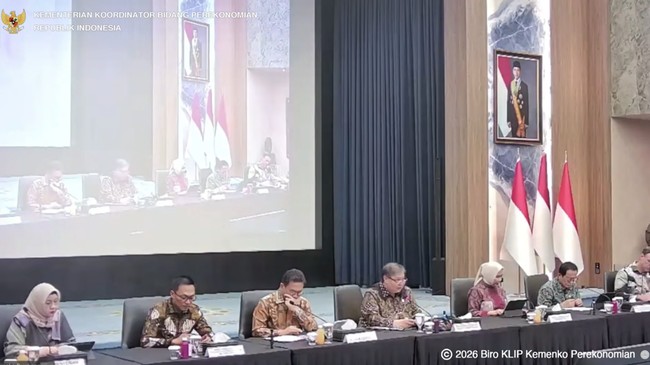
Jakarta, CNBC Indonesia — The Coordinating Ministry for Economic Affairs held a briefing for businesspeople in Jakarta on Friday (6 November 2026) about the implementation of regulations on foreign-exchange earnings from natural-resource exports (DHE SDA).
The event also discussed the latest developments in a policy requiring exports of three major commodities—coal, crude palm oil (CPO) and ferro-alloy—to be channelled through a single state-owned intermediary, PT Danantara Sumberdaya Indonesia (DSI). The policy is due to take effect on 1 January 2027.
Representatives from the main commodity sectors attended the briefing, including palm oil, coal and nickel (ferro-alloy) businesses.
Those present included the Indonesian Palm Oil Association (GAPKI), the Indonesian Chamber of Commerce and Industry (KADIN), Apindo, the Indonesian Nickel Industry Forum (FINI), the Indonesian Mining Association (IMA) and other related industry players.
DSI’s explanation
DSI chief executive Luke Thomas Mahony said exports of the three strategic commodities would be handled from 1 January 2027 through DSI’s NADI (National Data Intelligence) portal, which is directly connected to the Finance Ministry’s Directorate General of Customs and Excise CEISA system and the Indonesia National Single Window (S-INSW).
Mahony stressed that DSI would act only as an intermediary. He said NADI integrates transaction data to verify variables including prices, quantities, quality and export proceeds.
“At DSI, this is all about connecting data. A great deal of data is already available through ministry systems, and this is about further collaboration with existing programmes, systems and ministries to integrate and connect market data, and report daily transactions,” Mahony said at a press conference at the Coordinating Ministry for Economic Affairs in Jakarta on Friday (6 November 2026).
Preparations will begin with a technical briefing on 15 November 2026 to explain the changes and provide exporters with guidance on using the system. Company-account registration and the uploading of administrative documents to the NADI portal will open on 15 December 2026.
“At a very high level, on 15 November we will hold a technical briefing to explain the changes, take feedback and clarify what is expected of exporters,” he said.
The NADI portal is due to be fully operational on 1 January 2027. It will be used to upload contracts, register Export Declarations of Goods (PEB) and submit final cargo information.
Exporters will be required to register one company account and upload commercial contracts, which will serve as the basis for pre-clearance and post-clearance checks.
“Once they are registered, they will upload documents and commercial contracts, which form the basis for the PEB,” Mahony said.
As part of preparations, DSI, Customs and S-INSW have tested the NADI portal with 100 exporting companies, accounting for 50% of the total export value of the commodities concerned. The pilot involved processing around 340 transaction contracts to test the system’s reliability and data security.
“Ultimately, this is about prioritising business certainty, continuity of exports and market confidence, which underpin the system’s design and deployment,” he said.
Mahony said all commercial negotiations, goods flows and payment processes would continue to take place directly between sellers and buyers.
“Under the intermediary model, DSI will interact with sellers without obstructing exports, negotiations or the movement of goods. We will act as an intermediary,” he said.
He added that DSI would not take ownership of exported commodities and would not be involved in their commercial operations or sales.
“The commercial agreements, flow of goods and payments will remain between the buyer and seller. We will not take ownership of the goods and are not involved in commercial operations,” he said.
Business reaction
GAPKI chairman Edi Martono said the palm oil industry welcomed the single-intermediary export model through DSI. He said the additional reporting step through the NADI portal would not pose a problem for exporters as long as the process remained electronic.
“Based on what we heard at the briefing, there is no problem with having a single intermediary. Nothing is changing; the only addition is that transactions must be reported through NADI, DSI’s portal, before going through Customs’ CEISA 4.0 system,” Edi said on the sidelines of the event on Friday (6 November 2026).
Edi said electronic transaction reporting would help verify transactions and prevent fraud and illegal transfer pricing in CPO exports.
“I agree that this will help ensure transactions are genuine and that there is no fraud or illegal transfer pricing. Transfer pricing is legal, but it must comply with the rules; the Trade Ministry has already set the requirements for prices,” he said.
On DSI’s service fee, GAPKI is continuing discussions with the government to ensure the charge does not burden the palm oil industry or negatively affect prices received by farmers.
“We have cautioned them not to set the fee too high, because the effects could be passed on to farmers. Farmers would be affected if it is excessive, so the amount has not yet been finalised,” he added.
Meanwhile, FINI chairman Arif Perdana Kusumah said the nickel industry association welcomed business participation in testing the DSI portal ahead of its official launch on 1 January. He said the government’s briefing had addressed businesses’ concerns about DSI’s status.
“The official start is 1 January. We have now entered the piloting stage, with several companies involved. Some have begun sending documents to DSI. I think preparations are going well,” Arif said on the sidelines of the event.
Arif added that clarity that DSI would be a single intermediary, rather than a sole exporter, provided legal certainty and business continuity for nickel industry participants.
“As explained, DSI’s role is that of a single intermediary, not a sole exporter. That distinction is clear, and acting as an intermediary is the best approach for DSI at this stage,” he said.
Source: jawawa.id (https://jawawa.id/newsitem/coal-cpo-and-ferro-alloy-exports-via-dsi-business-reaction-1793976670)
Originally published by CNBC Indonesia (https://www.cnbcindonesia.com/news/20261106202049-4-783124/ekspor-batu-bara-cpo-ferro-alloy-lewat-dsi-ini-reaksi-pengusaha), translated from Indonesian