
Coal and CPO Exports via DSI to Begin on 1 January 2027: How It Will Work
Jakarta, CNBC Indonesia – The government has decided that exports of three of Indonesia’s strategic commodities—coal, crude palm oil (CPO) and ferro-alloys—will be handled centrally by PT Danantara Sumberdaya Indonesia (DSI) from 1 January 2027.
How will the export scheme through DSI work?
DSI Chief Executive Luke Thomas Mahony said that, from 1 January 2027, exports of strategic commodities will be processed through DSI’s portal, NADI (National Data Intelligence), which is directly connected to the Finance Ministry’s Directorate General of Customs and Excise CEISA system and S-INSW.
Exporters will have to prepare their export declarations (PEB) through the NADI portal.
He stressed that the single-intermediary scheme would not disrupt business negotiations, commercial transactions or the flow of goods between sellers and buyers.
“Under the single-intermediary model, DSI will interact with sellers without obstructing exports, negotiations or the movement of goods. We will act as an intermediary,” Luke said at a press conference at the Coordinating Ministry for Economic Affairs in Jakarta, as quoted on Monday (9 November 2026).
DSI has been piloting the NADI portal since late September with 100 exporting companies. Those companies account for 50 per cent of the total value of exports of the commodities and have uploaded around 340 transaction contracts to the system.
“We have had our first 50 companies testing the system, and have just started with the next 50. That means 100 different companies will be testing and piloting the system,” he added.
How can exporters register?
Exporters must first create a single company account on the NADI portal and upload commercial contract documents, which will serve as the basis for preparing the PEB.
DSI will then conduct pre-clearance and post-clearance checks covering variables including price, quantity, quality, HS code and the repatriation of export proceeds.
“Once they are registered, it is a matter of uploading the documents—the commercial contracts that form the basis for the PEB,” he said.
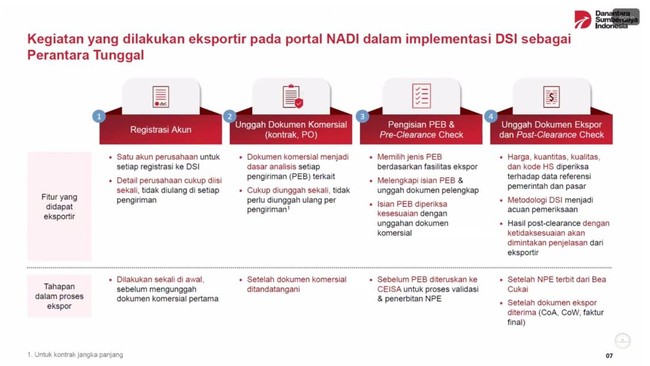
According to DSI’s presentation, the export process through the NADI portal is as follows:
- Account registration
Enter the company’s details once to create a company account, before uploading the first commercial document.
- Upload commercial documents (contract, purchase order)
Commercial documents provide the basis for analysing each related shipment (PEB). They need to be uploaded only once, not for every shipment, after they have been signed.
- Complete the PEB and undergo pre-clearance
Select the type of PEB based on the export facility, then complete the declaration and upload supporting documents. The PEB details will be checked against the uploaded commercial documents. This takes place before the PEB is forwarded to CEISA for validation and the issuance of the Export Service Note (NPE).
- Upload export documents and undergo post-clearance
After the NPE has been issued and export documents (CoA, CoW and the final invoice) have been received, data on price, quantity, quality and HS code will be checked against government and market reference data. DSI’s methodology will guide the checks. If discrepancies are found, DSI will ask the exporter for an explanation.
Source: jawawa.id (https://jawawa.id/newsitem/coal-and-cpo-exports-via-dsi-to-begin-on-1-january-2027-how-it-will-work-1794192625)
Originally published by CNBC Indonesia (https://www.cnbcindonesia.com/news/20261109080559-4-783394/ekspor-batu-bara-cpo-lewat-dsi-resmi-1-januari-2027-ini-caranya), translated from Indonesian