
CNG Cylinder System Provides Cost-Efficient Energy for Yogyakarta Restaurant
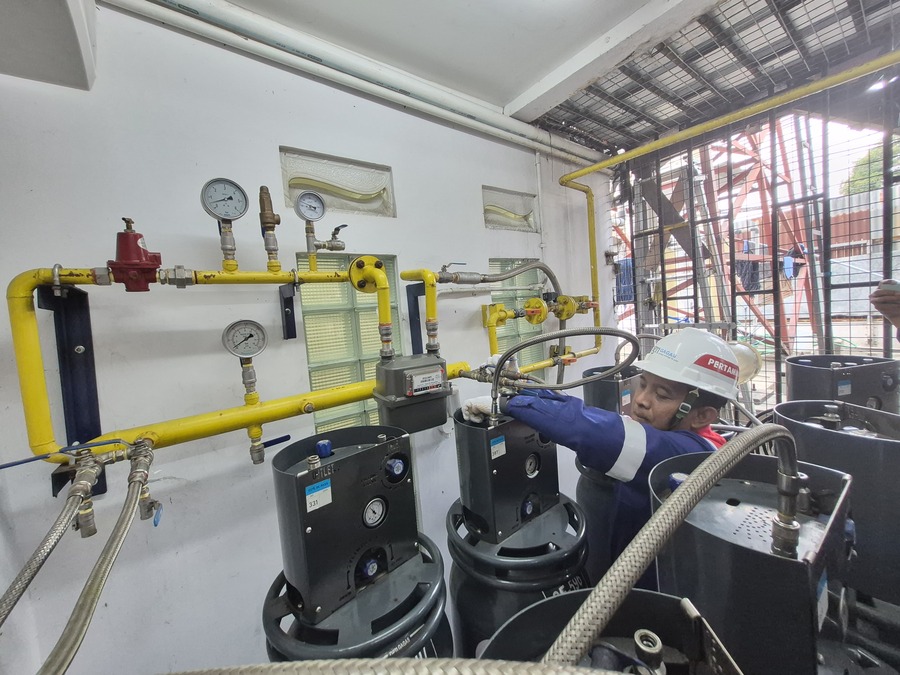
A row of compressed natural gas (CNG) cylinders stands neatly arranged at the Padang Payakumbuah restaurant in Depok, Sleman Regency, Special Region of Yogyakarta. The gas pipes are precisely installed, extending robustly from the cylinders to the row of stoves in the kitchen, ready to channel energy for cooking various dishes for customers.
With visitors always crowding the establishment every day, this restaurant requires a gas supply with cleaner combustion, reliable availability, and greater cost-effectiveness.
RM Padang Payakumbuah is one of the distribution points for natural gas in the form of CNG Cylinder (Cicil) or Gaslink owned by PT Gagas Energi Indonesia, a subsidiary of PT PGN Tbk, the gas subholding of Pertamina.
Adi Saputro, a representative of RM Padang Payakumbuah, said the restaurant has been using gas from Gaslink since November 2024. “From our experience using Gaslink from PGN, it is extraordinary. There are many benefits,” he told Media Indonesia on Thursday (13/8).
He still remembers the early days when the Padang restaurant had not yet adopted CNG. At that time, cooking relied on LPG with very large cylinders.
“Previously, since we opened, we did not use it. Comparing monthly usage converted to LPG, using Gaslink is more efficient,” he said, recalling the early days of Payakumbuah’s business.
The use of CNG is considered highly efficient for the business, allowing it to save operational costs, particularly for cooking. He cited that operational costs for CNG amount to only around Rp20 million per month, whereas using LPG could reach around Rp35 million to Rp40 million per month.
“We save approximately 30%,” he said.
Beyond cost efficiency, supply reliability is a primary consideration. Certainty of supply without being affected by national holidays or major religious celebrations is a crucial point for a culinary business that operates fully without days off.
Technical support from PT Gagas Energi Indonesia, a subsidiary of PT Perusahaan Gas Negara Tbk (PGN), is routinely provided to ensure installation safety and check for potential gas leaks.
“Officers educate us about gas safety. Their team also very routinely checks whether there are any gas leaks,” he said.
Miranti Dian Pramesti, Area Head of PT Gagas Energi Indonesia for the Yogyakarta region, explained that her team refills CNG at RM Padang Payakumbuah every one to two days.
“The truck will park in front, then inject gas into the storage cylinders at this location,” she said, describing the CNG distribution process to the restaurant.
The gas pressure from the truck, which reaches 200 bar, is injected into the storage cylinders. The pressure is then reduced according to the customer’s kitchen needs, around 0.5 bar for retail scale.
Regarding payment, she continued, although cylinders are used, the payment system is not calculated based on the number of containers as with LPG. Payment is calculated using a meter according to the CNG used.
Customers only pay according to the usage figure shown on the meter each month. The cost already includes the gas and its delivery.
“For retail scale with usage capacity of around 5,000 cubic metres per month, we use cylinders like these. The minimum customer requirement is around 500 to 1,000 cubic metres per month,” Miranti added to journalists.
She explained that gas delivered directly using 10-foot truck fleets is intended to accommodate consumers whose business locations are not yet reached by the gas pipeline distribution network.
In the Yogyakarta, Solo, and Magelang areas, around 30 customers from the restaurant, hotel, and industrial sectors have utilised the Gaslink service.
Regarding the use of non-pipeline natural gas, she explained that the characteristics of stoves and the calorific value of natural gas differ from LPG. The ignition holes on stoves need adjustment or enlargement for optimal combustion.
“Additionally, these Gaslink cylinders are very heavy, so they cannot be moved carelessly. That is why we use a direct injection system on site,” Miranti explained.
Miranti explained that access to clean and environmentally friendly natural gas energy continues to invade Yogyakarta and its surroundings. Based on data, the local gas distribution network includes 15.9 km of DTM pipeline infrastructure (180 mm and 90 mm diameter), while DTR pipeline (63 mm diameter) reaches 125.5 km.
In addition, to support the reliability of gas supply from the Gas Transportation Module (GTM) mode to end consumers, several supporting facilities have also been operated, namely one Pressure Regulating Station (PRS Sleman) and five Regulating Stations (RS) spread across several points in the network sector.
This infrastructure network has covered a number of strategic areas in Sleman Regency, such as Caturtunggal and Condongcatur. Public facilities and large commercial customers connected include Dr. Sardjito General Hospital, Sleman-2 Hospital, JIH Hospital, Loman Park Hotel, and culinary businesses such as Giorno’s Pizzeria.
To date, the total benefits of gas distribution have reached 4,545 household connections, 6 small customers, and 4 commercial and industrial customers.
The development of this natural gas network is expected to continue providing convenience, safety, and energy cost efficiency for the community and businesses in the Sleman area and its surroundings.
Furthermore, PT Gagas Energi Indonesia continues to expand the reach of clean and efficient energy services in the southern part of Central Java through the Point to Point Compressed Natural Gas (CNG) scheme.
Based on the latest operational data, the Point to Point CNG distribution scheme in the southern part of Central Java has served 20 customers with a total distribution volume reaching 74,000 m³ per month.
This Point to Point CNG scheme is an effective solution from PGN and PT Gagas Energi Indonesia to supply environmentally friendly fossil energy to areas not yet reached by conventional gas pipeline networks.
By utilising special transport modes (Gas Transport Module/GTM), PGN is able to distribute natural gas directly to commercial consumer points such as the food industry (Bakpia Tugu Jogja, Payakumbuah), the hotel sector (Aston Hotel Solo, Platinum Hotel), tourism areas (PGN Balkondes), and SPPG points supporting local operations.
Through the expansion of this programme, PGN is committed to accelerating the clean energy transition and supporting operational efficiency for businesses in Central Java and the Special Region of Yogyakarta.
The Point to Point CNG service supplies compressed natural gas to various commercial, hospitality, culinary, and supporting facility sectors in several key areas. In Sukoharjo and Surakarta, Central Java, the service has been utilised by Bening Big Tree with a capacity of 3,000 m³ per month, 12 SPPG points with 12,000 m³ per month, and Aston Hotel Solo with 1,500 m³ per month.
For the Special Region of Yogyakarta, the service has been utilised by Bakpia Tugu Jogja with 50,000 m³ per month, Payakumbuah Jogja with 2,000 m³ per month, and Platinum Hotel with 1,500 m³ per month.
In Magelang, Central Java, the service has been utilised by two SPPG points with 2,000 m³ per month and PGN Balkondes with 2,000 m³ per month.
Source: jawawa.id (https://jawawa.id/newsitem/cng-cylinder-system-provides-cost-efficient-energy-for-yogyakarta-restaurant-1786693872)
Originally published by Media Indonesia (https://mediaindonesia.com/nusantara/921820/masa-depan-energi-bersih-gas-bumi-invasi-jogja-dan-sekitarnya), translated from Indonesian