
Closing Railway Crossings: Not as Easy as It Seems, Here Are the Challenges
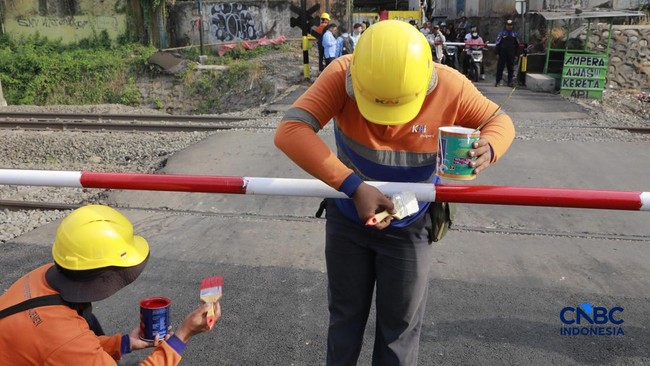
Commission V of the Indonesian House of Representatives has spotlighted funding issues as a key barrier to optimally handling railway crossings and enhancing tracks on the Bekasi-Cikarang line, making it challenging for PT Kereta Api Indonesia (KAI) to address the problems.
Commission V Chairman Lasarus stated that converting a level crossing to a non-level one, such as by building a flyover or underpass on the Bekasi-Cikarang route, would require approximately Rp400 billion per crossing.
“The purpose of this working meeting is to address recent railway issues, including budget matters. Although President (Prabowo Subianto) has provided KAI with Rp4 trillion in funding, it is still insufficient. I received information from the Ministry of Public Works that one crossing point requires significant funding for a flyover or underpass, potentially up to Rp400 billion,” Lasarus said when met by reporters at the DPR RI Building on Wednesday (13/5/2026).
The issue is that there are still 10 illegal crossings on that route, necessitating a much larger budget of up to Rp4 trillion for those 10 crossings.
“Rp400 billion is for one point, one crossing. On the Bekasi-Cikarang route, there are still 10 illegal crossings, requiring Rp4 trillion. That’s just for 10 crossings; there are many more in Jabodetabek, and even more across Indonesia, so there is still much to resolve,” Lasarus continued.
Moreover, KAI now faces the obligation to build a double-double track (DDT) on the Bekasi-Cikarang line, which has not yet been realised.
“We haven’t even discussed the double-double track construction. The reason for the collision incident is that the trains operate on a single line simultaneously like that because it’s still a double track there, not yet double-double track, and it doesn’t reach the end. Why doesn’t it reach the end? Because it hasn’t been built. Why hasn’t it been built? Is it because of lack of funds? This is the purpose of the working meeting, so that this can be resolved properly, including how to address the double-double track first,” Lasarus explained.
Lasarus emphasised that the working meeting has significant objectives, as the results of the investigation by the National Transportation Safety Committee (KNKT) could serve as a benchmark to prevent similar accidents in the future.
“So our targets are very substantial. This meeting is not about discussing the KNKT investigation results or the police investigation results, but about resolving issues with level crossings, railway operations, and so on. This is very complex, and that’s what we aim to address in this meeting. The DPR does not intend to interfere with the KNKT or the police, as they are protected by law and we cannot enter their domain,” he clarified.