
Climate Change Bill Emerges: Minister of Environment Provides Recommendations
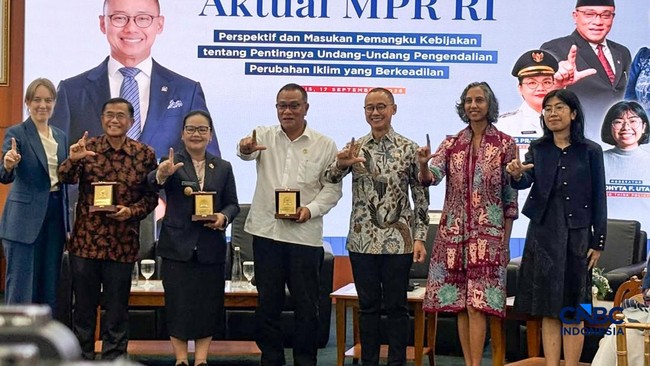
Jakarta, CNBC Indonesia - The Minister of Environment, Mohamad Jumhur Hidayat, has voiced the urgency of regulations to handle the environmental crisis in Indonesia. One of the proposed regulatory frameworks is the Just Climate Change Control Bill (RUU PPIB).
Essentially, the issue of handling the climate crisis involves two potential discussion schemes: integrating climate change rules into the revision of the 2009 Environmental Law or drafting it independently as a separate legal product.
According to Jumhur, the climate change law should be discussed separately from existing environmental regulations. He believes this separation is crucial so that the governance of the climate crisis response possesses specificity and a new, focused, and flexible approach.
“That question was asked to me because I am considered the one who will implement the law. Therefore, I said the most ideal way is to keep it separate so there is specificity, as this is a new theme and a new issue that requires new ways of management,” he explained during the Actual Discussion Forum (FDA) of the MPR RI regarding the Rul PPIB in Jakarta, Thursday (17/9/2026).
Furthermore, the government and parliament have agreed to add an emphasis on the aspect of justice, leading the regulation to be named the Just Climate Change Control Bill (RUU PPIB).
“It was eventually agreed upon by the Special Envoy to the President for Climate Change and Energy, Mr Hashim, that there was a proposal from the Ministry of Environment to add the word ‘justice’. Thus, it became the PPIB Bill,” said Jumhur.
In formulating the substance of the RUU PPIB, the Ministry of Environment is encouraging public consultations with various universities and non-governmental organisations, as well as sending a team to the United Kingdom to study the governance of the Climate Change Commission.
“I believe we have held dozens of meetings, both within the Ministry of Environment and with parliament, involving public consultations with various universities and NGOs, discussing international best practices and so on,” he stated.
Jumhur emphasised that handling the climate crisis and reducing emissions cannot be borne by the government budget alone, but requires the involvement of businesses and philanthropy.
However, he warned that the economic value of carbon generated should not only be enjoyed by investors but must be shared fairly with indigenous peoples and local residents through management units based on cooperatives.
“Therefore, we want to ensure that whenever there are profits or benefits from these activities, they are shared with the ground people, indigenous communities, and local residents. I want to ensure that carbon units in various places are owned or managed by cooperatives representing those who manage the local environment,” said Jumhur.
In this regard, Jumhur proposed that Indonesia add a new aspect of climate action, namely ‘prosperity action’, to complement the existing mitigation and adaptation actions.
Additionally, the government highlighted the aspect of a ‘just transition’ to protect workers and vulnerable groups from the impacts of layoffs (PHK) or loss of livelihoods due to changing industrial patterns.
“Usually, in the world, there is mitigation action and adaptation action; let us add one more: prosperity action. In carbon trading, there is also the matter of just transition, especially for workers. What the state must do so that we are not laid off or disadvantaged is what is being discussed,” he said.
Currently, his office is initiating specific research regarding the list of communities who are victims or potential victims of the climate crisis over the next two decades. The government hopes that the discussion of the RUU PPIB can be completed and passed this year to serve as a legal foundation for achieving equitable sustainable development.