
Climate a Thorny Issue in Indonesia, Energy Transition Must Continue
Climate change has become a serious challenge that cannot be underestimated. The impacts of the climate crisis are now being felt directly by the public amid increasing extreme weather and hydrometeorological disasters across various regions of Indonesia.
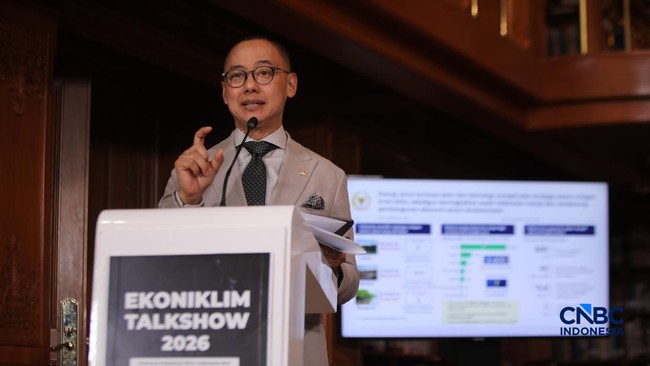
Deputy Speaker of the People’s Consultative Assembly (MPR), Eddy Soeparno, said these natural phenomena are a consequence of high carbon emissions, which have triggered climate change and massive environmental degradation.
“Today we are talking about climate issues. Climate issues today are not ordinary. If we look from 1970 until now, Indonesia has experienced an average climate increase of more than 6% per year. Since 1970, we can feel that the temperature rise has been very drastic. When it rains, the rain is never ordinary,” he said at the Ekoniklim Talkshow 2026 with the theme “Orientation of Indonesia’s Climate Policy from an Economic and Financial Perspective” at Wisma Habibie Ainun some time ago.
Eddy also cited the series of disasters that occurred in late 2025 in Aceh, North Sumatra, West Sumatra, as well as West Java and Central Java as tangible impacts of climate change and environmental damage. He then noted that climate change is affecting the melting of the eternal snow in the Jayawijaya Mountains, Papua. Currently, only 5% of the snow remains there and it is predicted to disappear completely by 2027.
Amid increasingly complex climate change challenges, Indonesia must strengthen its commitment to the energy transition agenda. Moreover, in addition to being blessed with the world’s largest tropical forests and abundant mangrove ecosystems, Indonesia is also rich in renewable energy potential.
Many of Indonesia’s renewable energy sources remain unexplored. Eddy said Indonesia has renewable energy potential of 3,600 gigawatts (GW), of which 3,300 GW comes from solar energy. In addition, Indonesia’s geothermal energy potential reaches 24 GW, but only 2.4 GW, or 10%, has been utilised.
Unfortunately, despite the abundant renewable energy potential, Indonesia still has a high dependence on coal, given its relatively low production costs and abundant reserves.
“We have large coal reserves. Today we produce 800 million tonnes of coal per year. Producing at that capacity, after 50 years there will still be coal remaining for the next 100 years. Our ability to produce coal is enormous. And now there is indeed pressure from countries, including Indonesia, to accelerate the energy transition,” he explained.
The push to accelerate the energy transition is no longer driven solely by climate change issues, but also by geopolitical uncertainty. Geopolitical conflicts have disrupted global energy supplies, forcing many countries to seek alternative energy sources.
From this, Eddy sees a phenomenon of an irregular global energy transition, as many countries are actually increasing fossil energy capacity alongside renewable energy development to maintain energy security amid volatile geopolitical conditions.
Therefore, Indonesia needs to learn from these global dynamics by maintaining its commitment to the energy transition towards decarbonisation without neglecting national energy security.
“This is already the government’s commitment. We are preparing the regulations, finalising the renewable energy law, and will also push for the climate change law as part of our commitment to carry out the energy transition as well as decarbonisation so that Indonesia can achieve net zero emissions before 2060,” he concluded.
Source: jawawa.id (https://jawawa.id/newsitem/climate-a-thorny-issue-in-indonesia-energy-transition-must-continue-1787367051)
Originally published by CNBC Indonesia (https://www.cnbcindonesia.com/news/20260820170646-4-761057/iklim-jadi-masalah-pelik-di-ri-transisi-energi-wajib-jalan-terus), translated from Indonesian