
Claiming Economy Is Resilient, This Country Sacks Economist Who Warned of Crisis
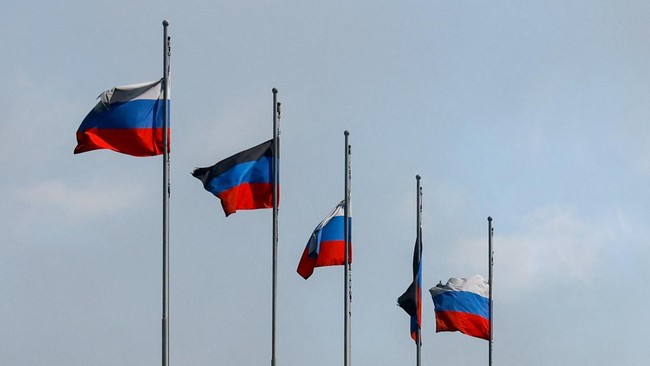
Russia insists its economy remains resilient. But as reported by CNBC International on Wednesday (19/8/2026), the country has instead dismissed a prominent economist after he warned that the war in Ukraine could trigger a social crisis.
Previously, government officials under President Vladimir Putin said the country’s economy remained healthy and strong despite facing “unprecedented foreign pressure”, following Russia’s full-scale invasion of Ukraine in early 2022.
This contrasts with the view of Andrei Klepach, former chief economist at Russian state development bank VEB. He was dismissed on Sunday after warning that Russia would not be able to win a protracted war against Ukraine and predicting a major social crisis.
“Klepach’s dismissal is said to be directly related to his harsh assessment of Russia’s economic condition,” reported independent Russian media outlet The Bell, citing an anonymous source.
What actually happened?
It began last May. At that time, in a speech before fellow economists, Klepach delivered sharp criticism of the ongoing war between Russia and Ukraine.
“In this resource-draining war, we will not win the competition. We are under the illusion that everything will collapse. That has not happened and will not happen. The costs we must bear continue to rise,” Klepach said at the time.
Although he stressed that Russia would not experience economic collapse, he believed a major crisis was coming. According to him, the country’s lag would continue to widen.
“I am confident Russia will not collapse, but I am almost certain that we will ultimately face a social crisis. We will not collapse economically, but our lag will continue to widen, with all its consequences,” he asserted.
A strong fiscal position?
The statement was immediately rebutted by Russian government officials. Through its embassy in Britain, for example, Russia said its fiscal position remained “significantly stronger” than many Western countries.
This referred to Russia’s external public debt of around US$57 billion, approximately Rp1,016 trillion. It was stressed that the figure was “far smaller” than the amount paid by the United States, Britain, Italy, or France merely to service their debts.
“The Russian economy remains resilient, as does the resolve of our people,” said a spokesperson for the Russian Embassy in Britain via email to CNBC International.
“Attempts to weaken Russia through economic pressure have not produced the impact their architects expected,” he added.
“On the contrary, the West—including Britain—has also had to pay a considerable price as a result of reckless sanctions policies. British companies have lost access to the Russian market, while supply chain disruptions and rising energy and commodity costs have added to the burden on the British economy.”
Is the economy now worrying?
Meanwhile, Swedish economist and former senior fellow at the Atlantic Council Anders Aslund said the news of Klepach’s dismissal was not surprising. He added that Klepach had concluded Russia was not winning the war.
“In a very important analysis, he concluded that Russia cannot win a resource-draining war against Ukraine and is likely to end in a social crisis like in 1917,” Aslund said via X on Sunday.
Nigel Gould-Davies, senior fellow for Russia and Eurasia at the International Institute for Strategic Studies, agreed. He said Klepach’s voice actually represented one of many concerned Russian economists.
“I have long said that Russia’s best economists are the ones most worried. This confirms it again,” Gould-Davies said via social media.
It should be noted that Russia’s wartime economy has come under sharper scrutiny in recent weeks due to Ukraine’s long-range drone attacks on Russian oil refineries and distribution depots. Although the Russian economy has held up beyond expectations and is even still growing slowly based on the latest data, analysts say that growth conceals a number of problems.
Russia is now heavily dependent on military spending. The country also relies heavily on tax increases and the distribution of subsidised bank credit.
Source: jawawa.id (https://jawawa.id/newsitem/claiming-economy-is-resilient-this-country-sacks-economist-who-warned-of-crisis-1787118677)
Originally published by CNBC Indonesia (https://www.cnbcindonesia.com/news/20260819093111-4-760511/sebut-ekonomi-tangguh-negara-ini-pecat-ekonom-yang-peringatkan-krisis), translated from Indonesian