
CKG, an effort to free border communities from disease
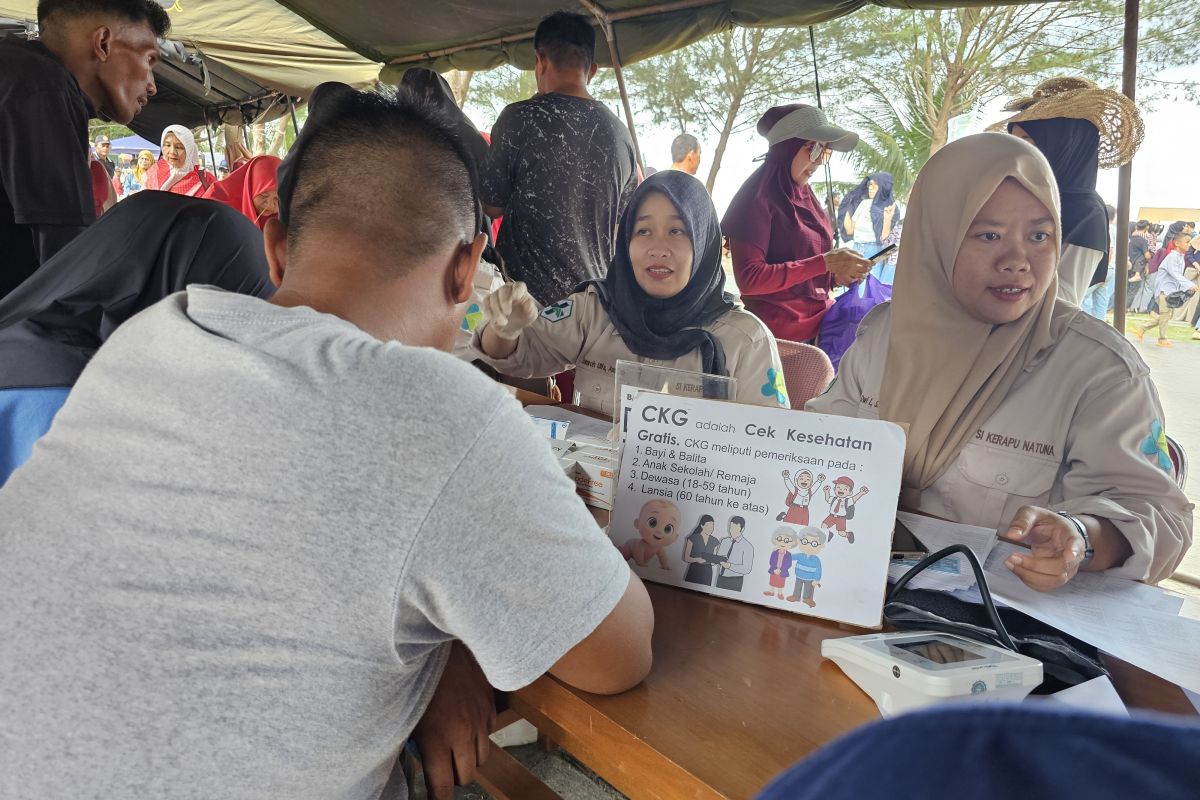
Natuna (ANTARA) - On Monday afternoon, 17 August 2026, Piwang Beach in Natuna Regency, Riau Islands, was filled with residents who came with their families to celebrate the 81st Anniversary of the Independence of the Republic of Indonesia. The laughter of children and the cheers of spectators blended amid various traditional games that were held.
In the midst of the festivities, health check-up tables were lined up under a brown tent among the crowd. The Natuna Regency Government presented the Free Health Check-up (CKG) service, giving residents the opportunity to check their body condition without having to first visit a health facility.
For some residents, the check-up may not have been part of their plans when they came to Piwang Beach. They came to enjoy the independence celebration atmosphere, watch traditional games, or simply spend time with family.
When health services are present in the middle of a crowd, the opportunity to find out one’s body condition is utilised, one of them being Lina (35). The woman initially came to watch the traditional games. After learning about the CKG service, she decided to queue for a health check.
Lina did not feel any significant complaints when undergoing the examination. Her body felt fine, but the examination results showed something different: her blood pressure was above the recommended limit.
“Now that I know this, I have to cut back a bit on my eating going forward. I do like savoury food, and slightly salty, as well as fatty foods,” she said.
For Lina, the examination result served as a reminder that the body’s condition cannot always be felt through daily complaints. She now has a reason to pay more attention to her diet and monitor her health.
That experience was also reflected in the examination results of other residents. Head of Ranai Community Health Centre Nazri said 67 people utilised the CKG service at Piwang Beach. Of that number, 30 people were found to have hypertension, five people had high blood sugar levels, while the rest were in normal condition.
These findings are an important reason for health workers to encourage the public to undergo examinations before complaints arise. Early detection allows risk factors to be identified and followed up according to each individual’s condition.
Approaching residents
The presence of the health team from Ranai Community Health Centre as part of the outdoor CKG programme is a strategy of the Natuna Regency Health Office to expand target coverage. This is because if services are only available at health facilities, the public rarely utilises them.
Medical personnel are always ready to carry out CKG outdoors, even though the team must bring facilities and infrastructure to check residents’ health. This approach has a major impact, as can be seen from the comparison of CKG data at the community health centre and at Piwang Beach.
So far, the public rarely utilises CKG at Ranai Community Health Centre, even though it is a health service in the centre of the regency capital. In a week, at most only a dozen people use it, whereas if it is carried out outdoors, the number is much higher, such as at the Independence Day moment which was utilised by 67 people.
The CKG programme was initiated by President Prabowo Subianto and followed up by the Ministry of Health. Through this programme, the government has a mission to create a healthy society by recognising health conditions earlier.
This programme departs from the belief that a healthy body makes a person more productive, able to learn and work well, and contribute to family and society.
For the nation and state, a healthy society becomes capital for development, increases productivity, and reduces the burden of health costs.
Reaching the islands
Head of the Natuna Regency Health Office Hikmat Aliansyah said the health check-up strategy at Piwang Beach is applied in the regency capital area.
Meanwhile, to reach communities on buffer and outermost islands, the Natuna Regency Government brings in specialist doctors who can generally only be accessed through advanced referral health facilities.
Cardiologists, internal medicine specialists, surgeons, and obstetricians and gynaecologists (obgyn) are brought to a number of islands to attract public interest in consulting and checking their body condition.
One of the services took place on Sedanau Island, Bunguran Barat District, on 16 July 2026. With the presence of specialist doctors, residents do not need to travel to the regency centre to obtain advanced examinations.
When residents learn that specialist doctors are coming, their enthusiasm is always different. They feel they are getting an opportunity that cannot be obtained every day.
This approach shows that health services in archipelagic areas require methods that follow geographical conditions. In the regency capital, the crowd of community activities becomes the entry point for CKG, while on the islands, the government brings services closer to where residents live.
Instilling awareness
Efforts to build the habit of maintaining health in Natuna Regency also target the school environment. Examinations among students not only aim to detect health problems, but also help students understand that body condition can affect learning activities.
Principal of SMA Negeri 1 Bunguran Timur Ida Susanti said student health has a direct relationship with their readiness to participate in learning.
If a child’s condition is healthy, it will certainly support the learning process. For example, if there is a problem with the ears or ear hygiene is not well maintained, it can affect the child’s hearing when following lessons.
For schools, the examination is an opportunity to introduce attention to health through things close to students’ lives, such as personal hygiene, diet, physical activity, and recognising changes in the body.
Habits built from school are expected to form a mindset that health check-ups are not only carried out when someone is already sick. That awareness is the foundation for a healthier society.