
Civil Society Coalition Highlights Flaws in Process and Substance of Human Rights Law Revision
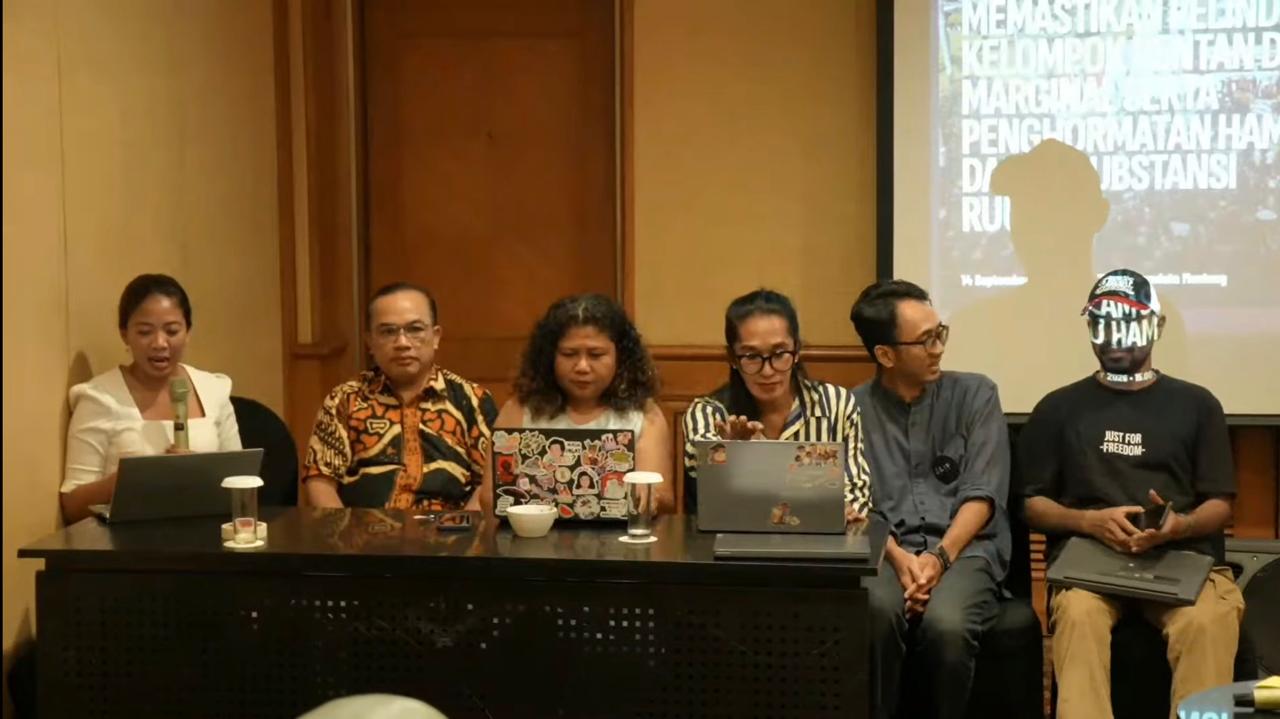
The Civil Society Coalition for Human Rights has raised a number of concerns regarding the process of revising Law No 39/1999 on Human Rights (the Human Rights Law). The coalition believes broader space for public participation is still needed, along with improvements to several substantive points in the draft.
These concerns were voiced at an event titled ‘Ensuring the Protection of Vulnerable and Marginalised Groups and Respect for Human Rights in the Substance of the Human Rights Bill’. The event was organised by Yappika and Sepaham Indonesia together with the Civil Society Coalition for Human Rights in Jakarta on Monday (14/9), following remarks by Deputy Law Minister Edward OS Hiariej in a keynote speech at the IX Constitutional Law Conference that the government had completed the harmonisation process for the revision of the Human Rights Law.
The Human Rights Law is considered to hold an important position in guaranteeing the rights of all citizens whilst serving as the foundation for the state in fulfilling its obligations. For that reason, the coalition believes the revision process must be conducted openly and inclusively, involving the groups who will be affected by the new provisions.
From a procedural standpoint, the coalition noted several matters that still need fixing. One of these is the availability of an academic text and a draft Human Rights Bill that can be officially accessed by the public and that reflects the latest developments.
According to the coalition, document openness must also take into account the needs of persons with disabilities, including through Braille formats, easy-read or plain language, alternative text (alt text), and sign-language videos.
Information on the process and substance of deliberations is also considered in need of being opened up so that the public can provide more meaningful input.
The coalition also highlighted the involvement of several institutions in the deliberation process based on the circulating draft, including the Indonesian National Armed Forces’ Legal Affairs Development Body (Babinkum TNI), whose relevance to the substance of human rights is considered in need of review.
In addition, public participation is deemed in need of expansion, including the involvement of gender minority groups, people with specific health conditions, persons with disabilities, women, children, indigenous communities, migrant workers, domestic workers, and other groups in situations vulnerable to human rights violations.
Muktiono, Chairperson of the Indonesian Human Rights Lecturers Association (Sepaham), said the drafting of human rights regulation needs to involve society in a meaningful way, particularly the groups who will be affected.
‘In the process of drafting the Human Rights Bill, there really should be meaningful participation from all of society, especially those who will be significantly affected,’ said Muktiono.
Sepaham, he said, has held public discussions in Padang, Makassar, Mataram, Jember, and Bandung. Muktiono also conveyed a number of notes on the initial draft, including on the notion of certification for human rights defenders and the mechanism for national human rights institutions before submitting amicus curiae.
Protection of persons with disabilities
On the substantive side, protection of persons with disabilities is one of the areas of concern. Fatum Ade, Executive Director of the Healthy Soul Association (PJS), believes the regulation of disability needs to be placed more comprehensively within the bill.
PJS is an independent organisation advocating for the rights of people with psychosocial and mental disabilities in Indonesia.
Dede believes persons with disabilities should not merely be placed in a single special provision; rather, their rights need to be integrated across various aspects of life, including family, education, health, employment, and political participation.
He also urged that the definition of disability-based discrimination clearly include the denial of reasonable accommodation. In addition, the bill is considered in need of anticipating multiple discrimination — discrimination occurring because of more than one condition at once.
‘We still have accounts that are frozen. We cannot buy or sell, we cannot manage our finances,’ said Dede.
He highlighted provisions concerning the legal capacity of persons with disabilities and guardianship mechanisms. According to data he presented, around 16,000 guardianship applications were granted in 2024 without sufficiently clear limits on guardians’ authority.
PJS is also paying attention to provisions relating to deprivation of liberty based on disability and the practice of institutionalisation in rehabilitation centres and psychiatric hospitals.
Requirements of being ‘physically and mentally healthy’ and the use of MMPI tests in recruitment processes are also considered in need of attention, so they do not become the basis for discriminatory treatment of persons with disabilities or people with certain health conditions.
On the institutional side, the independence of the National Disability Commission (KND) is also considered in need of strengthening.
Gender identity and the principle of non-discrimination
Another concern relates to the arrangement of the non-discrimination principle. Echa Wa’ode, Secretary General of Arus Pelangi, believes gender identity must retain its place in the bill’s provisions.
‘Gender identity is not merely an administrative term, but part of a person’s dignity and rights,’ said Echa.
According to her, the regulation of non-discrimination needs to encompass gender, gender identity and expression, religion and belief, ethnicity, disability, socio-economic status, and other identities.
Arus Pelangi recorded 141 cases of violence based on sexual orientation and gender identity throughout 2024–2025. Meanwhile, the organisation’s rapid response team recorded 27 cases in July–August, with 201 victims.
Consequently, Arus Pelangi is urging that gender identity be reaffirmed in the non-discrimination principle of the bill.
Rights of customary law communities
The rights of customary law communities are also among the coalition’s concerns. Arbi M Nur, a representative of the Sustainable Forestry Community Foundation (YMKL), highlighted several provisions in the draft that, in his view, still need clarification.
Arbi noted, among other things, the unclear definition of customary law communities and their origins. The placement of indigenous communities in the vulnerable group category also needs to be accompanied by a more adequate explanation of their position and rights.
According to Arbi, the phrasing that indigenous communities are ‘entitled to recognition and protection’ needs attention, because recognition of customary law communities is fundamentally part of the state’s responsibility.
He also highlighted provisions linking recognition of indigenous communities to lower-level regulations. In his view, such mechanisms must be designed carefully so they do not become obstacles to the recognition and fulfilment of indigenous communities’ rights.
YMKL is also urging that the principle of Free, Prior, and Informed Consent (FPIC) be applied from the planning stage of projects with potential impacts on indigenous communities, not after projects are underway.
Strengthening human rights protection mechanisms
Meanwhile, Arif Maulana, Vice Chairperson and Advocacy Manager for Civil and Political Rights (Sipol) at the Indonesian Legal Aid Foundation (YLBHI), said the revision of the Human Rights Law must be directed at strengthening respect for, protection of, and fulfilment of citizens’ rights.
‘If the draft law instead weakens human rights protection mechanisms, we have the right to ask: for whom is this law being revised?’ said Arif.
According to Arif, strengthening is needed not only in the norms on rights, but also in the mechanisms for enforcement and redress when violations occur.
Among other things, the coalition is urging the bill to provide clearer protection for human rights defenders, including women human rights defenders. Such protection covers access to legal aid, responses to emergency situations, and the handling of violence and intimidation.
Redress mechanisms for victims are also considered in need of strengthening, including compensation, rehabilitation, and guarantees that similar violations do not recur.
At the institutional level, the coalition is pushing for the strengthening of the National Commission on Human Rights (Komnas HAM), the National Commission on Violence against Women (Komnas Perempuan), the Indonesian Child Protection Commission (KPAI), and the National Disability Commission (KND) so they can carry out their respective functions more independently and effectively.
Several substantive provisions need clarification
Beyond the issues of non-discrimination, disability, indigenous peoples, and human rights defenders, the coalition raised notes on several fundamental principles in the bill.
The coalition requested that provisions on affirmative action be clarified in accordance with Article 28H paragraph (2) of the 1945 Constitution. For persons with disabilities, this also includes reasonable accommodation and universal accessibility.
Regulations on limitations of rights are also considered in need of being drawn up strictly and with measurable criteria. The coalition paid attention to the use of grounds such as public order, morality, and public security, which need clear boundaries to avoid excessive interpretation, including towards persons with disabilities or people with certain psychosocial conditions.
In the context of past gross human rights violations, the coalition is pushing for an independent procedure and clearer arrangements regarding exceptions to the principle of non-retroactivity.
The coalition also requested clarity on the competent judicial forum and victims’ rights, including procedural mechanisms that can accommodate the needs of persons with psychosocial and intellectual disabilities and the recognition of their legal capacity.
Eleven demands submitted
In light of these concerns, the Civil Society Coalition for Human Rights submitted eleven demands to the government.
First, the government is asked to release the Academic Text, the draft Human Rights Bill, and information on the legislative process so they can be accessed by the public.
Second, the government is asked to ensure meaningful participation from civil society, including grassroots women, indigenous women, farmers, fishers, migrant workers, gender minority groups, persons with disabilities, and survivors.
Third, the coalition requested the strengthening of the non-discrimination principle, encompassing gender, gender identity and expression, religion and belief, ethnicity, disability, socio-economic status, and other identities.
Fourth, the government is asked to strengthen provisions on affirmative action in accordance with Article 28H paragraph (2) of the 1945 Constitution, including reasonable accommodation and universal accessibility for persons with disabilities.
Fifth, limitations on rights are requested to be regulated strictly and measurably, including by clarifying the use of the grounds of public order, morality, and public security.
Sixth, the coalition requested an independent procedure for resolving past gross human rights violations and clarity regarding exceptions to the principle of non-retroactivity.
Seventh, the government is asked to clarify the judicial forum, victims’ rights, procedural accommodation, and the recognition of full legal capacity for persons with psychosocial and intellectual disabilities.
Eighth, protection for human rights defenders and women human rights defenders is requested to be strengthened through a gender-responsive approach.
Ninth, the coalition requested the strengthening of the rights of customary law communities through declarative recognition, protection of customary territories and land, natural resources, culture, customary institutions and law, the right to determine development priorities, and the application of FPIC.
Tenth, the government is asked to regulate protection against forced evictions more comprehensively, including guarantees of housing security and redress mechanisms for affected communities.
Eleventh, the government is asked to halt the legislative process temporarily to allow space for information transparency, meaningful and inclusive public participation, and improvements to the various substantive aspects of the Human Rights Bill.
Source: jawawa.id (https://jawawa.id/newsitem/civil-society-coalition-highlights-flaws-in-process-and-substance-of-human-rights-law-revision-1789494673)
Originally published by Media Indonesia (https://mediaindonesia.com/politik-dan-hukum/933835/koalisi-masyarakat-sipil-soroti-proses-dan-substansi-revisi-uu-ham), translated from Indonesian