
Civil Coalition Questions Quality of Supreme Court Candidates Lacking Basic Legal Knowledge
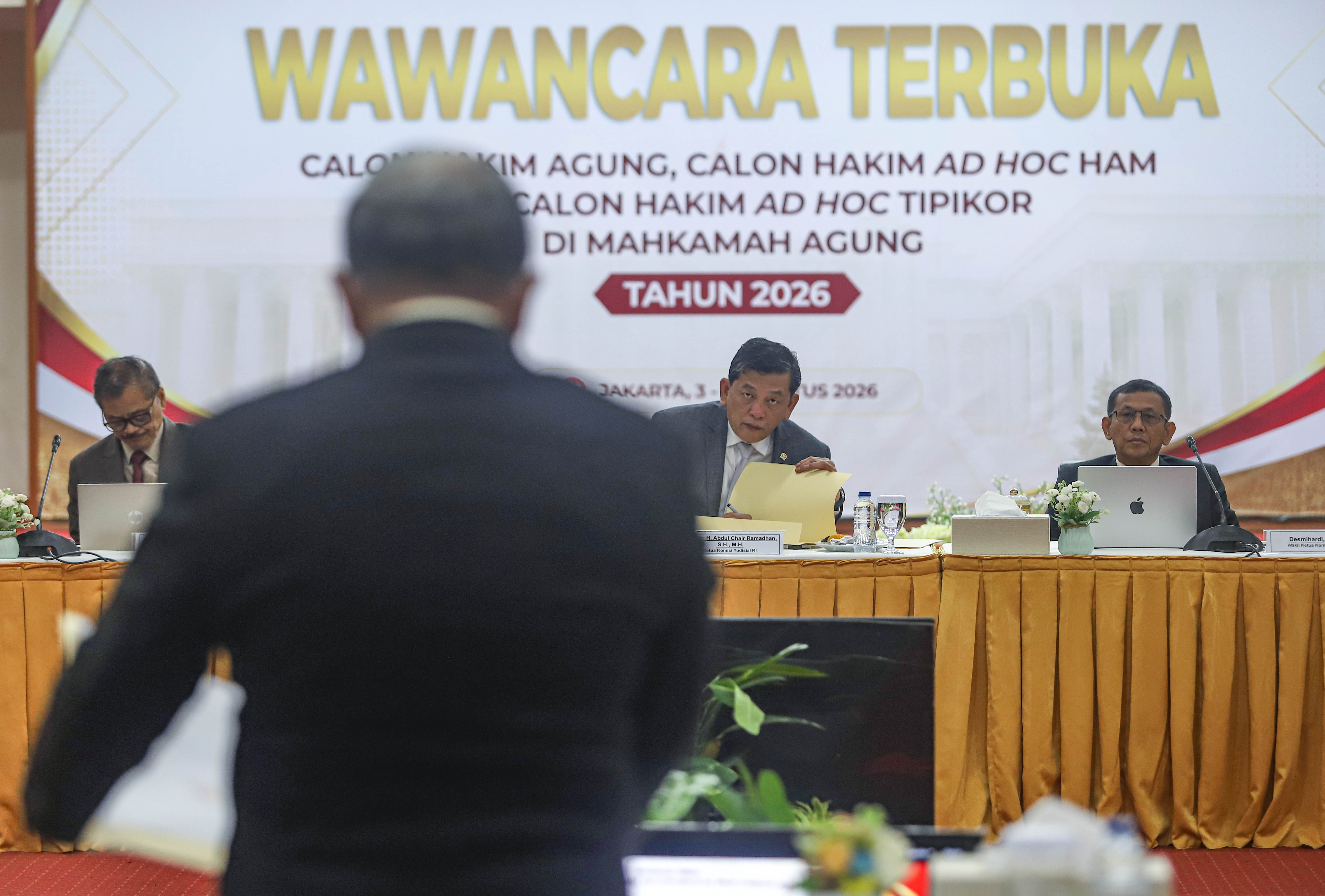
A civil society coalition comprising several organisations has scrutinised the selection process for 2026 Supreme Court justices and ad hoc human rights and corruption court judges conducted by the Judicial Commission (KY). One of the main concerns raised was the candidates’ lack of understanding of basic legal theory.
The KY announced the 14 names of candidates who passed the interview stage on Friday (7/8). These names will subsequently be submitted to House of Representatives Commission III for a fit and proper test.
Indonesian Legal Aid Foundation (YLBHI) Chairperson M Isnur questioned the KY’s decision, which was announced less than four hours after the final day of interviews concluded.
“The KY’s lightning-fast deliberation does not align with the quality of the participants who passed. Based on civil society monitoring, several participants with woefully inadequate substantive answers and highly questionable integrity passed the selection stage,” the coalition stated on Thursday (13/8).
Isnur also questioned the public participation process, which he considered to have narrowed compared to previous years. Previously, the public could attend in person and pose questions to candidates, whereas this year, public questions were only submitted via YouTube and not all were read out to the candidates.
“The essence of public participation is not merely providing access for the public to be spectators, but rather providing real and meaningful space for the public to test the worthiness of the candidates,” he said.
Beyond the selection mechanism, the quality of several candidates also came under fire. Based on civil society monitoring, some candidates were deemed not to understand basic legal theory, legislation, or issues related to the judicial chamber they were applying for.
One highlighted example was a candidate’s answer regarding ‘rechterlijk pardon’ or judicial pardon, which was equated with grounds for forgiveness. Another candidate reportedly struggled to mention provisions regarding coercive measures that can be challenged through pre-trial motions under the new Criminal Procedure Code (KUHAP).
“The quality of answers from several candidates falls far short of the minimum standard required for a Supreme Court justice,” Isnur asserted.
The quality of the panellists’ questions was also identified as a problem. Several questions were described as formalistic, repetitive, and long-winded, thus failing to adequately probe the capacity, integrity, independence, and critical thinking skills of the candidates.
“Interview time should be maximised to test the quality and integrity of each candidate, not serve as a platform for panellists to show off their knowledge,” Isnur remarked.
YLBHI and civil society organisations consider these issues critical because Supreme Court justices hold a strategic position in maintaining the consistency of law enforcement through case examinations at the cassation and judicial review levels. Justices also play a role in formulating Supreme Court Regulations (Perma) and various internal judicial policies.
“If this crucial role is held by unqualified Supreme Court justices, the resulting rulings will potentially exacerbate inconsistencies in verdicts, making unified law enforcement increasingly difficult to achieve,” Isnur said.
They even assessed that the ongoing selection process demonstrates the KY’s lack of seriousness in ensuring the best candidates for the Supreme Court. The passing of candidates whose quality and integrity are questionable also potentially indicates favouritism if not based on objective assessment.
“If, and only if, the selection was based on favouritism rather than an objective assessment of the selection process, it would be better to simply appoint them from the outset and not waste state funds on conducting a selection process,” Isnur concluded.
In light of these issues, YLBHI, along with the Institute for Study and Advocacy of Judicial Independence (LeIP), Transparency International Indonesia (TII), Indonesia Judicial Research Society (IJRS), KontraS, and Indonesia Corruption Watch (ICW), urged the KY to explain to the public the considerations and assessments used to determine the 14 successful candidates.
They also requested that the House of Representatives, particularly Commission III, conduct a comprehensive, objective, and responsible fit and proper test to ensure the approved candidates truly possess adequate integrity, capacity, and competence to serve as Supreme Court justices.