
Civil Coalition Protests TNI and Reserve Component Deployment Against Demonstrations, Police Respond
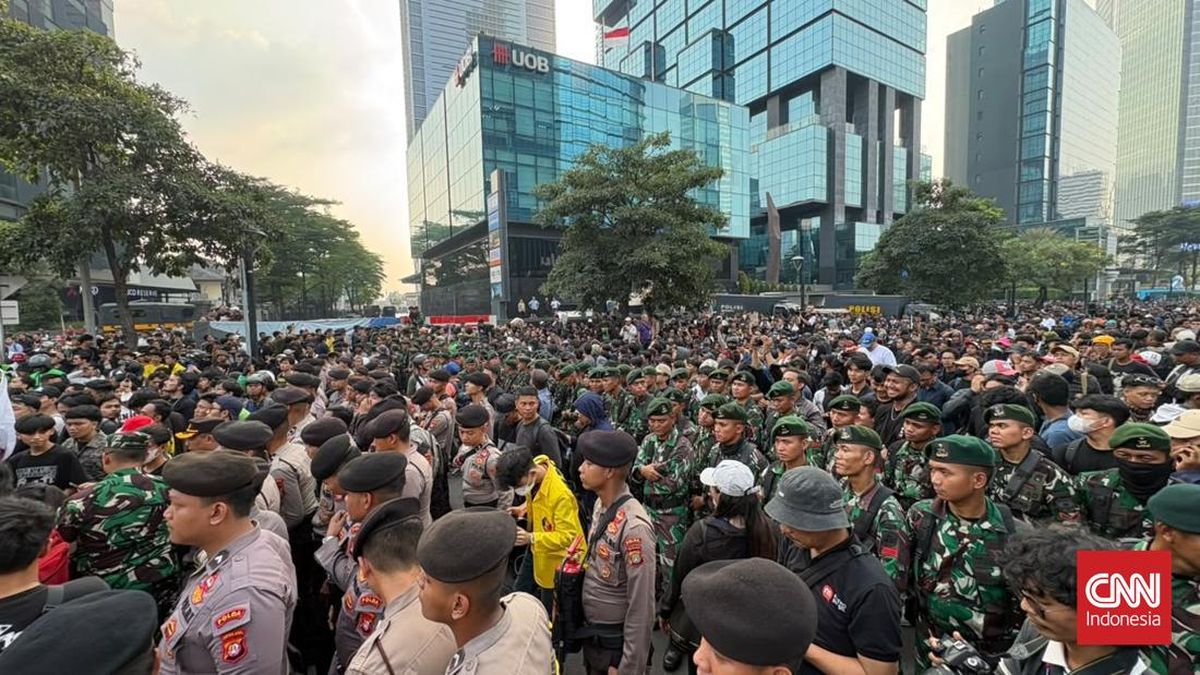
A group of students, including members of the University of Indonesia Student Executive Board (BEM UI), held demonstrations that were intercepted near the Tosari area, close to Bundaran HI, Central Jakarta, on Friday (12/6) afternoon and evening. The protesters originally intended to demonstrate against the Prabowo Subianto-Gibran Rakabuming Raka administration at Bundaran HI, but were blocked by joint forces from the National Police (Polri) and the TNI.
Meanwhile, the involvement of the TNI and the suspected use of the Reserve Component (Komcad) in securing the protests has drawn fierce criticism from the Civil Society Coalition for Security Sector Reform. This coalition comprises several civil society organisations, including LBH Jakarta, LBH Pers, AJI Jakarta, PBHI, ICJR, ELSAM, Imparsial, YLBHI, KontraS, and Walhi.
“On 12 June 2026, the TNI was mobilised to face student demonstrations at several points in Jakarta. Previously, on 11 June 2026, the Ministry of Defence (Kemhan) of the Republic of Indonesia issued Letter Number B/752/VI/2026/BACADNAS, dated 11 June 2026, ordering the deployment of approximately 500 Civil Servants (ASN) belonging to the Reserve Component (Komcad) from various ministries to attend a Komcad Readiness Parade at the Ministry of Defence on 12 June 2026,” stated the opening of their official statement received on Friday night.
“The coalition views the deployment of the TNI to face demonstrations at several points in Jakarta as an erroneous policy. In a democracy, military mobilisation should only be a last resort when all civil apparatus are no longer able to control the situation,” they said.
According to the civil coalition, this move raises serious issues regarding the direction and purpose of using the Reserve Component. “Within the national defence system, Komcad was formed as a resource prepared to strengthen the main components in facing threats to national defence. Therefore, the use of Komcal must be carried out carefully, proportionally, accountably, and based on clear threat parameters,” they noted.
The civil coalition reminded that in a democratic country—especially Indonesia—every use of defence instruments must be subject to the principles of accountability, transparency, and civilian supremacy. They emphasised that the Komcad must not evolve into an instrument that can be mobilised at any time based on administrative or political considerations without clear parameters.
“Such practices reinforce fears that the Komcad could be used for domestic security interests, which should not be its primary function. We view the mobilisation of the Komcad by the Ministry of Defence on 12 June as a fatal error, especially as it was conducted alongside student demonstrations. Indonesia is not in a state of war with another nation, nor is it facing a situation that clearly meets the threat parameters stipulated in Article 4, paragraph (3) of Law No. 23 of 2019 concerning the Management of National Resources for State Defence (UU PSDN),” they continued.
The coalition noted that the lack of explanation regarding the basis of such a threat raises serious questions about the urgency of the current Komcad mobilisation. Furthermore, they reminded that the TNI is the primary component of national defence, while the Indonesian National Police is the institution responsible for maintaining public security and order.
“Therefore, a fundamental question arises: what threat is the country facing that necessitates the deployment of the Reserve Component? Is the TNI, as the primary component of national defence, and the Polri, as the apparatus for maintaining security and order, considered unable to perform their functions and authority, thus requiring the deployment of the Komcad?” they asked.
Illegal Mobilisation
On this basis, the civil coalition views the deployment of the Komcad on 12 June as an illegal act under the law and constitutional framework. “We view the mobilisation of the Komcad on 12 June today as an illegal mobilisation,” they stated.
“Article 63, paragraph (1) of the UU PSDN explicitly states that the President may declare mobilisation in the event that all or part of the territory of the Unitary State of the Republic of Indonesia is in a state of military emergency or a state of war,” they added.
They further reminded that Article 63, paragraph (2) of the UU PSDN requires the President to obtain approval from the House of Representatives (DPR) before declaring such a mobilisation of the Komcad. Therefore, the civil coalition asserted that the deployment of the Komcad by the Ministry of Defence while Indonesia is in a state of peace—without war—is an illegal mobilisation and an act of usurping the President’s authority as the supreme commander of the armed forces under Article 10 of the 1945 Constitution.
“It is important to remember that in Indonesian history, there have been several instances of troop deployments without authorisation from the President, as the supreme commander, and the DPR in the capital, which led to allegations of treason attempts,” the coalition said.
“We view the deployment of the Komcad as a clear attempt to pit fellow civilians against one another. The Komcad are not active soldiers, but civilians who work daily as civil servants and perform public services,” they continued.
Additionally, the civil coalition believes that the deployment of the Komcad and TNI to face demonstrations reflects a government perspective that views criticism not as a vitamin for democracy, but as a threat—even a defence threat. In today’s demonstration, the student masses brought at least five demands, including:
Stop Budget Waste (APBN)
Lower the prices of basic necessities and fuel (BBM)
Stop the Free Nutritious Meal (MBG) Program and the development of the Red and White Village Cooperatives
Stop Militarisation