
Civil Coalition Highlights Three Potential Substantive Setbacks in Asset Forfeiture Bill Draft
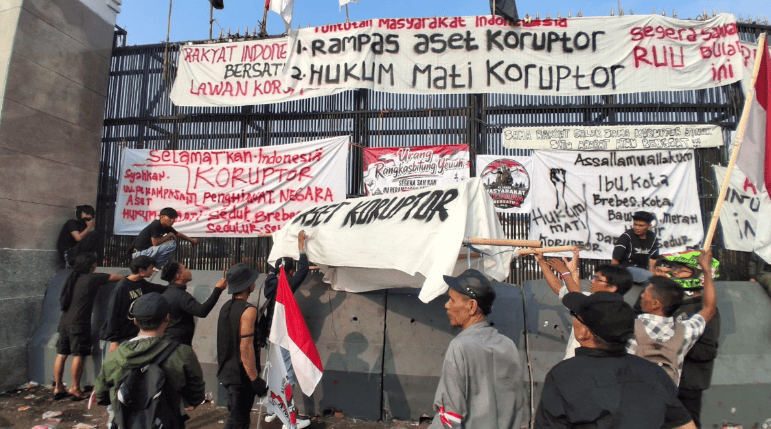
The Civil Society Coalition has found at least three potential substantive setbacks in the draft of the Asset Forfeiture Bill (RUU Perampasan Aset) produced by the House of Representatives (DPR) dated 10 July 2026. The findings emerged after the coalition compared the DPR draft with the version previously prepared by the government.
Researcher at Transparency International Indonesia (TII), Agus Sarwono, said the three issues relate to the removal of the illicit enrichment norm, the narrowing of the scope of non-conviction based asset forfeiture (NCB), and the lack of clarity regarding the asset management institution.
“The Civil Society Coalition has identified at least three substantive setbacks in the circulating DPR draft dated 10 July 2026 compared to the government’s draft,” Agus Sarwono said in an official statement on Thursday (28/8).
First, the coalition suspects the DPR has removed the norm concerning unlawful enrichment, or illicit enrichment. In the government’s 2023 draft, this provision allowed for the forfeiture of assets disproportionate to the owner’s income and whose origins could not be legally proven.
“It is strongly suspected that the DPR has removed the norm relating to unlawful enrichment (illicit enrichment),” Agus said.
According to him, this norm is important for reaching the wealth of public officials that is not commensurate with their official income. The instrument is also considered relevant in uncovering unreasonable wealth ownership in corruption cases.
Second, the coalition assesses that the DPR draft has the potential to narrow the application of NCB. In the DPR draft, the mechanism is regulated in Article 3 letter b and its conditions are detailed in Article 6, including when the perpetrator dies, flees, suffers permanent illness, or the case cannot be brought to trial.
The problem is that all asset objects in Article 5 are still linked to the perpetrator of a criminal offence. This condition is considered to make NCB difficult to use to reach assets that have failed to be executed or assets whose owners are unknown.
“As a result, NCB in the DPR draft in practice can only be used when the perpetrator is known but cannot be prosecuted, and it becomes unclear whether it can be used to seize assets that have failed to be executed or unclaimed assets,” Agus said.
According to him, this condition differs from the government’s 2023 draft, which explicitly targeted proceeds of crime when the perpetrator or owner is unknown. Examples include timber from illegal logging and proceeds from online gambling.
Third, the coalition highlighted the institutional design of asset management, which is considered unclear. In the government’s 2023 draft, the Attorney General was designated as the person responsible for asset management. The draft also regulated the duties of the manager, a transparent asset information system, and periodic reporting obligations.
Meanwhile, in the DPR draft, Article 46 mentions the Asset Management Agency without clearly explaining its institutional form, leadership, institutional position, or accountability mechanism.
“The asset management institution in the DPR draft is left hanging without a clear person in charge,” Agus said.
The coalition also considers that this lack of clarity could potentially lead to authority disputes between the Asset Management Agency and the Attorney General’s Office Asset Management Agency in the future. In addition, a supervisory mechanism is needed so that the management of assets derived from criminal acts can be accounted for to the public.
In light of these findings, the Civil Society Coalition is urging the DPR and the government to immediately publish the draft and the Problem Inventory List (DIM) of the Asset Forfeiture Bill through the DPR’s official channels. Transparency is considered important so that the public can monitor every substantive change during the deliberation process.
Furthermore, the coalition is asking the DPR to strengthen the illicit enrichment provisions, clarify the scope and procedural law of NCB, and ensure that the mechanism can reach assets that have failed to be executed and unclaimed assets.
“The DPR must design an accountable asset management institution with a single person in charge whose form and accountability are clear,” he concluded.
Source: jawawa.id (https://jawawa.id/newsitem/civil-coalition-highlights-three-potential-substantive-setbacks-in-asset-forfeiture-bill-draft-1787824232)
Originally published by Media Indonesia (https://mediaindonesia.com/politik-dan-hukum/926582/koalisi-sipil-soroti-3-potensi-kemunduran-substansi-draf-ruu-perampasan-aset), translated from Indonesian